

How Long Does It Take to Build Passive Income

The most common question I get after someone reads about passive income is some version of: “Okay, but when will I actually see money”
It’s a fair question. And it’s one that most passive income content answers badly, either with vague reassurances (it takes time, but it’s worth it) or with suspiciously precise numbers that don’t match any realistic experience.
What’s missing is an honest, model-specific breakdown. Because “how long does it take” doesn’t have one answer. It has seven or eight answers, depending entirely on which approach you’re building. A blog takes a different timeline than a YouTube channel. Investment income takes a completely different timeline from a digital product business. And understanding these differences before you start is what prevents you from quitting a model that was about to work or persisting with one that was never right for your situation.
This article gives you the honest timelines by model, with the variables that affect them, and with realistic milestone markers so you know what progress actually looks like from the inside.
Why Timeline Varies So Much: The Two Core Variables
Before the model-by-model breakdown, it helps to understand the two variables that affect almost every passive income timeline.
Capital vs time. Some passive income models primarily require money (investments, buying existing assets). Others primarily require time (content creation, building an audience). Which resource you start with more of changes everything about your realistic timeline.
Audience-first vs asset-first. Models that require an existing audience before earning can begin (blog ad revenue, YouTube Partner Programme, sponsored content) have a longer runway before income appears than models where an asset can earn without a prior audience (digital product on Etsy, dividend stocks, rental income).
Neither combination is inherently better, but mismatching your resources with your model is one of the most common reasons people start passive income projects and then experience inexplicably slow progress. You’re not doing it wrong; you chose a model that requires resources you don’t currently have in abundance.
Timeline by Model
Affiliate Marketing Through a Blog
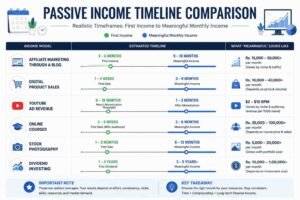
Realistic first income: 3–6 months. Meaningful monthly income: 9–18 months. What “meaningful” looks like: Rs. 15,000–50,000+ per month (varies significantly by niche and traffic volume)
This is the longest-runway content model, primarily because it’s Google-dependent. New domains typically take three to six months before Google begins ranking their content meaningfully in search results, and organic search traffic is the primary income driver for most affiliate blogs.
Months one through three typically look like this from the inside: you’re publishing consistently, traffic is near zero, affiliate clicks are nearly zero, and earnings are near zero. This phase looks identical to failure and feels deeply discouraging. It’s also completely normal for every blog that eventually succeeds.
The inflection point where traffic starts growing noticeably rather than creeping usually happens somewhere between month four and month eight for a niche blog with consistent, properly optimised content. After this inflection, growth tends to compound: more content, more indexed pages, more search visibility, more traffic, more conversions.
Factors that accelerate this timeline: Choosing a lower-competition niche where new content can rank faster, publishing more frequently (two or three articles per week versus one), targeting long-tail keywords rather than broad competitive ones, and building a few backlinks from relevant external sources in the early months.
Factors that slow it: Starting in a highly competitive niche without a clear differentiating angle, publishing infrequently, using thin content that doesn’t fully answer the search intent, and failing to request indexing through Google Search Console.
Digital Product Sales
Realistic first sale: 1–4 weeks (with active promotion). Meaningful monthly income: 3–9 months. What “meaningful” looks like: Rs. 10,000–40,000+ per month, depending on price point and volume
Digital products have the shortest gap between creation and potential first sale of any passive income model because a product can be live and accessible to buyers within hours of creation, and the first sale can happen the same day if you share it in the right place.
The variable that makes this timeline wide is the traffic question. If you’re selling on Etsy, their marketplace search can surface your product within days of listing. If you’re selling on Gumroad with no external audience, you need to build or borrow discovery through Pinterest, social media, or your own blog.
The realistic first-month experience for most beginners: one to three sales if actively promoted, often to people already in your network or community. Months two and three: beginning to see organic discovery traffic from platforms like Etsy or Pinterest if you’ve set those up properly.Months four to six: the product is either finding its audience (consistent weekly sales) or it needs adjustment, a different price point, a better product description, a clearer target audience, or a different product entirely.
One thing that makes digital products genuinely faster than content-based models: you don’t need Google’s six-month evaluation period. The platform handles discovery for marketplace listings, and Pinterest traffic can compound much faster than Google SEO for the right product types.
YouTube Ad Revenue
Reaching monetisation threshold: 6–18 months for most new channels. First meaningful ad cheque: 1–3 months after reaching the threshold.d What “meaningful” looks like: Varies dramatically by niche; $2–$15 RPM (revenue per thousand views) depending on topic
YouTube’s Partner Programme requires 1,000 subscribers and 4,000 watch hours within the past 12 months before you can enable monetisation. For a new channel in a specific niche, reaching these thresholds takes most creators between six months and a year and a half of consistent posting.
The timeline varies more by niche than by almost any other variable. A channel in a high-search-volume category with useful tutorial content can reach the threshold in four months. A channel in a smaller niche with slower audience growth might take two years.
What most YouTube income timelines miss: the first cheque after reaching the threshold is often disappointing because ad rates for a small channel in its early months are lower than they’ll eventually become. Income scales disproportionately as watch time increases; a channel earning $50/month at 2,000 monthly views might earn $300/month at 10,000 views, even with the same RPM, because the watch time depth increases with a more established audience.
Supplementing YouTube ad revenue with affiliate links in video descriptions from day one (regardless of whether you’ve reached the Partner Programme threshold) means the channel starts earning something earlier than the threshold milestone would suggest.
Selling Courses or Coaching
First sale: 2–8 weeks with an existing small audience. Recurring income: 3–12 months,s depending on marketing and launch approach. What “meaningful” looks like: Highly variable. A Rs. 5,000 course selling 10 copies per month is Rs. 50,000/month; a Rs. 25,000 course selling 4 copies per month is Rs. 100,000/month.
Courses and coaching sit in an interesting position: the income per transaction is often much higher than affiliate commissions or ad revenue, which means fewer sales are needed to reach meaningful income. But this model typically requires a more established trust relationship with your audience before conversions happen at scale.
Someone with an existing blog readership, email list, or social following can launch a course and make sales within days. Someone starting completely from scratch needs to build an audience and credibility before a course launch will produce significant revenue, which is why the “first sale” timeline above assumes at least a small existing audience.
The realistic experience for most beginners: the first course attempt, launched to a small audience, produces fewer sales than expected. Iteration on the topic, price point, and promotional approach across two or three launches typically produces better results than the first attempt.
Stock Photography or Music Licensing
First licensing payment: 1–6 months after uploading. Meaningful monthly income: 1–3 years of consistent uploading. What “meaningful” looks like: $100–$400/month from a catalogue of several hundred quality assets
This is one of the least hyped but most genuinely passive models once established. Upload a photo or music track once; it can be licensed hundreds of times over the years with no additional effort from you.
The timeline is long specifically because income scales with catalogue size. The first one hundred uploads might earn $20/month. At five hundred uploads, that same quality level might earn $150/month. At a thousand uploads across multiple platforms (Shutterstock, Adobe Stock, Pond5), consistent monthly income becomes genuinely meaningful without further active effort.
This model suits photographers and musicians who already produce content for other reasons; the passive income is almost an afterthought for existing creative work rather than a primary income project.
Dividend Investing
First dividend payment: As soon as you hold qualifying shares before the ex-dividend date (often weeks to months after first investment). Meaningful passive income from dividends: 5–10 years of consistent investing. What “meaningful” looks like depends on the capital deployed. $10,000 invested at a 4% dividend yield generates $400/year; $100,000 generates $4,000/year
Investment-based passive income has the most honest timeline of any model because it doesn’t depend on algorithms, audience building, or market demand for your content. It depends entirely on how much capital you deploy and the return that capital generates.
The timeline to meaningful dividend income is long for most beginners because the capital required to generate significant income from a 3–5% yield is substantial. This model makes the most sense as part of a diversified approach using active income from freelancing or content creation to fund investments that eventually compound into a meaningful passive income layer.
The realistic beginner experience: starting with whatever amount is accessible (even Rs. 5,000–10,000 monthly contributions to a diversified fund), accepting that the dividend income at this stage is tiny but compounding, and staying consistent for years rather than expecting meaningful income in months.
The Timeline Most Beginners Actually Experience
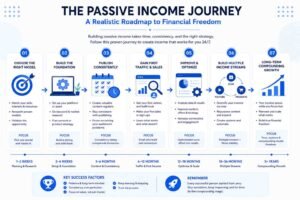
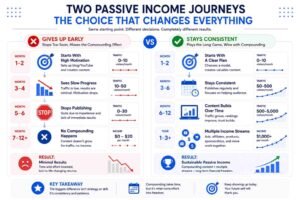
Here’s what the realistic passive income building journey looks like for someone starting with no capital and no audience, using a content-based model:
Months 1–3: Building the foundation. Content created, platform established, affiliate programmes joined. Income: near zero. Morale: wavering. Most people who quit do so in this phase.
Months 4–6: Early signals. First,t organic traffic begins appearing. First affiliate clicks recorded. First small commissions, possibly Rs. 500–2,000 total across the period. Morale: cautiously optimistic if you’ve stayed consistent.
Months 7–12: Compounding begins. Traffic is growing noticeably. Consistent monthly income appears. Possible first digital product launched and selling. Total monthly income is somewhere in the Rs. 3,000–15,000 range for someone who’s been genuinely consistent, depending on niche and effort.
Year 2: This is when the compounding becomes visible. Content published eighteen months ago is now well-ranked. Affiliate income is recurring rather than occasional. A second income stream (digital products, a YouTube channel, an email list with affiliate promotions) supplements the blog income. Monthly income in the Rs. 15,000–50,000+ range becomes realistic for consistent, focused effort.
These timelines are honest averages. Some people exceed them significantly with more time investment or better niche selection. Some take longer due to competitive niches or inconsistent effort. The range is real; the sequence is consistent.
Common Mistakes That Extend the Timeline Unnecessarily
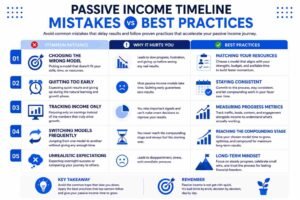
Choosing a model that doesn’t match available resources. The person with no time to create content but a small monthly savings capacity should consider investments before a blog. The person with no capital but ten hours per week of available time should start with content before investments. Mismatching the model to the resources is the most common timeline killer.
Going quiet during the slow phase. Every passive income model has a phase where results are nearly invisible. The timeline extends dramatically for people who slow or stop publishing during this phase, because it delays the compounding that was beginning to accumulate.
Measuring the wrong things in the early months. Checking income in month one of a blog is the equivalent of digging up a seed to see if it’s growing yet. Early metrics to watch are content output (are you publishing consistently), indexation (is Search Console showing your pages are being found), and trajectory (is any metric moving, even slightly, in the right direction), not income.
Switching models mid-timeline. Abandoning a blog in month four to start a YouTube channel resets the clock entirely. Four months of blogging effort disappear from the timeline, replaced by month one of a new project. Models require consistent time investment to reach their inflection points. Switching before reaching an inflection point is the equivalent of digging up the seed just before it would have sprouted.
Helpful Tips for Managing the Timeline Effectively
Set timeline expectations before starting, not after hitting a wall. If you start a blog knowing that meaningful Google traffic typically takes six to nine months, the experience at month three is “I’m at month three of a nine-month process” rather than “this isn’t working.” The same reality feels completely different with correct expectations.
Track non-income metrics in early months. Articles published, pages indexed, monthly impressions in Search Console, and Pinterest monthly views: these metrics show whether the foundation is being built correctly, even before income appears. Progress on leading indicators predicts eventual income better than income itself in the early stages.
Combine models with different timeline profiles. Pairing a longer-timeline model (blog) with a shorter-timeline model (digital product) means you have some earlier validation and income while the longer-term model is still in its slow growth phase. This combination approach significantly improves the psychological sustainability of the overall project.
FAQs
What’s the fastest passive income model for a complete beginner? Digital products with marketplace distribution (Etsy for digital downloads, Gumroad with active promotion) can produce first sales within weeks. It won’t be substantial income immediately, but the gap between creation and first revenue is the shortest of any model accessible without prior capital.
Is there any passive income model that works in under 30 days? Genuinely passive income in 30 days is unlikely for most beginners starting from scratch. You can sell a digital product within 30 days if you already have a skill and create something specific. You might earn a first affiliate commission within 30 days if you have an existing audience you haven’t yet monetised. But building something that earns without ongoing active effort within 30 days from a standing start is rare outside of investment income, which requires capital.
Why do so many people claim to have built passive income in 60 days? Some do, genuinely, usually because they had an existing skill, platform, or audience that reduced the normal ramp-up period significantly. Others present the timeline from their public launch rather than from when they started building, which makes the public timeline look shorter than the actual work period. And some overstate results for the content value of a dramatic timeline.
Does the timeline ever actually shrink as you do more? Yes significantly. A second passive income stream typically builds twice as fast as the first, because you have an existing content platform, an established domain with SEO authority, an existing audience, and the skills from building the first time. The timeline from scratch is the longest timeline you’ll face.
The Most Useful Thing to Take From This
The passive income timeline question most people want answered is: “Am I still on track?” rather than “How long will this take in total”
The honest answer to the first question is: if you’re publishing consistently, your content is genuinely useful, your platform is indexed and being found, and at least one metric is showing any positive trend, you’re on track, regardless of what month you’re in.
The path from nothing to meaningful income is genuinely longer than most content about passive income suggests, and shorter than the experience of month two or three makes it feel. The people who end up where they were trying to go are almost uniformly the ones who stayed long enough to find out.
Disclaimer: This article is for educational and informational purposes only. Passive income timelines vary significantly based on the model chosen, niche, effort, consistency, and market conditions. Nothing in this article constitutes a guarantee of income or financial results.