

How to Start Building Passive Income From Scratch

A reader once asked me, after I’d published a few articles about passive income, “Okay, but what do I actually do on day one?”
It was a fair question, and I realised I didn’t have a clean answer. I’d written about the concept, the mistakes, the mindset shift, all genuinely useful, but none of it told someone exactly what to open on their laptop this evening and start doing.
So I sat down and mapped out the actual sequence of what I’d tell someone to do in week one, week four, week eight, if they had zero passive income streams and wanted to build their first one starting from literally nothing.
This article is the plan. Ninety days, broken into specific phases, with no vague advice like “stay consistent” without explaining exactly what that means in practice. If you’ve read about passive income before and still don’t know what to actually do today, this is built for you.
Why 90 Days, and Why a Plan Matters More Than Motivation
Most people who try to build passive income from scratch don’t fail because the idea doesn’t work. They fail because they have no structure, just a vague intention to “start a blog” or “try affiliate marketing” with no specific weekly actions attached to it.
Ninety days is long enough to move past the slowest, most discouraging early phase of almost any passive income model, but short enough to stay focused and measurable. It’s a horizon you can actually plan against, rather than an open-ended “eventually.”
The plan below assumes you’re starting with no website, no audience, no existing content, and no budget beyond what’s genuinely free. If you have more resources than that, you can move faster through the early phases. If you have less time available than the plan assumes, stretch it to 120 or 150 days rather than abandoning the structure; the sequence matters more than the exact speed.
What This Plan Builds Toward
The model this plan is built around is a content-based passive income stream, specifically, a blog combined with affiliate marketing and/or digital product sales. This is the most accessible starting point for someone with no capital, because it requires time rather than money, and the skills involved (writing, basic research, simple promotion) are learnable without prior experience.
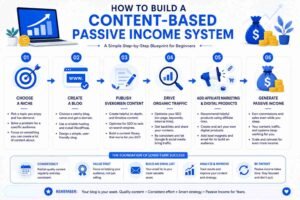
If your situation strongly favours a different model, you have investment capital, or you’re more comfortable on camera than writing, the phases and principles still apply, just adapted to YouTube, a different platform, or an investment-based approach. The structure of “build the foundation, create the asset, drive traffic, measure and adjust” holds across nearly every passive income model.
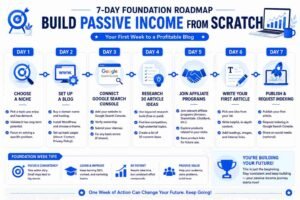
Days 1-7: Foundation Week
Day 1 — Choose Your Niche
Don’t overthink this for more than a day. Pick a topic you genuinely know something about or are willing to learn deeply over the next year. Write down three niche options, then choose the one where you can imagine writing fifty articles without running out of things to say.
Good criteria: Does this niche have people who actively spend money on related products or services? Personal finance, online earning, digital skills, productivity, and education all pass this test clearly.
Day 2 — Set Up Your Free Platform
If you’re starting with zero budget, set up a free blog today. Blogger or WordPress.com both work. If you have even a small amount available, Hostinger’s basic hosting plan (roughly $3–4/month) with self-hosted WordPress gives you more flexibility and SEO advantages long-term, but isn’t required to start.
Spend no more than two hours on this. A simple, functional blog beats an elaborately designed one that takes three weeks to finish.
Day 3 — Set Up Google Search Console and a Sitemap
Before you publish a single article, connect Google Search Console to your site. This ensures every piece of content you create from this point gets indexed faster than it would otherwise. Most beginners skip this step until month three and lose weeks of potential visibility in the process.
Day 4 — Research and List 30 Article Topics
Open a spreadsheet. Using Google’s autocomplete, AnswerThePublic, or simply browsing relevant Facebook groups and forums for the questions people ask repeatedly, build a list of thirty specific article ideas in your niche.
This list becomes your content roadmap for the next several months. Having it prevents the common stumbling block of finishing five articles and not knowing what to write next.
Day 5 — Join Two Relevant Affiliate Programmes
Apply to Amazon Associates (which works in almost any niche) and to one programme specifically relevant to your topic, such as Canva, Hostinger, Fiverr, or a niche-specific option. Approval for most of these is immediate or within a few days.
Day 6 — Write Your First Article
Pick the topic from your list of thirty that you feel most confident about. Write it properly, 1,200 to 1,800 words, clear structure, genuine usefulness. Don’t aim for perfection. Aim for genuinely helpful and complete.
Day 7 — Publish and Request Indexing
Publish your first article. In Search Console, use the URL Inspection tool and request indexing for that specific page. This is a thirty-second action that meaningfully speeds up how quickly Google notices your new content.
Days 8-30: Content Building Phase
This phase has one job: build a genuine library of useful content before worrying heavily about traffic or income.
Target: Publish two articles per week for the remaining three weeks of this month, six to eight additional articles, bringing your total to seven to nine published pieces by day 30.
Weekly rhythm that works: Spend one day researching and outlining two articles. Spend two days writing them properly. Spend one day on the promotion of older content (sharing on Pinterest, relevant Facebook groups, or social media). This rhythm is sustainable alongside a full-time job or studies, typically requiring five to eight hours per week total.
What to focus content on during this phase: A mix of foundational, evergreen articles (the kind that will keep being relevant and searched for years) and a few timely or specific articles that might rank faster due to lower competition. Roughly 70% foundational, 30% specific and timely is a reasonable split.
Don’t do this during month one: Don’t obsess over traffic numbers yet. At this stage, almost nobody is finding your content organically. Google needs time to evaluate and rank new domains. Checking analytics daily during this phase produces discouragement without useful information. Check weekly at most.
By day 30, you should have: eight to ten published articles, your affiliate links naturally placed where relevant, Search Console connected and showing your pages as indexed (even with low or zero traffic so far), and a content roadmap covering your next twenty article ideas.
Days 31-60: Traffic and Visibility Phase
With a foundation of content in place, this phase shifts the emphasis toward ensuring people actually find what you’ve built.
Continue publishing, but at a sustainable pace. One to two articles per week keep your content library growing without exhausting your capacity for promotion work.
Start Pinterest seriously, if your niche supports it. Create a business account, design five to ten pins per article using Canva’s free tier, and pin consistently. Personal finance, productivity, online earning, and education niches all perform well on Pinterest.
Engage genuinely in two or three relevant online communities. Facebook groups, Reddit communities, or niche forums where your target audience already congregates. Answer questions thoroughly, and where genuinely relevant, reference your own content.
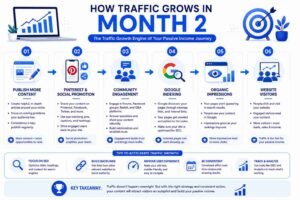
Check Search Console weekly and note what’s changing. By day 45 or so, most new sites in reasonably competitive niches start showing small amounts of organic impressions, not necessarily clicks yet, but evidence that Google has indexed and is starting to surface your content for some searches. This is the first real, measurable sign of progress.
Revisit your oldest articles and improve them. Articles you wrote on day 6 or day 10 can often be improved with what you’ve learned since, such as better structure, additional detail, and updated information. A thirty-minute revision pass on your earliest three or four articles during this phase often produces a meaningful ranking improvement.
By day 60, realistic expectations: a handful of consistent daily visitors (anywhere from 10 to 100 depending on niche competitiveness and effort), some Pinterest traffic if you’ve been consistent there, and your first affiliate clicks, possibly your first commission, though this varies significantly by niche and effort.
Days 61–90: Optimisation and First Income Phase
By this phase, you have enough data to start making informed decisions rather than guesses.
Identify your best-performing content. Check Search Console for which articles are getting impressions and clicks. These topics reveal what your specific audience is actually searching for. Use this insight to plan your next content batch around similar, related topics.
Double down on what’s converting. If a particular article is generating affiliate clicks even at a small volume, that topic and format are working. Create two or three more pieces of content in that same vein.
Add a simple digital product if it fits your niche. By this point, you likely have enough understanding of your audience’s specific problems to create something they’d pay for, such as a checklist, template, or short guide. This doesn’t need to be elaborate. A genuinely useful $7–15 product, created in a few hours using knowledge you’ve already demonstrated in your content, adds a second income mechanism alongside affiliate marketing.
Set up a basic email capture if you haven’t already. Even a simple free offer (“get my free [niche-relevant] checklist”) connected to a free-tier email tool like Brevo starts building a list you’ll own regardless of any platform’s algorithm changes.
Review your full 90 days honestly. What content performed best? What traffic sources actually worked? What didn’t work that you should stop doing? This review becomes the foundation for your next 90-day plan because passive income building, realistically, is a sequence of these cycles, not a single sprint that ends.
Real Example: What a Genuine 90-Day Journey Looks Like
Someone starts a blog about budgeting for university students with zero prior experience. Days 1–7: niche chosen, free WordPress.com blog set up, Search Console connected, first article published “How I cut my monthly spending by 30% as a student.”
Days 8–30: eight more articles published, covering specific topics like meal planning on a budget, free apps for tracking spending, and side income ideas for students. Two affiliate programmes were joined (Amazon for budgeting tools and a relevant budgeting app).
Days 31–60: Pinterest account is active with consistent pinning, one article starts appearing in Google’s results for a specific long-tail keyword, first ten organic visitors in a single week by day 50, first affiliate click is recorded by day 55.
Days 61–90: A simple “student budget planner” Notion template was created and listed on Gumroad for $9, promoted within the existing blog content. First Gumroad sale on day 74. First Amazon Associates commission ($1.20) on day 81. By day 90: roughly 200 monthly visitors, one small but real product sale stream, and a clear sense of which content topics are resonating with the actual audience that’s forming.
The numbers are modest. That’s intentional; this is what a genuine, honest 90-day starting point looks like, not an exaggerated success story. But it’s a real foundation that compounds from here.
Common Mistakes During a 90-Day Start
Checking analytics too frequently in the first month. Daily traffic checks during the period when there’s genuinely almost nothing to see produce unnecessary discouragement. Weekly checks are sufficient until month two.
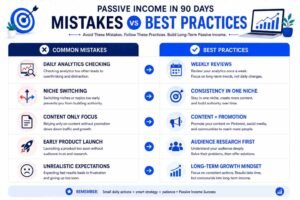
Switching niches or platforms mid-plan. Ninety days isn’t long enough to fairly evaluate a niche if you abandon it at day 20 for something that seems more promising. Commit to the full period before making a significant pivot.
Spending the entire 90 days only creating content, with no promotion. Content without distribution is invisible. The traffic and visibility phase (days 31–60) is not optional; it’s where content actually starts reaching people.
Adding a digital product too early. Creating and trying to sell a product before you understand your audience’s specific problems (which content creation during the first 60 days teaches you) often results in a product that doesn’t quite fit what your readers actually need.
Treating 90 days as a deadline for “success” rather than a foundation-building period. Ninety days is enough time to build real momentum and see early signals; it’s rarely enough time to reach substantial income. Judging the plan as a failure if you’re not earning significantly by day 90 misunderstands what this period is actually for.
Helpful Tips for Sticking to the Plan
Block specific time on your calendar, not just a vague intention. “I’ll work on this when I have time” rarely survives a busy week. “Tuesday and Thursday evenings, 7–9 PM” is a commitment that’s far more likely to actually happen.
Keep a simple weekly log. One sentence per week: what you did, what you noticed, what you’re doing next week. This takes two minutes and becomes genuinely valuable when you review your full 90 days at the end.
Find one accountability point. A friend who checks in weekly, a relevant Facebook group where you post your progress, or simply a public commitment to someone you respect. Accountability significantly increases the odds of completing the full 90 days rather than quietly stopping at week three.
Expect the middle to feel the slowest. Days 20 through 50 are typically the most discouraging stretch; early enthusiasm has worn off, but meaningful results haven’t appeared yet. This is normal and temporary, not a sign the plan isn’t working.
FAQs
Can I really build a passive income stream from scratch in 90 days with no money? You can build the foundation content, platform, traffic beginnings, and possibly your first small income in 90 days with no budget beyond your time. Substantial, life-changing income typically takes longer, usually one to three years of continued effort beyond this initial period. This plan gets you a real, validated start, not a finished result.
What if I don’t see any results by day 90? Review what you actually did versus the plan. Inconsistent publishing, no promotion effort, or constant niche-switching are the most common reasons for a lack of results, and all are fixable by extending the plan with corrected habits, not by concluding the model doesn’t work.
Should I follow this exact plan, or adapt it to my situation? Adapt the timeline if needed; stretch it to 120 or 150 days if your available time is more limited than the plan assumes. But keep the sequence: foundation first, content second, traffic third, optimisation and first income fourth. The order matters more than the exact speed.
Is a blog still the best starting point in 2026, or should I start with YouTube or social media instead? A blog remains the most accessible, lowest-cost starting point for someone with primarily time (not money or video comfort) to invest. If you’re significantly more comfortable on camera, the same 90-day phase structure applies to a YouTube channel instead of foundation, content, visibility, and optimisation.
Where You Are Right Now
If you’ve read this far, you’re at day zero. That’s not a disadvantage; it’s the only point from which any of this ever actually starts.
The plan above isn’t complicated. It doesn’t require a course, a mentor, or capital you don’t have. It requires roughly five to eight hours a week for ninety days, applied in the specific sequence described, with the patience to get through the genuinely slow middle weeks without quitting.
Most people who start this kind of project quietly stop somewhere around week three or four, not because the plan failed, but because they never had a plan specific enough to follow through on the parts that didn’t feel exciting yet.
You now have the plan. Day one starts whenever you choose to open that blank niche list and pick three options.
Disclaimer: This article is for educational and informational purposes only. Results from building passive income streams vary significantly based on niche, effort, consistency, and market conditions. Nothing here constitutes a guarantee of income or financial advice.