

How to Become a Social Media Freelancer in 2026


A friend of mine managed social media for her university’s student council for two years. Designed the posts, wrote the captions, replied to comments, and tracked what performed well. She did it voluntarily, because she genuinely enjoyed it.
When she graduated and couldn’t find a job immediately, someone suggested she offer the same service to small businesses. She pushed back, “I’ve never done it professionally.” But she put together three samples using her student council work as a portfolio, reached out to five local businesses on WhatsApp, and landed her first paid client within two weeks.
Six months later, she had four retainer clients, earning more than the entry-level marketing position she’d originally been looking for.
She didn’t take a course. She didn’t buy expensive tools. She just recognised that what she’d been doing for free had genuine market value and found the confidence to charge for it.
That story is the cleanest illustration I know of what social media freelancing actually looks like when you start from scratch. This guide fills in everything she figured out through trial and error.
What a Social Media Freelancer Actually Does
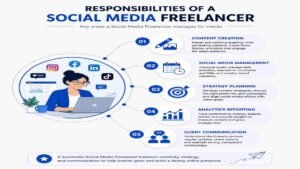
A social media freelancer manages, creates content for, or grows social media accounts on behalf of clients,s usually small businesses, personal brands, or organisations that don’t have the time or expertise to do it themselves.
The work varies depending on what you offer and what clients need:
Content creation: Designing graphics using tools like Canva, writing captions, shooting or editing short videos, creating Reels or Stories. Many clients need a consistent flow of professional-looking posts and simply don’t have the design skills or time to create them.
Account management: Scheduling posts using tools like Buffer or Meta Business Suite, responding to comments and DMs, and monitoring brand mentions. Some businesses just need someone to handle the day-to-day so their feed doesn’t go quiet.
Strategy and consulting: Advising clients on what content to create, which platforms to focus on, and what posting frequency makes sense for their goals. This is typically higher-level work that comes after you’ve developed real results to point to.
Paid advertising management: Running Facebook or Instagram ads, managing ad budgets, tracking campaign performance. This is a specialised skill that commands higher rates but requires more specific knowledge.
As a beginner, you don’t need to offer all of these. Picking one or two to start, most commonly content creation and basic account management,t is the practical approach.
How Social Media Freelancing Works as a Business
Unlike one-off freelance projects (write this article, design this logo), social media freelancing typically works on a retainer model, where clients pay you a fixed monthly fee in exchange for an agreed scope of work.
This might look like: Rs. 15,000 per month for twelve Instagram posts, caption writing, two Stories per week, and basic comment management.
The retainer model is what makes social media freelancing genuinely sustainable. Instead of constantly hunting for new projects, you build a base of monthly clients who pay you predictably. Four clients at Rs. 15,000 each amount to Rs. 60,000 per month, equivalent to many full-time jobs, and once those retainers are established, your primary job is keeping clients happy rather than constantly selling.
Getting to that point takes time and consistency. But the model itself is one of the more beginner-friendly in freelancing because clients who like your work keep coming back automatically, without you having to re-win the business each month.
Step-by-Step: How to Start as a Social Media Freelancer in 2026
Step 1 — Decide What You’re Actually Offering
“Social media management” is too broad to be immediately useful as a service description. Before anything else, get specific about what you can actually deliver.
A practical starting combination for most beginners is:
- Monthly content calendar (planning what goes up and when)
- Graphic design for posts (Canva-based)
- Caption writing
- Scheduling posts
This package is concrete, deliverable, and doesn’t require skills you’re unlikely to have on day one (like ad management or advanced analytics reporting).
Once you have clients and results, you can expand. But starting too broad, “I’ll do everything,g” typically leads to overpromising and underdelivering, which ends client relationships quickly.
Step 2 — Learn the Tools You’ll Use Daily

You don’t need to master everything before starting. But knowing these tools well will make you credibly professional from your first client interaction:
Canva: The standard tool for social media graphic design. The free version handles most beginner client work. Learn how to use brand kits (for applying client colours and fonts consistently), templates, and the resize feature for multiple platform formats. This alone can take you from zero to a professional-looking portfolio in a weekend.
Meta Business Suite: Facebook’s free tool for scheduling posts on Facebook and Instagram simultaneously, managing DMs across both platforms, and accessing basic analytics. If your clients are on Facebook or Instagram, most small business clients are, so this is essential.
Buffer or Later: Third-party scheduling tools that work across more platforms (Instagram, Facebook, Twitter/X, LinkedIn, Pinterest). Buffer’s free plan covers the basics for one or two clients. Later has a strong free tier specifically for Instagram.
Google Sheets or Notion: For content calendars. Clients need to see what’s being planned and approve content before it goes live. A clean, shareable content calendar separates professional freelancers from amateurs.
CapCut: For basic video editing on mobile, if clients want Reels or TikToks. It’s free, powerful for its category, and doesn’t require prior video editing experience to produce decent results.
None of these requires a paid subscription to start. You can build an entirely professional social media freelancing operation on free tools until you’re earning enough to invest in upgrades.
Step 3 — Build a Portfolio Before You Have Paying Clients
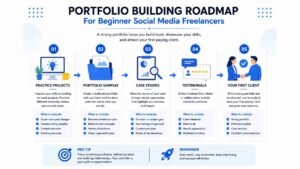
The most common roadblock for beginners is “I have no portfolio because I have no clients, but I can’t get clients without a portfolio.” It’s a real problem with a real solution: create your portfolio before you have paying clients.
Option 1 — Use existing work. Like my friend with the student council account, if you’ve managed any social media account, even for a school club, university society, community organisation, or family business, that’s legitimate portfolio work. Document the results: follower growth, engagement rate, and any notable posts.
Option 2 — Create spec work. Pick a real local business you admire that has weak social media. Design ten Instagram posts for them as if you were their social media manager. Write the captions. Plan the content themes. Create a mini content calendar for one month. You’re not submitting it to them; you’re demonstrating your capability to potential clients. Put it in a PDF or Canva presentation as “Sample project.”
Option 3 — Offer one free or heavily discounted month. Find one small local business, a café, boutique, clinic, or service business, and offer to manage their social media for free or at a token charge for one month in exchange for a testimonial and permission to show the work in your portfolio. One real client result, even from a free project, is worth more than ten spec samples.
By the time you have three portfolio pieces showing what your content looks like and a brief testimonial from even one real client, you’re ready to start approaching paid clients.
Step 4 — Set Your Pricing as a Beginner
Pricing social media freelancing is something beginners consistently get wrong in one of two ways: either pricing so low it’s not worth the effort, or pricing at experienced-freelancer rates before having results to justify them.
A realistic starting range for Pakistan-based social media freelancers targeting local businesses:
Basic package (12 posts/month + scheduling): Rs. 8,000–15,000/month Standard package (20 posts, captions, Stories, scheduling, basic reporting): Rs. 15,000–25,000/month Premium package (full management including engagement, ads consultation): Rs. 25,000–45,000/month
For international clients through platforms like Fiverr or Upwork, equivalent pricing in USD is $80–$300/month, depending on scope,e significantly more than local rates, which is why many Pakistani freelancers deliberately target English-speaking markets.
Start at the lower end of these ranges for your first two or three clients. Once you have documented results, “grew this account from 400 to 1,800 followers in three months,s” you have the evidence to charge the higher end.
Step 5 — Find Your First Clients
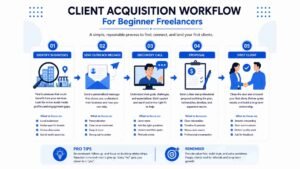
The fastest path to a first paying client is direct outreach, not platform listings.
Make a list of ten to fifteen local businesses that have active Facebook or Instagram accounts but poor-quality content,nt inconsistent posting, low engagement, unprofessional graphics, and missing captions. These are businesses that clearly need help and haven’t found it yet.
Send a short, personalised message. WhatsApp or Instagram DM works fine:
- References something specific about their current social media
- Explains briefly what you do
- Offers a free audit or sample post to start the conversation
Don’t pitch the full service in the first message. The goal of the first message is a reply, not a sale. The sale happens in the follow-up conversation.
In parallel, set up a Fiverr gig or Upwork profile offering social media content creation. These platforms take longer to generate results than direct outreach, but they work consistently once your profile has reviews, and they bring international clients with larger budgets.
Step 6 — Deliver and Retain
Landing a client is step one. Keeping them for six months is where the sustainable income comes from.
The single most important thing I’ve learned about client retention in social media freelancing is this: proactive communication beats reactive communication. Don’t wait for clients to ask how things are going. Send a brief monthly report, even a simple one showing what was posted, which posts performed best, follower change, and what you’re planning for next month. Clients who feel informed and considered rarely leave. Clients who feel like they have to chase their freelancer for updates almost always do.
Real Examples: What Beginner Social Media Freelancers Are Doing in 2026
The student side-hustler: A graphic design student in Lahore starts offering Instagram content creation to restaurants. She charges Rs. 10,000 per month for fifteen posts. Her Canva skills are strong from studying design. Within four months, she has three restaurant clients, a Rs. 30,000 monthly income managed in roughly fifteen hours of work per week alongside her studies.
The English-language Fiverr seller: A business graduate in Karachi creates a Fiverr gig offering “social media content calendar + 20 Canva posts for small businesses.” He targets English-speaking buyers by writing his gig in fluent, professional English and offering clear deliverables. First order takes three weeks to arrive. By month four, he has a 4.9-star rating and consistent orders earning $200–$350 monthly through Fiverr alone.
The niche specialist: A healthcare worker starts offering social media management specifically to private clinics and medical practices, a niche she understands from her own experience. She charges a premium because of her industry knowledge and ability to write medically accurate captions without requiring extensive client briefing. Three clinic clients at Rs. 20,000 each equals Rs. 60,000/month from a highly focused, specialised service.
Common Mistakes Beginners Make
Taking on too many clients before building systems. Managing four clients simultaneously without templates, scheduled workflows, and a clear content approval process leads to missed deadlines, inconsistent quality, and stressed relationships. Build your workflow for one client before taking on a second.
Not getting content approved before posting. Posting content without a client sign-off is one of the fastest ways to lose a client. No matter how confident you are about a piece of content, always share it with the client before it goes live. A simple content calendar shared weekly with a “approve by Friday” deadline keeps everyone aligned.
Promising results you can’t control. “I’ll grow your account to 10,000 followers in three months” is a promise you can’t guarantee. Organic social media growth depends on too many factors outside your control. Promise deliverables: number of posts, response time, reporting frequency, and outcomes. Clients who understand the distinction will respect you more for the honesty.
Undercharging long-term. Starting low to build your portfolio makes sense. Staying at beginner rates indefinitely does not. Once you have results and testimonials, raise your prices with existing clients respectfully, ly “I’m updating my rates from next month as I’ve expanded my service offering,g” and price new clients accordingly.
Ignoring analytics. Many beginner social media freelancers create and post content, but never look at what’s actually performing. Meta Business Suite, Instagram Insights, and Buffer’s analytics are all free. Knowing which posts get the most engagement tells you what to make more of and gives you real data to show clients in your monthly report.
Tips That Give You a Real Edge
Specialise in a niche as soon as possible. “Social media management for restaurants in Lahore” is more compelling and easier to get referrals within than “social media management for any business.” Niche clients talk to each other. One happy restaurant client recommending you to their restaurateur friends is more efficient than cold outreach every time.
Create templates for everything. Content calendars, proposal documents, client onboarding checklists, and monthly report formats, building reusable templates once saves you hours every month. The freelancers who scale most efficiently aren’t working harder; they’re working within better systems.
Stay one step ahead of clients on platform changes. Facebook and Instagram regularly update their algorithms, best practices, and format recommendations. If you know about a change before your client does and inform them proactively, you look like an expert. Following five or six social media marketing newsletters and accounts keeps you current without much effort.
Offer quarterly strategy reviews. Once every three months, offer each client a thirty-minute call to review performance and adjust the strategy. Most freelancers never do this. The ones who do rarely lose clients because the client feels actively partnered rather than just serviced.
FAQs
Do I need a degree or certification to become a social media freelancer? No. Clients pay for results and reliability. A portfolio showing what your content looks like and a clear communication style matter far more than credentials. Free certifications from Meta Blueprint or HubSpot add credibility if you want them, but they’re supplementary, not foundational.
How long does it take to land the first paying client? With active direct outreach, personalised messages to fifteen or twenty businesses, most beginners land a first client within two to four weeks. Passive methods like Fiverr take longer, often one to three months before the first order.
Can I manage multiple clients while working a full-time job? Two to three clients can be managed in ten to fifteen hours per week, which is realistic alongside a full-time job. Beyond three clients, time management becomes the main constraint. Most people build to three retainer clients on the side before making decisions about whether to transition to full-time freelancing.
What if a client is unhappy with the content? Build a revision process into your service from the start.t “All packages include up to two rounds of revisions.” This manages expectations before unhappiness arises. When a client is unhappy despite revisions, ask specifically what they want changed rather than guessing. Specific feedback produces better results than general dissatisfaction.
Is this viable long-term, or will AI replace social media and freelancers? AI tools are changing the content creation process. Many freelancers already use AI to draft captions, generate ideas, or accelerate design work. But the strategic judgment, client communication, brand understanding, and relationship management that make social media management effective remain human skills. The freelancers who embrace AI as a tool rather than fear it as a replacement are producing higher-quality work faster than before, and that’s a competitive advantage, not a threat.
Getting Started This Week
The gap between reading this guide and having a first client is not as large as it feels right now.
Decide on your core service offering today. Open Canva and create three sample posts for a fictional or real local business this week. Write a short, honest outreach message you’d feel comfortable sending to ten local businesses on WhatsApp or Instagram DM by the end of the week.
That’s it. That’s the entire first step. Not a course, not a certification, not a perfect plan. Three sample posts and ten outreach messages.
The rest of the skills, higher rates, more clients, rand efined systems get built from there.
Disclaimer: This article is for educational and informational purposes only. Freelancing results vary based on skill, effort, niche, and market conditions. Platform features, pricing, and policies mentioned are subject to change. Nothing in this article constitutes a guarantee of income or employment.