
How to Start Affiliate Marketing with No Money in 2026


When I first looked into affiliate marketing, I assumed it required a website. And a website, I assumed, required hosting. And hosting required a credit card, which I didn’t have set up for international payments at the time.
So I did nothing for two months.
Then a conversation with someone who’d been doing affiliate marketing for a while completely changed my assumptions. She hadn’t paid for anything when she started. No hosting, no paid tools, no course. She used a free blogging platform, free Canva graphics, and a free affiliate programme. Her first commission, about $,8 came from a blog post she’d published on a platform that cost her nothing to use.
That conversation made me realise the barrier I thought existed mostly existed in my head. The tools to start affiliate marketing with no money have been available for years. The question was whether I was willing to use them properly.
This guide is built around that reality, with a complete, practical path to starting affiliate marketing without spending a single rupee or dollar upfront.
What Affiliate Marketing With No Money Actually Means
Let’s be clear about what “no money” means here and what it doesn’t.
It means no paid hosting, no paid tools, no paid courses, no paid advertising. You can build the entire foundation of an affiliate marketing business using free platforms, free tools, and programmes that cost nothing to join.
What it doesn’t mean is no effort. Free platforms require more manual work than paid setups; you work around limitations instead of removing them with money. Free traffic methods take longer than paid advertising. The trade-off is real. You invest time rather than money, and the results compound more slowly than they would with a paid approach.
But for someone starting from zero, no budget, no established audience, no prior experience,e this is the most honest and realistic path available. And it works.
How the No-Money Model Works
Affiliate marketing itself requires no upfront investment from you by design. Joining affiliate programmes is free. Getting your affiliate link is free. Sharing that link costs nothing.
The things that cost money in a typical affiliate marketing setup are creating a professional platform to share those links on a self-hosted WordPress blog, a premium tool, and a paid email service. These improve results and are worth investing in once you’re earning. But they are not required to start.
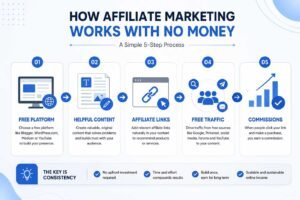
Here’s the basic no-money architecture:
Free platform → original content → affiliate links → traffic → commissions
You create content on a free platform (a Blogger blog, a free WordPress.com site, a Medium publication, or a YouTube channel). That content naturally recommends products or services relevant to your topic. Each recommendation includes your affiliate link. People who find your content through search or social media click the links. When they buy, you earn a commission.
The platform is free. The content creation tools are free. The affiliate programmes are free to join. The traffic sources, organic search, Pinterest, and social sharing cost no money, only effort and time.
Step-by-Step: How to Start Affiliate Marketing With No Money in 2026
Step 1 — Pick a Niche You Can Write About Without Research Paralysis
A niche is the focused topic area your content will cover. The no-money path works best when you start with a niche you already understand because the free approach relies on your own knowledge and writing rather than expensive tools or research resources.
Think about what you genuinely know. What questions do people ask you? What topics do you follow closely without being asked to? What have you figured out through personal experience that others around you haven’t?
Your niche doesn’t need to be unique. It needs to be specific enough that the right people can find your content, and you need to know enough to write genuinely useful articles about it.
Good niches for a no-money start:
- Personal finance and budgeting
- Online earning and freelancing
- Student productivity and study skills
- Cooking on a budget
- Learning a language
- Mental wellness and daily habits
- Digital tools for remote workers
Avoid niches that require expensive first-hand experience to cover well: travel, luxury goods, and high-end tech. These are harder to do credibly on a zero-budget start.
Step 2 — Choose Your Free Platform
This is the decision that shapes everything else. You have several solid free options, each with different strengths.
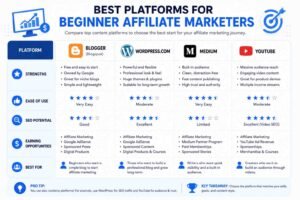
Blogger (blogger.com): Google’s own free blogging platform. No cost, no ads on your content unless you choose to add them, and a clean URL structure that works reasonably well for SEO. You can add affiliate links freely. The design options are limited but functional. For a pure writing-and-links approach, Blogger is underrated as a starting point.
WordPress.com (free plan): More design flexibility than Blogger. The free plan has limitations: you can’t install plugins, and you can’t place certain types of ads, but affiliate links in content are permitted. If your plan is purely content-based affiliate marketing with links in articles, the free WordPress.com tier works.
Medium: A large publishing platform with its own built-in audience. You can write articles and include affiliate links (check Medium’s current affiliate link policy, which changes occasionally). Medium’s internal discovery and distribution can expose your content to readers without you doing any external promotion at all, which is a genuine advantage for a zero-budget beginner.
YouTube (free channel): If you’re more comfortable speaking than writing, a YouTube channel costs nothing to start and can include affiliate links in video descriptions immediately. No subscribers required to start, though YouTube’s Partner Programme (for ad revenue) requires threshold-level subscribers and watch time.
Pinterest + Linktree combination: If you have no interest in writing long-form content, you can create Pinterest pins that link to a free Linktree page listing your affiliate links. This is a lean, minimal setup, though it has lower earning potential than a content-rich blog.
My recommendation for most beginners: start with Blogger or a free WordPress.com blog if you prefer writing, or YouTube if you prefer speaking. These two paths have the clearest route to long-term income.
Step 3 — Join Free Affiliate Programmes
Affiliate programmes are always free to join; you are never charged to become an affiliate. Here are the best free options for beginners with zero budget:
Amazon Associates: Free to join, works in almost any niche, and Amazon’s name recognition means high conversion rates. Commission rates vary by category (1–10%). The 24-hour cookie window is a limitation, but the breadth of products and Amazon’s universal trust make it essential for most beginner setups.
Canva Affiliate Programme (via Impact): Free to join. Canva’s free tier is genuinely excellent, making it easy to recommend authentically. You earn a commission when someone you refer upgrades to Canva Pro. The product essentially sells itself.
Fiverr Affiliates: Free to join. You earn a flat commission for each new buyer you refer to Fiverr. Works naturally in any content about freelancing, online business, or digital skills.
ShareASale and Impact (affiliate networks): Free to join, giving you access to hundreds of different brand affiliate programmes through a single dashboard. Once inside, you apply to individual brand programmes, most of which are free and are approved quickly.
Hostinger, Bluehost, or Namecheap affiliate programmes: If your content covers blogging, online business, or web creation, hosting affiliates pay some of the highest commissions available, often $30–$65 per referral. Free to join.
Apply to two or three programmes that are directly relevant to your niche. Don’t spread across ten programmes before you have any traffic.
Step 4 — Create Content That Earns Trust Before It Earns Commissions
This is the phase where the no-money path requires the most patience. Without paid traffic, you depend entirely on organic discovery, which takes time to build.
Your first ten articles or videos should do one thing: genuinely help your target reader with something they’re actively searching for. Not just introduce them to a topic, but actually solve a problem or answer a question completely.
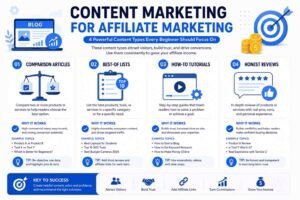
Types of content that work best for affiliate marketing:
Comparison content: “Platform A vs Platform B, which one is actually worth it?” People searching comparisons are close to a decision and often convert well.
Best-of lists: “Best free tools for freelancers in 2026.” Each item on the list can carry an affiliate link naturally.
How-to tutorials: “How to set up a Canva portfolio in 30 minutes.” The tutorial demonstrates a product in use in a natural environment for affiliate recommendations.
Honest reviews: “I used X for 60 days, here’s what I actually think.” Experience-based reviews build the most trust and convert the best, but require you to have genuinely used the product. If you haven’t used it, research it thoroughly and be transparent about that.
Write or record with a clear editorial standard: every piece of content must be something you’d genuinely want to find if you were searching for that topic yourself.
Step 5 — Drive Free Traffic to Your Content
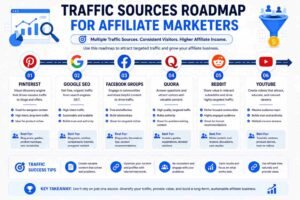
No paid ads. That means every visitor comes from organic efforts. Here are the realistic free traffic sources in order of effectiveness for a beginner:
Pinterest: Exceptional for blogs in personal finance, productivity, home, food, and education niches. Create vertical pins in Canva (free), link them to your articles, and pin consistently five to ten pins per day. Pinterest content has a long lifespan, often driving traffic for months after a pin is created.
Google SEO (organic search): The highest-value traffic source long-term, but the slowest to develop on a new free blog. Focus on long-tail, specific keywords, such as “best budgeting apps for university students in Pakistan”, rather than broad keywords where established sites dominate. Google Search Console (free) helps you track which searches your content appears in.
Facebook Groups: Participate genuinely in communities related to your niche. Answer questions, contribute real value. Where group rules allow, share your relevant content when it directly answers someone’s question. Never spam links; this gets you removed from groups and damages your credibility.
Quora and Reddit: Answer questions in your niche on Quora and relevant subreddits. Your answers can reference your content where genuinely relevant. These platforms have large audiences actively searching for answers to specific questions, which is exactly the intent that converts to affiliate clicks.
YouTube (cross-platform): If you have a blog, consider making simple videos summarising your most useful articles. Embed them in your posts. This drives traffic from YouTube to your blog and improves the time visitors spend on your blog page,s a signal Google uses to assess content quality.
Step 6 — Build Toward Paid Infrastructure Over Time
The no-money start is a beginning, not a permanent state.
Once your free blog or channel generates its first few commissions, reinvest some of that income into infrastructure that removes the limitations of free platforms. This typically means:
- Moving from a free blog to self-hosted WordPress (approximately $3–5/month with affordable hosting like Hostinger)
- Setting up a domain name for credibility
- Starting a basic email list (Brevo/Sendinblue’s free tier allows up to 300 emails/day)
The sequence matters: validate that your content earns something before spending money on the platform. The no-money start is how you validate without risk.
Real-World Examples: What No-Money Affiliate Marketing Looks Like in Practice
The Blogger + Amazon Associates path: A student in Faisalabad starts a Blogger blog about affordable tech accessories, earphones, phone stands, USB hub, and things she genuinely uses and can test. She writes detailed, honest reviews with her Amazon Associates links. After three months, she has fourteen articles published. One review of a specific budget earphone starts ranking on Google and drives consistent daily traffic. Amazon commissions from that one article: approximately $12–$20 per month. Not large, but earned with zero upfront cost.
The Medium + Fiverr affiliate path: A writer publishes articles about building an online freelance career on Medium, how to write a Fiverr gig, how to get first clients, and how to price services. Medium’s internal distribution exposes the articles to readers interested in side income. Each article includes a Fiverr affiliate link disclosed clearly. Monthly Fiverr affiliate commissions after six months of consistent publishing: $30–$60.
The Pinterest + digital product affiliate path: A designer creates Pinterest content about Canva tutorials, tips, tricks, and template recommendations. Each pin links to a short blog post on a free WordPress.com site, which includes Canva affiliate links and links to Canva template packs on Etsy (with an Etsy affiliate link). Pinterest drives consistent traffic; Canva and Etsy commissions combine to approximately $40–$80 per month within eight months of consistent effort.
These numbers are modest. That’s the honest reality of a no-money start. But they’re real, they’re verifiable, and they compound over time as content accumulates.
Common Mistakes on the No-Money Path
Treating “free” as “unlimited shortcuts.” Free platforms have limitations, design restrictions, feature gaps, and slower SEO performance compared to self-hosted sites. Expecting free platforms to perform like paid ones leads to frustration. Work within the limitations patiently and upgrade when your earnings support it.
Publishing too infrequently. One article per month will not build the content volume needed for consistent organic traffic in a reasonable time. On a no-money path, volume of high-quality content is your primary asset. One or two articles per week, sustained for six months, produce a library of thirty to fifty pieces enough for real search visibility in most niches.
Promoting products you haven’t used. On a zero-budget start, you’re relying entirely on the authenticity and usefulness of your content to build trust. Hollow recommendations that lack specific, experience-based detail are visible to readers in a way that paid traffic can partially mask. Don’t recommend something you know nothing about just because it has a good commission.
Expecting free traffic to convert immediately. Organic traffic builds slowly. The first three months on a free platform in a competitive niche will feel almost invisible, with low traffic and near-zero commissions. This is normal. The fourth, fifth, and sixth months look meaningfully different if you’ve been consistent. Most people who say “affiliate marketing didn’t work” quit during months two or three.
Putting affiliate links in content before the content is genuinely useful. Links in a thin, unhelpful article earn almost nothing. The same links in a detailed, genuinely useful article earn consistently. Invest in the content first.
Helpful Tips for Starting With No Budget
Use Google Keyword Planner (free) to find what people are actually searching for. You need a free Google Ads account to access it, but you don’t need to spend on ads. Search volume data tells you which article topics have genuine search demand before you invest time writing them.
Build a content plan before you start publishing. Map out twenty-five to thirty article or video ideas in your niche before you publish the first one. This prevents the common scenario of publishing five pieces, running out of ideas, and going quiet for two months while the content that exists never gets enough time to rank.
Read your own content as a first-time visitor before publishing. The question to ask: if I found this through a Google search, would I stay, read to the end, and feel like it helped me? If the honest answer is no, revise before publishing.
Use your affiliate link disclosure as an authenticity signal, not a formality. “This article contains affiliate links. If you click and buy, I earn a small commission. I only recommend things I genuinely use or have researched thoroughly” is not just a requirement,d it’s also a trust statement. Readers who see this and then read genuinely useful content trust you more, not less.
Track what you share and where. Keep a simple Google Sheet noting which articles or videos you’ve published, which affiliate links they contain, which traffic sources you’ve promoted them on, and what commission data shows after 60 days. This tracking turns random effort into a learnable system.
FAQs
Is affiliate marketing really possible with absolutely no money? Yes, for content creation and traffic, the free tools available in 2026 are genuinely functional. The trade-off is time. You’ll invest more hours per result than someone paying for hosting, premium tools, and advertising. But the ceiling on what you can build is real.
How long before I make my first commission with no money? Realistically, two to five months of consistent effort, publishing content regularly, building a free traffic source, and promoting appropriately. Some people get lucky faster. Some take longer. The variable is almost always consistency and content quality, not the absence of a budget.
Can I use social media instead of a blog? Yes. Instagram, TikTok, Pinterest, and YouTube all support affiliate marketing without a blog. Most affiliate programmes accept social media profiles as your platform during application. The limitation is that most social platforms make link placement awkward (link in bio, rather than embedded in content), which reduces click-through rates compared to a blog.
Which free platform is best for SEO? Blogger, because it’s owned by Google and therefore crawled reliably, with clean URL structures that index well. Free WordPress.com also works reasonably, though with more limitations on customisation. Self-hosted WordPress (paid) is still the best for SEO, but among free options, Blogger is the underrated choice, specifically for search visibility.
Do free affiliate marketing platforms work long-term? They work well as a starting point and poorly as a permanent infrastructure. Most serious affiliate marketers move to self-hosted websites within six to twelve months of starting,g once their content is validated and their first commissions provide funds to reinvest. The free path is how you get to that point without financial risk.
The Real Starting Point
There’s a specific kind of procrastination that comes from feeling like you need everything set up perfectly before you can start. The right niche. The right platform. The right tools. A plan you’re fully confident in.
That feeling is real, but the solution to it isn’t more planning. It’s a smaller first step.
Open Blogger today. Create an account in fifteen minutes. Write one article about something in your chosen niche that you genuinely know well. Apply for Amazon Associates using that blog as your platform. Publish.
That’s not the complete strategy. It’s just the part you can do today, that you’ve been postponing by reading guides, es including this one.
The rest of the strategy, more content, better traffic, improved writing, and higher commissions come from having started. Not from having planned more.
Disclaimer: This article is for educational and informational purposes only. Results from affiliate marketing vary significantly based on niche, consistency, content quality, and effort. Platform policies, affiliate programme terms, and tool availability mentioned are subject to change. Nothing in this article constitutes a guarantee of income or financial advice.