

How to Build Trust Before Promoting Affiliate Products


I once clicked an affiliate link from a blogger I’d been reading for three years without a second thought.
I didn’t compare prices. I didn’t read alternative reviews. I just bought it because I trusted the person who recommended it. That trust had been built across dozens of articles, honest assessments, and one specific post where the blogger talked candidly about a product they’d tried and found genuinely disappointing. That honesty is what sealed it for me. Someone willing to admit when something wasn’t worth it was someone whose positive recommendations I believed completely.
That experience taught me more about affiliate marketing than any course I’ve seen on the topic. The conversion didn’t happen because of the affiliate link. It happened because of everything that came before it, months of content, consistent voice, and demonstrated honesty. The link was just the final step in a relationship that had already done its job.
Building that kind of trust before you promote affiliate products isn’t a nice-to-have. For anyone who wants affiliate income that grows and compounds over time, it’s the actual work.
What “Trust” Means in Affiliate Marketing: The Specific Definition
Trust in this context isn’t a vague, feel-good quality. It’s a specific, measurable thing: your audience’s confidence that your recommendations reflect your genuine experience and judgment, rather than your commission structure.
When that confidence exists, affiliate recommendations convert at dramatically higher rates, and more importantly, they continue to convert as you add more content, because the trust earned from one honest article carries over to the next.
When it doesn’t exist, when readers sense that recommendations are financially motivated rather than genuinely helpful, the opposite happens. Every link is viewed skeptically. Conversion rates are low regardless of how relevant the product is. And a single misleading recommendation can undo months of goodwill in one post.
The practical definition of trust for an affiliate marketer is this: your reader should believe, correctly, that you would recommend the same products even if you weren’t earning a commission from them. If that statement is true, if your recommendations genuinely reflect your experience,e the only remaining work is making that authenticity visible.
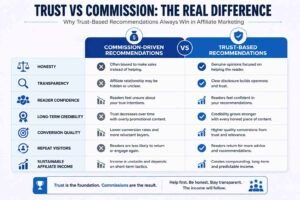
How Trust Actually Gets Built: The Mechanism
Trust doesn’t accumulate from a single impressive action. It accumulates from many small, consistent signals over time,e each one either adding to or subtracting from the reader’s overall assessment of your credibility.
The signals that add to trust:
Honesty about limitations. Mentioning what a product doesn’t do well, what type of user it’s not suited for, or what you personally found frustrating about it is the single most trust-generating thing an affiliate can do. Readers expect promotional content to be entirely positive. When it isn’t, it reads as genuinely independent,t which is exactly what you want.
Specificity from personal experience. Details that could only come from actually using a product, the slightly counterintuitive menu structure, the way the customer support response took 36 hours, and the specific feature that works differently than advertised, signal real use far more than any amount of general praise.
Consistency of voice and values across content. A reader who follows your work over time develops a sense of your standards, your typical reaction to things, and your editorial judgment. When your affiliate recommendations align with that established voice, they feel like a natural extension. When they don’t,t when you suddenly recommend something dramatically different from your usual standards, the inconsistency is jarring and raises questions.
Disclosed relationships, handled with transparency. Paradoxically, clear affiliate disclosure builds trust rather than undermining it. A reader who sees “this post contains affiliate links” and then finds genuinely balanced, honest content underneath that disclosure learns that your disclosures mean something. A reader who finds undisclosed affiliate content, especially after trusting you,u feels deceived in a way that’s very difficult to recover from.
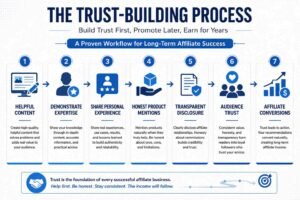
Step-by-Step: How to Build Trust Before Your First Affiliate Promotion
Step 1 — Establish Your Editorial Voice in Non-Commercial Content First
Before any affiliate promotion, publish a meaningful body of content that exists purely to help readers with no commercial agenda attached.
The exact number matters less than the principle: your audience should have a basis for trusting your judgment before you ask them to act on it financially. Ten genuinely useful articles in your niche is a reasonable minimum. Twenty is better.
During this phase, resist the temptation to drop affiliate links into content before you’ve established why readers should trust your recommendations. Early affiliate links in a young, trust-light blog convert poorly and can actually damage the reader relationship you’re trying to build before it’s had a chance to form.
Step 2 — Demonstrate Genuine Knowledge of Your Niche
Trust in your recommendations is built on trust in your expertise. Readers who’ve seen you demonstrate real knowledge of your topic through accurate information, nuanced perspective, and honest admission of what you don’t know are readers who’ll take your product recommendations seriously.
For a freelancing blog, this means articles that show you understand the real friction points of freelancing: proposal writing, pricing conversations, platform algorithm changes, and managing client expectations. Not just the highlights.
For an affiliate marketing blog, it means content that reflects experience with traffic building, programme selection, conversion rate realities, and the unglamorous early months before income appears.
The knowledge signals that build trust are specific and honest, not a recitation of commonly available information, but the kind of detail and perspective that only comes from genuine immersion in the topic.
Step 3 — Introduce Products as Tools You Use, Before Selling Them
One of the most effective trust-building sequences in affiliate marketing is the organic mention.
Before writing a formal affiliate review of a product, mention it naturally in the course of other content:t “I use Canva for all my template work, it’s genuinely become a daily too,l” or “I track my blog performance through Google Search Console, here’s what I check weekly.” These mentions establish your relationship with the product in a way that feels incidental rather than promotional.
When you later write a dedicated review or recommendation, readers have already seen you reference this tool multiple times in passing. The endorsement feels like a natural conclusion to an established pattern, not a sudden sales pitch.
Step 4 — Write One Honest Negative Review or Critical Assessment
Nothing builds trust faster than demonstrating you’re willing to say when something isn’t worth it.
This doesn’t mean manufacturing criticism where none is warranted. But if you’ve genuinely tried something and found it disappointing, a course that didn’t deliver its promises, a tool with a frustrating interface, a platform whose commission structure changed for the worse, writing honestly about it is one of the most powerful trust signals available.
Readers who see you willing to criticize something, especially something you don’t have an affiliate relationship with, or something where you explain clearly why the commission doesn’t influence your opinion, will believe your positive recommendations with a fundamentally different level of conviction.
Step 5 — Make Your Affiliate Disclosure Genuinely Transparent
Most affiliate disclosures are buried, rushed, or written in language designed to satisfy a legal requirement while being as invisible as possible. This is a missed opportunity.
A transparent, prominent disclosure placed near the top of any article containing affiliate links, written in plain language, does several things simultaneously. It fulfils your legal and platform obligations. It signals editorial integrity. And it gives readers who don’t mind affiliate content the context to proceed with confidence, rather than feeling ambushed by it later.
Your disclosure should be specific rather than vague. “This article contains affiliate links. If you click and buy through my links, I earn a commission at no extra cost to you. I only recommend products I’ve personally used or researched thoroughly and believe offer genuine value. This is meaningfully different from a generic “some links may be affiliate links” buried in a footer.
The specificity signals that you’ve thought about this, that your disclosure has a standard behind it, and that it means something.
Step 6 — Respond to Reader Questions Thoroughly and Without Agenda
How you handle questions from readers in comments, in email replies, and on social media is a significant trust signal that most affiliate marketers underestimate.
When someone asks, “Is this product worth buying for someone in my specific situation?” and your honest answer is “Actually, probably not, it sounds like you’d be better served by [free alternative],” that response does something a conversion-focused affiliate rarely does: it puts the reader’s interest above the commission.
Readers remember this. Readers who received genuinely helpful, unbiased guidance when they asked a question tend to come back to you when they are ready to buy something because you’ve demonstrated that your advice is reliable even when it costs you a sale.
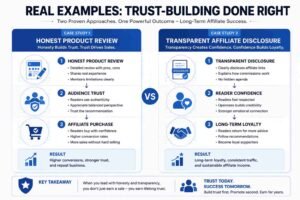
Real Examples: Trust-Building Done Right
The blogger who criticized her sponsor: A productivity blogger who makes part of her income from sponsored content and affiliate links, published an honest comparison between two project management tools,s one of which she had an affiliate relationship with. In the comparison, she concluded that for most of her readers’ use cases, the tool she wasn’t affiliated with was actually the better fit. She disclosed the affiliate relationship clearly and explained why she was recommending against it in this context.
The response from her audience: the article became one of her most-shared pieces. Multiple readers specifically commented that the honest assessment made them more likely to trust her other recommendations. The article still earned affiliate commissions from readers whose situations matched the affiliated tool’s strengths.
The YouTuber who disclosed every time, prominently: A freelancing YouTube creator started every video that contained an affiliate link with a thirty-second explanation: which tool he was mentioning, that he had an affiliate relationship with it, that he’d been using it personally for X months, and what he genuinely thought of it. Not buried in the description at the start of the video, out loud.
His comment sections consistently included observations from viewers about the transparency. His affiliate conversion rates, by his own reporting, were higher than those of comparable channels that disclosed less visibly. Trust, made explicit, accelerated conversion rather than impeding it.
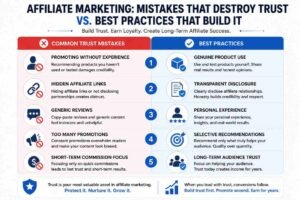
Common Mistakes That Destroy Trust Before It’s Built
Promoting products before having a genuine experience with them. The absence of specific, experience-based detail is visible to readers even when they can’t articulate why. “This tool is great, and I highly recommend it,” from someone who clearly hasn’t used the product in any meaningful way, reads differently from the same sentence written by someone who can describe exactly how they use it and what they found surprising about it.
Using urgency and scarcity tactics borrowed from sales pages. Countdown timers, “only 3 spots left,” and manufactured FOMO are tactics that have been thoroughly learned and rejected by the online audience. Using these signals that conversion is more important to you than the reader’s decision-making directly contradicts the trust signal you’re trying to build.
Promoting too many products simultaneously. An affiliate site with dozens of promoted products in every article reads as a catalogue, not a recommendation. When everything is promoted, nothing feels genuinely recommended. Restraint fewer, more specific, more thoroughly justified recommendations produces higher trust and better conversion rates.
Changing recommendations when the commission structure changes. If a product you’ve publicly praised later cuts its affiliate commission rate and you quietly stop recommending it, readers who notice this pattern, and some always do, will correctly conclude that your recommendations follow the money. This is trust-destroying in a way that’s very difficult to recover from.
Not updating content when products change. Recommending a product that has since deteriorated in quality, significantly raised its prices, or changed its features creates a mismatch between your readers’ expectations and their experience. Regularly reviewing and updating affiliate content signals ongoing editorial care and protects readers from outdated recommendations.
Helpful Tips
Keep a running list of everything you personally use in your niche. These are your most credible affiliate recommendations, tools, and services you already reference naturally in your work. Start your affiliate promotion from this list rather than from the marketplace of the highest-commission options.
Create a “tools I use” or “resources” page on your blog. A dedicated page listing the tools, platforms, and resources you genuinely use with honest assessments and affiliate links where applicable is one of the highest-converting pages on most affiliate blogs, because readers come to it specifically looking for your recommendations. It also signals that your affiliate relationships are organized around what you actually use, not whatever pays most.
Ask yourself before every recommendation: “Would I recommend this if I weren’t earning a commission?” If the answer is no, don’t promote it. If the answer is yes, you have a recommendation worth making, and your content will reflect that genuine conviction in ways that readers can sense and act on.
Track the long-term conversion rate of your recommendations, not just immediate clicks. A product you enthusiastically recommended that generates high refund rates or reader complaints is costing you trust, even if it’s earning commissions in the short term. Monitor what happens after readers buy.
FAQs
How much content should I publish before my first affiliate recommendation? There’s no precise number, but the principle is that readers should have a meaningful basis for trusting your judgment before you ask them to act on it. Ten to fifteen genuine, helpful articles in your niche is a reasonable minimum. The quality and honesty of that content matter more than the exact quantity.
Does disclosing affiliate relationships actually hurt conversion rates? Evidence consistently suggests it doesn’t, and for trust-sensitive audiences, it helps. Readers who find honest, balanced content beneath a clear disclosure learn that the disclosure has substance. This reader trusts your next recommendation more, not less.
What if I haven’t personally used a product I want to promote? Either use it before promoting it, or be transparent in your content that you’re recommending it based on thorough research rather than direct use. “I haven’t personally used this, but I’ve researched it extensively and here’s what I found” is more honest than implied personal experience where none exists and more credible than it might initially sound.
How do I promote affiliate products without feeling like I’m being salesy? The recommendation that doesn’t feel salesy is the one that solves a real problem the reader already has, delivered by someone who demonstrably knows what they’re talking about, with honest context about both strengths and limitations. If the product genuinely fits your reader’s situation and you’ve been honest throughout, the recommendation is a service, not a sales pitch.
The Bottom Line
The affiliate marketers who build genuinely durable income are not the ones who optimize links, engineer click-throughs, or build elaborate promotional funnels. They’re the ones whose readers think of them first when they’re ready to buy something in that niche because the trust was built long before the purchase moment.
That trust is slow to build and fast to damage. It’s built in aggregate, across dozens of small signals, honesty where it’s easier to be vague, specificity where it’s easier to be general, transparency where it’s easier to stay quiet. None of these individual moments feels significant at the time. Together, they determine whether your affiliate marketing compounds into something real or remains permanently stuck at the conversion rates of a site nobody quite believes.
The affiliate link is never the hard part. The trust that makes someone click it is.
Disclaimer: This article is for educational and informational purposes only. Affiliate marketing results vary significantly based on niche, audience trust, content quality, and individual effort. Nothing here constitutes a guarantee of income.