

How to Start Freelancing With No Experience in 2026


The first time I tried to create a freelancing profile, I stared at the “Describe your experience” field for twenty minutes and typed nothing.
I had no portfolio. No clients. No testimonials. The only thing I had was a skill I’d been using for myself, writing, and a quiet, stubborn belief that someone, somewhere, would pay me for it if I just figured out how to reach them.
That was uncomfortable. But here’s what I know now that I didn’t know then: almost every freelancer you see with a full client roster and a polished profile started from exactly that same blank page. The difference between the ones who made it and the ones who didn’t wasn’t talent or connections. It was that they pushed through the awkward beginning instead of waiting until they felt “ready.”
If you’re sitting on a skill right now, wondering whether you can actually turn it into freelance income with zero experience, this guide is the one I wish I’d had.

What Freelancing Actually Means (No Jargon Version)
Freelancing simply means working for yourself, on a project-by-project basis, for different clients instead of working a fixed job for one employer.
You choose your clients. You set your rates. You decide your working hours. And you get paid per project or per hour, depending on how you structure things.
The word “freelancer” covers an enormous range of work: graphic design, content writing, video editing, web development, social media management, translation, data entry, virtual assistance, SEO, and dozens of other skills. If someone needs a task done and doesn’t want to hire a full-time employee for it, they hire a freelancer.
What makes 2026 a particularly good time to start is that the market for remote, flexible work has matured significantly. Businesses of all sizes, from solo entrepreneurs to mid-sized companies, now routinely hire freelancers for tasks they used to keep in-house. The stigma around “gig work” has largely disappeared. Clients are comfortable with it. Platforms to connect freelancers with clients are well-established and genuinely functional.
The barrier to entry is lower than it has ever been. The competition is also real, but beginners who approach it strategically can still build a client base faster than most people expect.
Freelancing isn’t the only way to earn online. Many beginners also explore affiliate marketing as another low-cost method of building income online.
The “No Experience” Problem Is Smaller Than You Think
Here’s the truth about the experience problem: most clients aren’t looking for someone with a decade of freelance history. They’re looking for someone who can do the specific task they need done, reliably and well.
Your experience using a skill for yourself, for school projects, for personal work, or even just through self-teaching counts as experience in a practical sense. You don’t have a portfolio yet, but you can build one before you have a single paid client, which I’ll explain in detail below.
The experience gap is real for about the first 60–90 days. After that, if you’ve done even two or three small projects well, you have proof of work. And proof of work is what clients are actually paying for.
Step-by-Step: How to Start Freelancing From Zero in 2026
Step 1 — Identify One Skill Worth Selling
Don’t try to offer five services when you’re starting. Pick one.
Think about what you already do reasonably well, even if you’ve only done it for yourself. Writing. Designing social media posts. Editing videos on your phone. Organising data in Excel. Building basic WordPress websites. Managing emails and calendars. Translating between two languages you speak fluently.
If you genuinely can’t identify a current skill, pick one to learn. Graphic design with Canva, basic video editing with CapCut or DaVinci Resolve, copywriting, social media content creation all of these can reach a beginner-sellable level within four to eight weeks of focused practice.
The keyword is focused. Watching ten hours of tutorials without practicing produces nothing. Spending two hours actually designing something every day for a month produces a portfolio.
Step 2 — Build Three to Five Portfolio Samples Before Applying Anywhere

This is the step most beginners skip, and it’s the reason most beginners get ignored.
When a client visits your profile and sees no work samples, they move on. It takes three seconds. They have forty other applicants.
You don’t need paid work to build a portfolio. Here’s what actually works:
Create samples for fictional clients. If you want to do social media design, invent a fictional cafe, pick a name, and design five Instagram posts for it. Make them look real. Put them in a PDF. That’s a portfolio piece.
Redesign something that already exists. Find a real local business with a weak social media presence and redesign their posts without them asking you to. You’re not submitting it to them; you’re showing potential clients what you could do for businesses like theirs.
Do one small job free or at a heavy discount for someone in your network. A family member’s business, a friend’s small online store, a local NGO. You get a real testimonial and a real piece of work you can show. One good testimonial from a real client is worth more than ten made-up portfolio pieces.
By the time you have three to five solid samples and one brief testimonial, you are no longer “inexperienced” in any practical sense that matters to clients.
Step 3 — Choose the Right Platform for Your Skill
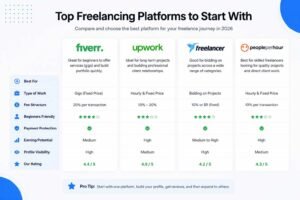
The platform you start on matters more than most people realise. Different platforms attract different types of clients and different levels of budget.
Fiverr is beginner-friendly because when clients come to you create a “gig” (a service listing), and buyers find it. The downside is high competition and lower starting rates. It works best for creative and digital services: writing, design, voiceover, translation, video editing.
Upwork requires more effort upfront when you apply to job postings with proposals. Clients tend to have bigger budgets than Fiverr, but they also have higher expectations. Start here once you have at least a small portfolio.
LinkedIn is underused by freelance beginners and surprisingly effective. Optimise your profile for your freelance skill, connect with small business owners and marketing managers, and post content demonstrating your knowledge. Inbound leads from LinkedIn don’t require you to compete with hundreds of other applicants on a platform.
Contra and PeoplePerHour are smaller platforms with less competition, good for beginners trying to land their first few jobs without fighting through thousands of established profiles.
Local and direct outreach should not be ignored. Small businesses in your city or town often need help with social media, website content, or basic design, and they have no idea how to find a freelancer. A politely worded WhatsApp or email to ten local businesses explaining what you offer costs you nothing and can land you a paying client faster than any platform.
Step 4 — Write a Profile That Sells Your Potential, Not Your History
Your profile headline and bio cannot say “I am a beginner with no experience.” That’s honest but commercially useless. What your profile should say is what you can do for clients, specifically.
Bad headline: “Freelance writer, new to Fiverr, willing to work hard.” Good headline: “I write clear, engaging blog posts that help small businesses rank on Google.”
Bad bio opener: “I am just starting in freelancing.” Good bio opener: “If you need blog content that reads as if a real person wrote it, not a template, I can help. I specialise in educational and business content for small brands that want to sound authoritative without sounding corporate.”
Notice that neither version mentions experience years. The good version focuses entirely on what the client gets.
For your portfolio section, upload your three to five samples. Label them clearly. If they’re spec pieces (made for fictional clients), you can note “Sample work” without over-explaining. Most clients just want to see the quality of the output.
Step 5 — Send Your First Ten Proposals With This Structure
For platforms where you write proposals (Upwork, PeoplePerHour), the proposal is where beginners lose jobs they could have won.
Most beginners write proposals that start with “I am a [skill] with [X] years of experience and I would love to help you with your project.” Every client has read this sentence five hundred times this week. It registers as noise.
A proposal that gets read starts by addressing the client’s actual problem. Read their job posting carefully. Find the specific thing they’re worried about: quality, speed, tone, technical requirements, and open by showing you understand it.
Structure that works:
Line 1–2: Show you understood their specific needs. Line 3–4: Briefly explain how you’d approach it. Line 5–6: One relevant sample or result, stated plainly. Line 7: A simple, confident close, no begging, no excessive flattery.
Keep it under 150 words. Clients skim. A focused, short proposal beats a long, enthusiastic one every time.
Step 6 — Price Yourself Honestly at the Start (Then Raise)
The most common pricing mistake beginners make is one of two extremes: pricing so low it screams desperation, or pricing at market rate before having any proof of quality.
For your first three to five jobs, price slightly below market rate enough to be competitive without being suspiciously cheap. The goal of the first few jobs is not maximum income. It’s a real testimonial and a real portfolio piece. Once you have three genuine five-star reviews, raise your rates. Repeat every few months as your reputation builds.
On Fiverr, a beginner content writer might start at $10–$15 for a 500-word article. That’s not a long-term rate. It’s a “let me prove myself” rate for 30 days, after which $25–$35 becomes defensible with a small track record.
Real Examples: What a Beginner’s First Month Can Look Like
Someone with basic Canva skills spends two weeks making five Instagram post samples for a fictional food brand. They create a Fiverr gig offering “5 custom Instagram posts for small food businesses.” They also send direct messages to eight local restaurants explaining the service. Within three weeks, one restaurant replies. They charge Rs. 3,000 for the first set. The restaurant is happy. They leave a review. The freelancer has a portfolio piece, a testimonial, and a client who will likely come back.
That’s not a dramatic success story. But it’s a real one. And it’s more than most people achieve because most people wait until they feel ready rather than starting while they feel uncertain.
Common Mistakes Beginners Make
Offering too many services at once. A profile that says “I do writing, design, video editing, data entry, and social media” tells clients you haven’t specialised in anything. Pick one service and be excellent at it.
Writing proposals that are about themselves, not the client. Every sentence that starts “I am” is a sentence that isn’t about the client’s problem. Flip the focus.
Giving up after five rejections. On Upwork, a 10–20% response rate on proposals is considered good for beginners. Five rejections means you need to send fifteen more proposals, not that freelancing doesn’t work.
Underpricing indefinitely. Starting low is a strategy for the first month. Staying low forever is a trap. Raise your rates after every five positive reviews.
Ignoring response time. Clients on freelance platforms notice how quickly you respond to messages. Being responsive even just acknowledging receipt within a few hours is a professionalism signal that experienced freelancers use to stand out.
Skipping the follow-up. After a job is done, many clients would happily give you more work; they just forgot about you. A simple “it was great working with you, let me know if you need anything else” message after delivering work costs you 30 seconds and occasionally results in a repeat client.
Tips That Actually Help
Niche down as soon as you can. “Social media designer for restaurants” books faster than “social media designer.” Clients feel like you understand their world specifically.
Use your client’s language. Before writing a proposal, read their job post carefully and mirror the words they used to describe their problem. It creates a subconscious sense that you understand them better than other applicants.
Treat every small job like a big one. Your reputation on freelance platforms is entirely built on reviews. A Rs. 2,000 job done exceptionally well produces a review that helps you win a Rs. 20,000 job next month. No job is too small to do properly.
Keep a simple record of everything. What you sent, to whom, when, what they said. A basic spreadsheet is enough. It helps you spot patterns: which types of proposals get replies, which services get repeat orders, which clients are worth pursuing again.
Invest back into your skill. Every few months, spend a small amount learning something that makes your service more valuable: a better Canva template pack, a writing course, a video editing tutorial. The freelancers who grow fastest are the ones who keep improving, not just the ones who keep bidding.
FAQs
Do I need a degree to freelance? No. Clients pay for output quality, not credentials. A strong portfolio and good communication matter far more than any certificate.
How long until I earn my first money? With focused effort, a polished profile, real portfolio samples, and consistent proposals, most beginners land their first paid job within 30 to 60 days. Some get lucky in week two. Some take three months. The timeline depends almost entirely on how active you are in the process.
Which is better to start with, Fiverr or Upwork? Fiverr if you want clients to find you (passive discovery). Upwork if you’re willing to write proposals and want higher-budget clients. Many successful freelancers use both simultaneously once they’re established.
Can I freelance part-time while studying or working? Absolutely, this is actually the ideal way to start. Build your client base and reputation on the side before making any larger decisions. Most people who build sustainable freelance income do it gradually, not by quitting everything on day one.
What if a client doesn’t pay? Use platforms that hold payment in escrow (Upwork does this well) for the first jobs with new clients. For direct clients, take a 50% deposit upfront before starting work. This one habit prevents most payment problems before they happen.
While freelancing requires active work, many people eventually combine it with passive income strategies to diversify their earnings.

One Last Thing
Starting freelancing with no experience feels uncomfortable. That discomfort is the entry fee, and it’s the same for everyone who’s ever done it.
The profile you build this month won’t be your best one. The proposals you write this week won’t be your most effective ones. The first client you work with may not become a long-term relationship. None of that matters as much as whether you actually start.
Everything else you need- better proposals, higher rates, more confidence, repeat clients comes from doing the work, not from waiting until you’re ready to do the work.
Disclaimer: This article is for educational purposes only. Freelancing results vary based on skill level, effort, niche, and market conditions. Nothing in this article constitutes a guarantee of income or employment.