

Is Affiliate Marketing Still Worth It in 2026?


Every few months, someone in a Facebook group or YouTube comment section declares that affiliate marketing is dead.
It was dead when Google’s Panda update hit. Dead again after Penguin. Dead after the rise of social media. Dead when AI content flooded the internet. Dead after the 2023 helpful content updates wiped out entire blogs overnight.
And yet quietly, without drama, affiliate marketing continues to be one of the most documented, consistently functional ways to earn money online. The people declaring it dead are usually the ones who tried a specific tactic, watched it stop working, and concluded the whole industry was finished. That’s like saying restaurants are dead because one particular menu stopped selling.
The real answer to “Is affiliate marketing still worth it in 2026?” is more nuanced than yes or no. It depends enormously on how you’re doing it. The approaches that worked in 2018 are genuinely harder now. The approaches that work in 2026 are different and, in some ways, better than what came before.
This article is my attempt to give you an honest, experience-based answer.
What Affiliate Marketing Is For Anyone Who’s Still Fuzzy on the Basics
Affiliate marketing is a simple business model: you recommend a product or service to your audience, using a unique tracking link. When someone clicks your link and makes a qualifying purchase, you earn a commission. The company gets a customer, the customer gets the product, and you get a cut of the sale.
You don’t manufacture anything. You don’t handle payments, shipping, or customer service. Your contribution to the chain is the recommendation and the audience that trusted it.
The commission you earn depends on the programme. Physical product programmes like Amazon Associates pay 1–10% per sale, but Amazon’s conversion rate is high because almost everyone already trusts and shops there. Digital product programmes and SaaS affiliate programmes often pay 20–50%, sometimes with recurring monthly commissions as long as the referred customer keeps their subscription.
At its core, affiliate marketing is the monetisation of trust and relevance. If people trust your recommendations and they’re relevant to what they’re looking for, you earn. That basic equation hasn’t changed in 30 years and isn’t going to.
What Has Changed About Affiliate Marketing in 2026
This is where the honest conversation gets interesting.
Several things that used to work easily are now significantly harder:
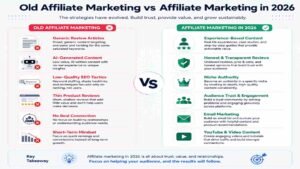
Generic review content no longer ranks. A blog post that lists a product’s features, adds a few pros and cons pulled from the product page, and slaps an affiliate link at the bottom ranks reasonably well in Google. In 2026, after multiple helpful content updates, Google actively deprioritises this type of content. The bar for ranking a review article now requires genuine first-hand experience, specific observations, and honest assessments, not a rewritten version of the product’s marketing copy.
AI-generated affiliate content is a liability, not an advantage. The wave of AI-generated product review sites that flooded the internet between 2022 and 2024 was largely wiped out by Google’s algorithm updates. Sites that mass-produced thin AI content to cover every product in a category found their traffic reduced dramatically. The lesson: volume of coverage matters less than depth and authenticity of coverage.
Amazon Associates commission rates are lower than they used to be. In 2020, Amazon cut commissions in many categories, significantly reducing furniture from 8% to 3%, and several other categories saw similar reductions. This hasn’t reversed. Affiliates who relied heavily on Amazon for all their income had to diversify. This is still relevant in 2026.
Social media affiliate promotion faces more scrutiny. Platforms have tightened their rules around undisclosed affiliate promotion. FTC regulations and equivalent laws in many countries now require clear disclosure on every post containing affiliate links, and platforms can penalise undisclosed affiliate content.
So is this all bad news? Not really. Here’s why.
What Makes Affiliate Marketing More Viable Now Than Ever in Some Ways
The same factors that killed low-quality affiliate content have made high-quality affiliate content more valuable than before.
When Google deprioritises thin review content, genuine, experience-based reviews rise. If you’ve actually used a product and write about it honestly, including the parts you didn’t like, you’re providing something neither AI nor lazy affiliates can replicate. That authenticity is genuinely competitive in 2026 in a way it wasn’t in 2019, when even generic content could rank.
The range of affiliate programmes has also expanded dramatically. Beyond Amazon and a handful of large networks, there are now affiliate programmes for almost every SaaS tool, digital course, niche subscription service, and professional platform imaginable. Many of these pay significantly better than Amazon, with longer cookie windows and recurring commissions. A beginner in 2026 has access to better-paying programme options than affiliates did five years ago.
Niche communities, email newsletters, YouTube channels, niche forums, and private Facebook groups have proven to be more durable affiliate income sources than SEO-dependent blogs alone. An email list of 2,000 genuinely interested subscribers can consistently outperform a blog with 20,000 monthly visitors, because the subscriber relationship is more direct and trust is higher.
Step-by-Step: How Affiliate Marketing Actually Works in 2026
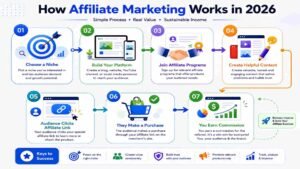
Step 1 — Pick a Niche That Has Buyers, Not Just Readers
Not every niche monetises well with affiliate marketing. The key variable is purchase intent. How often do people reading content in this niche actually buy products as a result?
Finance, software and tech tools, online education, health and fitness equipment, home improvement, and professional development consistently have high purchase intent. People reading “best accounting software for freelancers” are actively trying to make a decision. People reading general lifestyle inspiration are often not.
Pick a niche that overlaps between something you genuinely know about and something where people regularly buy products or services related to that knowledge.
Step 2 — Build a Platform Where Your Recommendations Are Seen
In 2026, you have more options for this than ever:
A blog with SEO remains the highest-ceiling platform for affiliate marketing. Articles rank in Google, attract readers with specific purchase intent, and earn commissions from organic traffic that compounds over time. The upfront effort is higher, and it takes longer to see results, typically 6–12 months before significant organic traffic builds, but the long-term return is the most durable.
A YouTube channel is the second strongest platform. Product review and comparison videos convert extremely well because videos demonstrate a product in a way that text cannot. YouTube’s own search engine also gives videos long ranking lifespans, similar to Google SEO for blogs.
An email newsletter is the most direct and highest-converting affiliate channel for an established audience. Email subscribers have already chosen to hear from you, which means their trust level is higher than that of a random search visitor. Many experienced affiliate marketers now consider their email list their most valuable asset.
Social media (Instagram, TikTok, Pinterest, Facebook) works for affiliate promotion but is more dependent on volume, consistent posting, and link-in-bio workarounds on platforms that don’t allow links in posts. Shorter cookie windows also mean conversions are more time-sensitive when traffic comes from social.
Step 3 — Join Programmes That Make Sense for Your Niche
Start with two or three programmes rather than ten. For most beginners:
Amazon Associates for physical products in any niche. One niche-specific programme, a software tool, a course platform, or a hosting provider that your readers would genuinely consider purchasing.
As your content grows, add programmes whose products naturally fit what you’re already writing about. The worst affiliate strategy is reverse-engineering your content around high-commission products you don’t naturally cover. It reads as promotional and doesn’t convert well.
Step 4 — Create Content That Serves the Reader First, the Commission Second
This is the step that separates affiliates whose income grows from those who plateau.
The content that converts best in 2026 is content that genuinely helps people make good decisions, including decisions not to buy something if it isn’t right for them. A review that says “this product is great for X type of user, but I’d avoid it if you need Y” builds more trust and ultimately more conversions than a review that says everything is perfect.
Readers have become remarkably good at sensing when a recommendation is genuinely helpful versus when it’s just a vehicle for an affiliate commission. Authentic specificity, the detail that only comes from actually using something, is what separates the two.
Step 5 — Track, Learn, and Double Down on What Works
Most affiliate platforms give you detailed data: clicks per link, conversion rates, and revenue per product. Use this.
After 90 days of content, patterns emerge. Some products convert better than others. Some types of articles generate more clicks. Some programmes pay commissions that make the effort worthwhile; others don’t.
Spend more time creating content similar to what’s already converting. Retire or rework content that isn’t. This iterative process is how affiliate income actually grows, not by constant addition of new content, but by optimising existing content and expanding what demonstrably works.
Real Examples of Affiliate Marketing Working in 2026
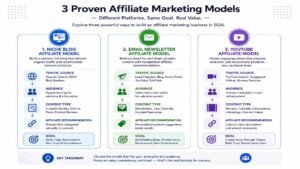
The honest software reviewer: A freelance designer runs a blog covering design tools, Canva, Adobe Express, Figma, and Notion for project management. She’s tried all of them personally and writes comparative, honest assessments. Her Canva Pro review ranks on page one for several related searches. She earns Canva affiliate commissions passively every month from a single article she wrote eight months ago and has updated once since.
The niche newsletter: A developer writes a weekly newsletter about productivity tools for remote software teams, including tool recommendations, workflow tips, and occasional tutorials. After 18 months, his list has 3,800 subscribers. He earns affiliate commissions by recommending the tools he genuinely uses, disclosing every affiliate relationship clearly. His conversion rate per recommendation is significantly higher than any of his blog articles because the relationship with subscribers is more personal.
The YouTube reviewer: A tech creator in Pakistan makes honest unboxing and review videos of affordable tech earphones, keyboards, and budget laptops. He links to products on Amazon Pakistan and internationally in video descriptions. His videos rank in YouTube search for specific product names. Affiliate commissions from YouTube description links have grown from zero to a consistent monthly income over two years of consistent posting.
None of these people went viral. None of them used a secret strategy. They found a niche they understood, built a genuine audience, and recommended things honestly with proper disclosure.
Common Mistakes That Make Affiliate Marketing Not Worth It
Picking programmes for commission rate alone. A product that pays 50% commission but that your audience would never buy generates no income. A product that pays 5% but is exactly what your readers are looking for will consistently earn. Relevance beats rate.
Not disclosing affiliate relationships. This is both a legal requirement in most countries and an ethical one. Undisclosed affiliate links, when discovered by readers, destroy trust permanently. Disclosed affiliate links, handled honestly, rarely affect reader behaviour negatively. Most people understand and accept that creators earn from recommendations.
Writing about too many unrelated products. An affiliate site that covers fifty different unrelated product categories confuses both readers and Google. Narrow focus builds authority. Authority builds trust. Trust converts to commissions.
Giving up during the traffic-building phase. The first four to six months of a new affiliate blog or channel typically generate almost no income, not because the model doesn’t work, but because the audience hasn’t built yet. Most people who conclude “affiliate marketing doesn’t work” quit during this phase, just before results would have started appearing.
Treating every piece of content as a sales pitch. If every article you write exists to push an affiliate product, readers stop trusting your content. The ratio that tends to work is roughly two or three genuinely useful informational pieces for every one conversion-focused piece. The informational articles build trust; the conversion articles benefit from it.
What Actually Works in 2026: The Honest Summary
Experience-based content wins. Generic content loses. This has been true for several years and is more true now than ever.
Longer cookie windows matter more than higher commission rates for most beginners. A 30-day cookie with a 10% commission outperforms a 24-hour cookie with a 15% commission for most content types, because the buying decision rarely happens the moment someone reads a review.
Email lists and YouTube channels are more algorithm-resistant than SEO blogs alone. Diversifying across two platforms protects you from the impact of a single Google update.
Honest, specific, negative information in reviews about things you genuinely didn’t like about a product dramatically increases reader trust and conversion rate. It sounds counterintuitive, but readers trust balanced assessments far more than universal praise.
Recurring commissions where you earn every month as long as a referred customer keeps their subscription, compound in a way that one-time commissions don’t. Prioritising programmes with recurring structures (SaaS tools, membership platforms, hosting) builds more predictable income over time.
Pros and Cons of Affiliate Marketing in 2026
Pros:
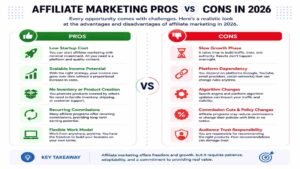
No product to create or manage. No customer service. No inventory. You contribute the recommendation and the audience; everything else is handled by the company you’re promoting.
Income can genuinely compound over time. An article written this month can earn commissions for years with minimal updates. This is the compounding effect that makes affiliate marketing worth the long build-up phase.
Low barrier to entry. Joining most affiliate programmes is free. Building a blog, YouTube channel, or email list requires time but minimal upfront cost.
You can operate in any niche you genuinely understand. The variety of affiliate programmes available in 2026 means there’s a viable monetisation path in almost any topic area.
Cons:
The build-up phase is slow and unglamorous. Realistic first-year income for most new affiliates is modest and zero for the first several months. This requires patience that most people don’t have.
You depend on third parties. If a programme closes, cuts commissions, or changes its terms, as Amazon did in 2020, your income from that programme is affected. Diversification across multiple programmes mitigates this, but doesn’t eliminate it.
Platform algorithm changes can significantly affect traffic-dependent income. A Google update can reduce organic traffic to a blog overnight. This is a genuine risk that experienced affiliates manage by building diverse traffic sources.
You are responsible for the quality of what you recommend. Your audience’s trust is your most valuable asset. Recommending a product that turns out to be poor damages that trust in a way that’s hard to recover from.
FAQs
Is affiliate marketing saturated in 2026? Certain niches and tactics are genuinely oversaturated by generic Amazon review blogs in highly competitive categories, for instance. Niche-specific, experience-based content in focused topic areas still has significant room for new entrants who do it properly.
How much can a beginner realistically earn from affiliate marketing? In the first year, most dedicated beginners earn somewhere between very little and a few hundred dollars per month by the end of the year. After two to three years of consistent effort, income in the range of $500–$2,000 monthly is achievable for many affiliates operating in reasonable niches. Higher is possible but not typical. Anyone promising specific income figures is either an outlier presenting their exception as the rule, or is being misleading.
Do I need a blog to do affiliate marketing? No. YouTube, email newsletters, Pinterest, and social media all work as affiliate platforms. A blog with SEO remains the highest long-term ceiling for most affiliates, but it’s not the only path.
Is affiliate marketing passive income? Partially. Content creates passive income potential. An article or video you made six months ago can continue earning. But building and maintaining the content library, staying current in your niche, and updating older content require ongoing (though reduced) effort. It’s more accurate to call it “leveraged income” than purely passive.
Which is better, a blog or YouTube, for affiliate marketing? Both work. YouTube has lower written competition, and video content demonstrates products more effectively. A blog has lower equipment requirements, and written content is easier to produce at scale. Many successful affiliates use both and link them together.
The Verdict
Affiliate marketing in 2026 is not what it was in 2015. The easy shortcuts are gone. The race-to-the-bottom content farms have largely been penalised out of the rankings. The thin, generic, AI-written review sites that flooded the internet two years ago are being systematically deprioritised.
What remains is a genuinely viable model for people willing to build something real,l a genuine audience, honest content, and recommendations that come from experience rather than maximum commission chasing.
Is it worth it? For someone patient enough to build properly, in a niche they genuinely understand, with content that serves readers before it serves commissions, ns yes. Clearly yes.
For someone looking for quick returns without an existing audience or a willingness to invest months in building one, probably not, at least not yet. The foundation has to come first.
The people asking “Is affiliate marketing dead?” are almost always people who tried a specific shortcut, watched it stop working, and stopped. The people quietly earning from it aren’t asking that question. They’re busy updating their content.
Disclaimer: This article is for educational and informational purposes only. Affiliate marketing results vary significantly based on niche, effort, consistency, and market conditions. Nothing here constitutes a guarantee of income or financial advice.