

Common Passive Income Mistakes Beginners Make


Two years ago, I tried to build passive income the way most beginners do by doing five things at once and finishing none of them.
I had a half-built blog, a Fiverr gig I’d posted twice, a YouTube channel with three videos, and a digital product I’d been “almost ready to launch” for four months. My monthly passive income at the end of year one? Around $23. Most of it came from a single affiliate link I’d placed almost accidentally in a blog post I’d forgotten about.
The frustrating thing wasn’t that passive income didn’t work. It was that it was working, just not for me, because of decisions I was making that I didn’t yet recognise as mistakes.
If you’re in the research phase, or you’ve started and stalled, this article is the honest post-mortem I wish I’d read before wasting a year. These aren’t theoretical warnings; they’re the patterns I’ve seen derail beginners consistently, including myself.
Why Passive Income Mistakes Are So Common (And Costly)
Passive income has an image problem. The version sold online- automated systems, income while sleeping, and total freedom tends to create expectations that collapse the moment reality shows up.
The actual model is straightforward and genuinely works: you invest time or money upfront to create something that generates returns over time without continuous effort. A blog, a digital product, a YouTube channel, an investment portfolio. All of these work exactly as described.
But the gap between “this model works” and “this model is working for me” is where most beginners get stuck. Not because the idea is flawed but because the specific decisions made in the early stages determine almost everything that follows.
Here are the mistakes that close that gap most consistently, if you recognise and correct them early enough.
Mistake 1: Treating “Passive” as “Effortless”
This is the foundational mistake that all the others flow from.
Passive income refers to money that arrives in a recurring way, without you trading hours directly for it. It does not describe the process of building the thing that generates it.
A blog that earns passive income through AdSense and affiliate links requires real, sustained effort to produce the content library that ranks in Google. A digital product that sells overnight required hours of research, creation, and promotion. Dividend income from an investment portfolio required years of consistent saving and strategic buying.
When beginners expect the building process to feel passive, easy, low-effort, and quick, they experience the actual work as a betrayal. “This isn’t what I was told it would be.” And they quit, usually right before the effort would have started paying off.
What to do instead: Mentally separate the building phase (active, effortful, time-consuming) from the earning phase (genuinely lower-effort, recurring). Budget real-time hours per week, every week, for the building phase before you expect any significant earnings.
Mistake 2: Starting Too Many Things Simultaneously
This one ended my first year. I genuinely believed that more streams meant more income, faster. What it actually meant was more half-built things generating nothing.
Passive income streams require a minimum viable foundation before they produce anything. A blog needs enough content to rank. A YouTube channel needs enough videos to be recommended. A digital product needs enough promotion to be discovered. An investment portfolio needs enough capital to generate meaningful returns.
When you split limited time across five projects simultaneously, none of them reaches that foundation quickly enough, so all five are permanently stuck in the pre-earning phase while you interpret this as the model not working.
What to do instead: Pick one stream and give it focused effort until it either earns consistently or you’ve genuinely confirmed it’s the wrong fit. Then add a second. Sequential building almost always outperforms parallel building for people with limited spare time,e which is most people.
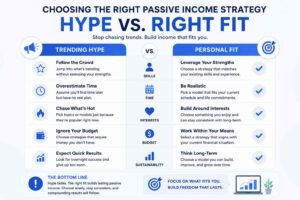
Mistake 3: Choosing a Method Based on Hype, Not Fit
Passive income trends cycle. Print-on-demand. NFTs. Dropshipping. AI-generated content sites. Faceless YouTube channels. Each wave brings a burst of “I made $X in my first month” content, which attracts thousands of beginners to that specific model.
The problem isn’t that these methods are fake. Some genuinely work for some people. The problem is that “this worked for someone else” is not the relevant question. The relevant question is “Does this fit my skills, my time, my interests, and my risk tolerance?”
A method that requires daily video creation from someone who dreads being on camera is a poor fit. A method that requires writing skills from someone who has no genuine interest in writing is a poor fit. A method that requires upfront capital from someone with no savings is a poor fit.
Poor-fit methods can be forced, but they’re rarely sustained long enough to produce results. And passive income, almost universally, requires sustained effort over months before it generates significant income.
What to do instead: Before choosing a method, write down honestly: what skills you already have, how many genuine hours per week you can commit without burning out, and what topics you’d be willing to produce content about for twelve months. Then match the method to those answers, not to whatever is trending.
Mistake:4 Quitting During the Slow Build Phase
This is the mistake that makes the previous ones irreversible.
Almost every passive income stream has an early phase that looks identical to failure. A blog with no traffic. A YouTube channel with 43 subscribers after three months. A digital product that sold two copies in its first week. These numbers, at the three-month mark, feel like proof that the idea doesn’t work.
They’re rarely proof that the idea doesn’t work. They’re evidence of being at month three of a twelve-month build.
I once tracked a blog article through its Google rankings for the first six months after publication. At month two, it appeared on page seven of search results and received virtually zero clicks. At month five, it appeared on page one for two related keywords. At month seven, it was generating consistent monthly commissions. Nothing changed about the article. The algorithm simply needed time to validate it.
The people who quit at month two never saw month seven.
What to do instead: Set a minimum commitment period before evaluating whether to continue, six months for content-based strategies, twelve months for investment-based ones. During this period, adjust your tactics based on data, but don’t abandon the strategy because the timeline feels slow.
Mistake:5 Ignoring the Traffic Problem
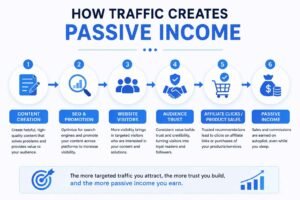
A beautiful blog with zero visitors earns nothing. A digital product on Gumroad with no promotion earns nothing. A YouTube channel nobody watches earns nothing.
Traffic, the people who actually find your content or product,uct is the mechanism that converts a passive income asset into actual income. It doesn’t appear automatically just because you published something.
Many beginners spend enormous energy creating content and almost no energy on the promotion and discoverability that would bring people to it. This is particularly common with blog writers who assume good content automatically rises to the top of Google. It doesn’t, especially on new domains, without active SEO work and some form of external promotion in the early months.
What to do instead: Spend at least as much time on traffic as on creation. For a blog, this means keyword research before writing, not after, using free tools like Google’s own search suggestions, AnswerThePublic, or Ubersuggest to confirm that people are actually searching for what you’re writing about. For a digital product, it means choosing a platform with built-in discovery (Etsy, Gumroad’s marketplace) and actively sharing in relevant communities where the product would be genuinely useful.
Mistake 6: Spending Money on Courses Before Validating the Idea
This one is particularly visible in the passive income space, where there’s a whole industry built around selling people courses about how to build passive income.
I’m not against paid courses. Some are genuinely valuable, especially once you know exactly where you’re stuck. But buying a $200 course on print-on-demand before you’ve uploaded a single design, or a $300 course on blogging before you’ve written ten articles, front-loads cost into a process that hasn’t yet proven it works for you specifically.
The beginner’s knowledge gap is real, but it’s almost entirely fillable with free resources for the first six months. YouTube tutorials, platform documentation, active online communities, and free tools like Google’s own guidelines cover the foundation of every major passive income model.
What to do instead: Start with free resources. Build your first version of whatever you’re attempting using what’s freely available. Invest in paid education once you’ve hit a specific, real obstacle that free resources aren’t resolving; then the course has a concrete problem to solve, rather than being a substitute for starting.
Mistake 7: Not Tracking What’s Actually Working
Passive income, somewhat ironically, requires active measurement to optimise.
Most beginners who’ve been blogging for six months couldn’t tell you which of their articles gets the most traffic, which affiliate links are actually being clicked, or what their email list’s open rate is. Without this data, every decision is a guess.
Google Search Console (free) shows you exactly which searches bring people to your site, which articles rank, and which are invisible. Affiliate dashboards show you click rates, conversion rates, and which products are actually earning. YouTube Studio shows average view duration per video, which tells you whether people are watching to the end or leaving in the first thirty seconds.
This data is available for free. Most beginners never look at it.
What to do instead: Set a monthly date with your analytics. Thirty minutes per month reviewing what’s performing and what isn’t is enough to make genuinely informed decisions about what to create more of, what to update, and what to stop investing time in.
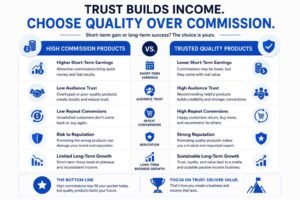
Mistake:8 Choosing Low-Quality Affiliate Products for High Commissions
This mistake is specific to affiliate marketing, but common enough to deserve its own section.
ClickBank and certain other networks offer commissions of 50–75% on digital products. These rates are genuinely attractive and genuinely functional for legitimate products. But some of the highest-commission products in these marketplaces use aggressive, exaggerated claims to sell and promote them, even once, damaging your audience’s trust in a way that’s disproportionate to any commission you earn.
A reader who buys a product on your recommendation and feels misled doesn’t just buy from you again. They actively distrust everything you subsequently recommend. The commission from one misleading recommendation can cost you a dozen future conversions from a now-sceptical audience.
What to do instead: Evaluate every product you promote as if a close friend is about to buy it on your recommendation. Would you stand behind what they’d receive? If not, regardless of the commission rate,e skip it. Long-term audience trust is worth more than any single commission.
Real Examples of These Mistakes Playing Out
The scattered beginner: Someone spends six months working on a blog, a faceless YouTube channel, a Reels account, and two affiliate programmes simultaneously. After six months, the blog has eight articles, the YouTube channel has four videos, the Reels account has thirty posts, and neither affiliate programme has generated a click. He concludes that passive income doesn’t work. In reality, he built five things to 10% completion and gave the algorithm nothing to work with.
The course buyer: Someone spends Rs. 25,000 on an online course about building a digital product business. The course is thorough and well-made. But without a specific audience in mind, a clear product concept, or any existing platform to promote from, she finishes the course with more knowledge and no clearer path forward than before. Six months later, she hasn’t launched anything.
The analytics ignorer: A blogger writes eighteen articles over a year, earning modest but real affiliate commissions. On reviewing their Google Search Console data for the first time, they discover that four articles are generating 80% of their traffic, ic all in one specific sub-niche they hadn’t consciously focused on. Had they noticed this at month six, they could have doubled down on that sub-niche and accelerated their results significantly.
Helpful Tips for Avoiding These Mistakes
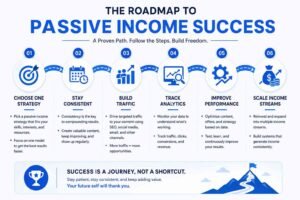
Write down your one passive income focus for the next six months and review it monthly. The act of committing to a written direction makes it significantly harder to drift into another shiny object when results are slow.
Create a weekly minimum, not a daily one. Daily commitments are fragile; miss one day and the psychological pressure of a broken streak can derail a week. A weekly commitment (four articles this week, or two hours of work on the digital product) is more resilient to life’s interruptions.
Find one community of people doing the same thing. A Facebook group, a subreddit, a Discord server. Seeing other people at the same stage struggling, persisting, occasionally celebrating small wins, normalises the slow build phase in a way no article can.
Measure progress in outputs, not income, for the first six months. Articles published. Products listed. Videos uploaded. These are things you control. Income is a lagging indicator; it follows output and time, not the other way around.
FAQs
How long should I give a passive income idea before deciding it isn’t working? Minimum six months of consistent effort, with active adjustments based on data. If you’ve been consistent and are still seeing zero traction after six months, evaluate whether the traffic problem or the product problem is the issue, and then fix the specific thing, not abandon the model.
Is it normal to feel like passive income is taking forever? Yes. The slow early phase is nearly universal. The people who appear to have built it quickly are almost always showing you a stage of their journey without the years of foundation underneath it.
Which passive income mistake is most common? Starting too many things at once. It produces the most common outcome: six unfinished, non-earning projects after a year and is the most preventable with a simple decision to focus.
Do I need to spend money to build passive income? For most content-based models, blogging, YouTube, and digital products. Time is the primary input, not money. Investment-based models require capital. Start with the model that matches your actual current resources.
What Recognising These Mistakes Actually Changes
None of these is obscure or particularly complex. Most people reading this article will recognise at least two or three of them in their own approach, past or present.
Recognition is what makes the difference. The beginners who eventually build real passive income aren’t usually smarter or more talented than the ones who don’t. They’re the ones who diagnosed what wasn’t working specifically enough to fix it, and stayed in the game long enough for the fixing to matter.
The slow, frustrating, data-informed, one-thing-at-a-time approach is the one that works. It just doesn’t make for exciting social media content, which is exactly why you rarely see it celebrated, and exactly why it surprises people when it’s the thing that finally gets them somewhere.
Disclaimer: This article is for educational and informational purposes only. Passive income results vary significantly based on effort, consistency, niche, and individual circumstances. Nothing here constitutes a guarantee of financial results or professional financial advice.