
How to Make Money on Facebook in 2026

My aunt runs a small stitching business from her house in Rawalpindi. No website, no Shopify store, no formal marketing budget. Just a Facebook Page she started three years ago, and a WhatsApp number pinned to the top of it. Last Eid, she got forty-seven orders in two weeks. All from Facebook.
I remember thinking she’s not doing anything that looks like “digital marketing.” She posts pictures of her work, responds to comments, shares prices in DMs, and occasionally boosts a post for Rs. 500. And yet she’s genuinely making money on Facebook in a way that most people who call themselves digital marketers aren’t.
That story stuck with me because it stripped away the complexity. Making money on Facebook isn’t about cracking an algorithm or going viral. It’s about finding the overlap between what you can offer and what the people already on Facebook are looking for, then showing up consistently in that space.
This guide covers the realistic, practical ways to make money on Facebook in 2026, what each method actually requires, and which ones are worth your time as a beginner.
What “Making Money on Facebook” Actually Means in 2026
Facebook has evolved significantly from a platform where you just posted status updates and hoped something would happen. In 2026, it has a mature ecosystem of monetisation tools, some built directly into the platform, others that use Facebook as a traffic or discovery channel.
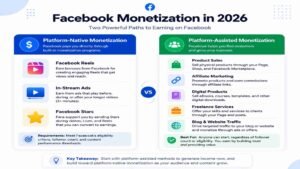
There are two broad categories to understand:
Platform-native monetisation: Facebook pays you directly. This includes Facebook Reels bonuses, in-stream ads on videos, and Facebook Stars. These require you to meet Facebook’s eligibility thresholds, a certain number of followers, video watch time, and country eligibility. Pakistan, India, and many other countries now qualify for several of these programmes.
Platform-assisted monetisation: Facebook helps you find customers, but the actual money comes from outside the platform. This includes selling products through a Facebook Shop, promoting your freelance services, driving traffic to an affiliate blog, or selling digital products through a link in your posts. This category is accessible to almost anyone, regardless of follower count, because you’re not waiting for Facebook’s approval to start earning.
Most beginners should focus on platform-assisted methods first and build toward platform-native as their following grows.
How Each Money-Making Method Works — The Real Mechanics
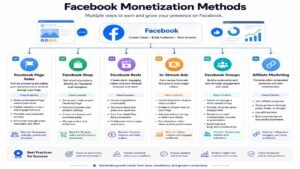
Before the step-by-step section, it helps to understand the core mechanics behind each approach so you can choose the one that fits your situation.
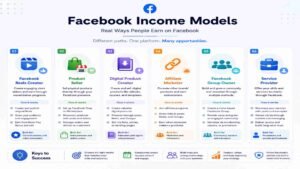
Facebook Page + Product/Service Sales: You create a Page for your business or service. People find it through search, shares, or Facebook’s recommendations. They message you to enquire; you close the sale via DM or send them to a payment link. No follower threshold. Works immediately.
Facebook Shop: An extension of a Page that allows you to list products with photos, descriptions, and prices. Buyers can browse and purchase directly within Facebook in some regions, or be directed to your external checkout. Best for physical products or digital downloads linked to an external platform.
Facebook Reels (Creator monetisation): Short videos uploaded as Reels can earn from Facebook’s Reels Play bonus programme or overlay ads. Requires meeting follower thresholds and eligibility criteria set by Meta. Works best with consistent, original video content.
In-Stream Ads on Facebook Videos: Longer videos (at least 3 minutes) can be monetised with ads that play before or during the video, similar to YouTube. Requires 10,000 followers and 600,000 total minutes viewed in the last 60 days. A longer-term goal for most beginners.
Facebook Groups as a Business Tool: A well-run niche group builds an engaged community you can later monetise through course sales, digital products, paid memberships, or directing members to your blog or YouTube channel.
Affiliate Marketing via Facebook: You share affiliate links in posts, Reels descriptions, or group content (where permitted by group rules). When someone clicks and buys, you earn a commission. Requires disclosure and careful platform compliance.
Step-by-Step: How to Start Making Money on Facebook in 2026
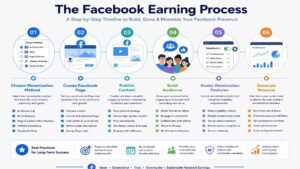
Step 1 — Decide Which Method Fits Your Current Situation
Don’t try all six methods at once. Ask yourself three questions:
Do you have a product or service already? Start with a Facebook Page and Shop. Do you have knowledge or expertise to share? Start with a Page or a Group focused on that topic, building toward digital product sales or affiliate marketing. Are you comfortable making short videos? Start with Reels and build toward in-stream ad eligibility over time.
Your answer to these questions narrows the path considerably. The biggest mistake I see is people who try to do everything: a Page, a Group, Reels, a Shop, and affiliate links all in the first week. They spread themselves too thin and end up with nothing working well.
Step 2 — Set Up a Facebook Business Page (Not a Personal Profile)
If you’re using Facebook for income, do it through a Page, not your personal profile. There are several reasons this matters practically:
Pages have access to Facebook Insights analytics showing who is engaging with your content, which posts perform best, and when your audience is most active. Personal profiles don’t have this.
Pages can run Facebook Ads if you want to boost posts or run targeted campaigns later. Personal profiles cannot.
Pages can access Facebook Creator Studio and Facebook’s monetisation tools. Personal profiles cannot.
Setting up a Page takes fifteen minutes. Name it clearly, either your real name (if building a personal brand) or your business name. Fill in the “About” section completely. Add a profile picture and cover photo that make the Page look intentional, not placeholder.
Step 3 — Define Your Page Topic Clearly Before Posting Anything
This is the step most people skip, and it costs them months of wasted effort.
Facebook’s algorithm pushes your content to people whose interests match what you post about. If your Page posts about cooking one week, business tips the next, and travel the week after, the algorithm can’t categorise you, so it stops pushing your content to anyone in particular.
Pick one focus. “Online earning tips for beginners in Pakistan.” “Handmade clothing and stitching services.” “Canva tutorials for social media managers.” The tighter your focus, the faster Facebook’s recommendation system can find your audience for you.
Step 4 — Create Content That Serves Your Monetisation Goal
The type of content you create should directly connect to how you plan to earn.
If selling a product or service: Post photos of your work, behind-the-scenes of your process, client results (with permission), and occasional posts that address common questions your customers have. Social proof photos of happy customers, before/after results, and genuine reviews are the most effective content in this category.
If building toward affiliate marketing or blog traffic: Post educational content that genuinely helps people tips, how-to posts, short Reels explaining something useful. Each post ends with a natural call to action: “I’ve written a full guide on this link in my bio” or “comment ‘guide’, and I’ll send it to you.” This drives traffic to where your monetisation actually happens.
If building toward in-stream ads or Reels bonuses: Focus on original video content on a consistent topic. The fastest-growing Facebook Reels accounts in the education and online earning niche post short, specific, actionable tips. “3 things I stopped doing that saved me Rs. 15,000 per month” performs better than “general money tips.”
Step 5 — Grow Your Audience Deliberately, Not Randomly
Follower count matters differently depending on your monetisation method.
For product and service sales, you don’t need a large following. My aunt’s stitching business gets all its orders from a Page with 800 followers because those 800 are genuinely interested, local, and trusting of her work. Quality over quantity.
For in-stream ads and platform monetisation, follower count and watch time genuinely matter. Growth strategies that work in 2026: posting Reels consistently (Facebook currently pushes Reels more aggressively than static posts), engaging in relevant Facebook Groups as a participant and mentioning your Page where appropriate and allowed, running a small boost (Rs. 500–1,000) on your best-performing posts to expand reach, and cross-promoting your Page on other platforms where you already have an audience.
Step 6 — Enable and Apply for Available Monetisation Features
Once you have 30+ pieces of quality content live and a Page that clearly communicates its topic, check your Facebook Creator Studio or Professional Dashboard for monetisation eligibility.
Go to Professional Dashboard → Monetisation. Facebook will show you which features you currently qualify for and what thresholds you still need to reach. This dashboard is updated regularly; checking it every few weeks helps you track your progress toward in-stream ad eligibility or Reels bonuses.
If you’re using affiliate links on Facebook, ensure you disclose them in every post, “This post contains affiliate links”, and comply with both Facebook’s policies and FTC guidelines.
Real-World Examples: What Different People Are Actually Earning
The small business owner: A clothing boutique in Lahore runs a Facebook Page with 3,200 followers. They post daily new arrivals, styling tips, and customer photos. They run Rs. 1,000 Facebook ad boosts twice a month, targeting women aged 22–40 in major Pakistani cities. Monthly revenue from Facebook-sourced orders: Rs. 80,000–120,000. Zero website, zero Shopify. Facebook Page and WhatsApp only.
The content creator: A Pakistani creator posts personal finance Reels in Urdu, budgeting tips, how to save on everyday purchases, and honest reviews of financial apps. After eight months of consistent posting, they reached 12,000 followers and qualified for Facebook’s in-stream ad programme. Monthly income from Facebook ads: approximately $80–$150. They supplement this with affiliate links to financial tools they recommend.
The digital product seller: A graphic designer creates Canva templates for Pakistani small businesses’ menus, flyers, and social media kits. They post tutorials on their Facebook Page showing how the templates work, then direct interested viewers to their Gumroad link in the post. Monthly template sales driven primarily through Facebook: Rs. 25,000–40,000.
None of these people started with large followings or big budgets. What they share is consistency, a clear niche, and a realistic understanding of what Facebook can and cannot do.
Common Mistakes Beginners Make on Facebook
Posting inconsistently. Facebook’s algorithm deprioritises Pages that go quiet. Three quality posts per week, every week, outperform seven posts one week and silence the next two.
Treating the Page like a personal profile. Sharing unrelated life updates, political opinions, or random reposts muddies the focus of your Page and confuses both the algorithm and your audience.
Buying followers. Fake followers actively hurt your Page. Facebook’s algorithm calculates your engagement rate based on how many of your followers interact with your posts. 10,000 fake followers who never engage tell the algorithm your content is low quality, so it stops showing it to real people, too.
Not responding to comments and messages. Facebook tracks response rate and response time on Pages. A Page that replies quickly signals an active business, which Facebook promotes more actively in its recommendations. I’ve watched Pages with half the followers outperform bigger Pages simply because they respond to every single comment.
Expect immediate results from organic posting alone. Growing a Facebook Page organically in 2026 is slower than it was five years ago. That’s the reality. Supplementing with even small, well-targeted boosts on your best-performing content accelerates this significantly, and Rs. 500 targeted well can reach several thousand genuinely relevant people.
Using affiliate links without disclosure. This violates both Facebook’s terms and advertising law in most countries. Always disclose. Always.
What Actually Works in 2026
Short-form video (Reels) gets significantly more organic reach than static image posts or link posts. If you’re not comfortable on camera, text-based Reels with on-screen captions and background music perform nearly as well as face-cam videos in most educational niches.
Facebook Groups still drive remarkable engagement compared to Pages. People in a Group feel like a community, not an audience. Running a Group alongside your Page, focused on your niche topic, builds the kind of trust that converts to customers and clients faster than broadcasting from a Page alone.
The comment-reply method, posting a question or tip and asking people to comment on a specific word (“comment GUIDE and I’ll send you the full article”), generates high engagement signals that the algorithm reads as proof your content is worth showing more people. Use it sparingly, but it genuinely works.
Collaborating with other creators in complementary niches through Facebook’s Collab feature (where both accounts publish the same Reel) can double your reach with a single piece of content.
Tips That Give You an Edge
Post at the right time for your specific audience. For Pakistani audiences, evening posts between 7–10 PM tend to outperform morning posts. Check your Page Insights to confirm what time your specific followers are most active.
Use your cover photo as a billboard. Your Page’s cover photo is the first thing visitors see. Put your service, your unique value, or a clear call-to-action directly in the cover image. “DM for stitching orders | Rawalpindi” on a cover photo does more work than a beautiful but uninformative photo.
Pin your most important post to the top of your Page. Visitors who find your Page first see the pinned post. Pin your best client testimonial, your most useful free resource, or your most clear service description. Update it as your best content changes.
Build an email list or WhatsApp broadcast alongside your Facebook presence. Facebook can change its algorithm or policies at any point. Email subscribers and WhatsApp contacts are yours; they don’t disappear if Facebook decides to change how it works. Use Facebook to grow your audience, then migrate the most engaged part of it to something you own.
FAQs
How many followers do I need to start earning on Facebook? For product and service sales, literally zero followers are required. You can make your first sale the day you set up your Page if you actively reach out and share it with relevant people. For platform-native monetisation (in-stream ads, Reels bonuses), the thresholds are typically higher: 10,000 followers and specific content metrics. Focus on value and sales first, and platform monetisation as you grow.
Can I make money on Facebook without showing my face? Yes. Text-based Reels, product posts, tutorial videos with screen recordings or hands-only shots, and informational posts with designed graphics all perform well without requiring you to appear on camera.
Is Facebook still worth using in 2026 for earning? Yes, particularly for local business sales, niche content creation, and community-based monetisation. Facebook has over 3 billion monthly active users and remains the dominant social platform in Pakistan, large parts of India, Southeast Asia, Africa, and the Middle East. “Facebook is dying” has been said for a decade. It hasn’t.
How long does it take to start earning from Facebook? For product and service businesses, days to weeks if you’re actively promoting and engaging. For platform monetisation (in-stream ads, Reels bonuses), typically 6–12 months of consistent content before reaching thresholds. Set realistic expectations based on which method you’re pursuing.
Can I do affiliate marketing on Facebook? Yes, with disclosures. Facebook allows affiliate links in posts and Reels descriptions as long as they are properly disclosed and the linked content complies with Facebook’s community standards. Some affiliate programmes also have specific Facebook policies. Check your programme’s terms.
The Realistic Picture
Facebook is not a get-rich-quick platform. What it is particularly for people with a product, a skill, or consistent content to share is a genuine business channel with a massive built-in audience and increasingly functional monetisation tools.
The people I’ve seen earn consistently on Facebook all share one trait: they treated it like a business from day one, not a slot machine they hoped would pay out.
Show up consistently. Be clear about what you offer. Serve your audience before asking them to buy anything. And give it more time than feels comfortable because the results from Facebook usually come about three months after you expected them.
Disclaimer: This article is for educational and informational purposes only. Earnings from Facebook monetisation features, product sales, and affiliate marketing vary significantly based on niche, audience, content quality, and individual effort. Platform policies and monetisation thresholds mentioned are subject to change; always verify current requirements directly on Facebook’s Creator Studio or Help Centre. Nothing in this article constitutes a guarantee of income.