

What Is Passive Income? and How Does It Work


A friend once told me she’d started “earning passive income,” and I remember feeling a small jolt of envy. Money coming in while she slept? While she was at her actual job? While she was, presumably, doing nothing?
I asked her how it worked. She said she’d written an eBook a year ago, put it on Gumroad, and it still sells a few copies every month without her doing anything.
Then she added something that stuck with me: “It took me about four months of evening work to write it, though. And I had to redesign the cover twice because the first one looked terrible.”
That second part is the half of the passive income story that almost nobody talks about. Everyone wants to discuss the “money while you sleep” part. Almost nobody wants to discuss the four months of evenings that came before it.
If you’ve been searching for a clear answer to “what is passive income and how does it work” and you’re tired of vague definitions and unrealistic promises, this article is going to give you the honest, complete picture.
What Passive Income Actually Means

Passive income is money you earn from something you built or set up once that continues generating income with little to no ongoing daily effort.
That’s the textbook definition, and it’s accurate. But it leaves out the most important word in that sentence: “little.” Not “zero.” Little.
Almost every passive income source requires some level of maintenance, updating, or occasional attention. A rental property needs repairs. A blog needs occasional updates so the information doesn’t go stale. An online course needs updating when the industry it teaches about changes. Even index fund dividends require you to have done the work of saving and investing money in the first place.
The defining feature of passive income isn’t the absence of work; it’s that the work happens up front or only occasionally, rather than continuously. You’re trading a concentrated period of effort now for a stream of income later that doesn’t require you to “show up” every single day to earn it.
Compare that to active income, which is what most people are familiar with. A job pays you for hours worked. Stop working, stop earning. A freelancer who isn’t taking on clients isn’t earning. Active income requires continuous input.
Passive income breaks that direct link between time and money, but only after you’ve put in the initial time.
How Passive Income Actually Works: The Mechanism Behind It
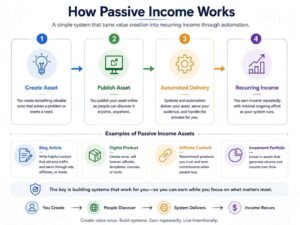
Here’s the part that clicked for me once I understood it properly: passive income works because you’re creating something that can be “sold” or “used” repeatedly without you needing to recreate it each time.
Think about the difference between a tutor and a textbook.
A tutor’s time is sold once per session. Teach for an hour, get paid for that hour. Stop teaching, stop earning. That’s active income, valuable, but tied directly to time.
A textbook is written once. Then it can be sold to a thousand different students without the author having to rewrite it for each one. The effort was front-loaded into writing the book. After that, each sale requires no additional time from the author.
That’s the core mechanism of nearly every passive income model: separate the creation of value from the delivery of value. Create something valuable once. Let a system, a platform, a marketplace, an automated process handle the repeated delivery of that value to different people.
The “systems” that handle delivery vary. For a digital product, it’s a platform like Gumroad processing downloads automatically. For a blog, it’s Google sending readers to your article and an ad network displaying ads automatically. For dividend-paying stocks, it’s the company’s profit-sharing system sending you a portion of profits based on shares you own. For rental property, it’s a tenant paying rent each month for continued use of something you already built or bought.
In every case, the heavy lifting of writing the book, building the blog’s content library, accumulating the investment capital, buying and preparing the property happened before the passive income began.
Step-by-Step: How Passive Income Actually Gets Built
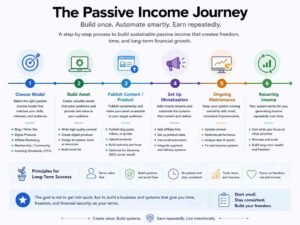
Step 1 — Understand That “Passive” Describes the Income, Not the Setup
This is the mental shift that changes everything. The word “passive” describes how the money arrives later, not how the project feels while you’re building it.
Building a passive income source often feels exactly like active work, because it is active work. The difference only becomes visible months later, when the thing you built keeps earning without requiring that same active effort again.
If you go into this expecting the building phase to feel passive, you’ll get discouraged and quit during the very phase that determines whether anything passive ever happens.
Step 2 — Choose a Model That Matches What You Already Have
Different passive income models require different starting resources: time, money, skills, or existing assets. Being honest about what you currently have determines which model makes sense to start with.
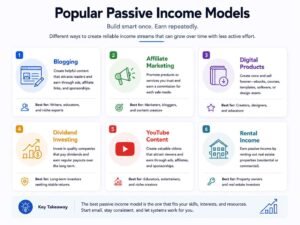
If you have time but little money: Content-based models work best. Blogging with ad revenue (Google AdSense) and affiliate marketing, YouTube videos with ad revenue, or digital products built from your existing knowledge.
If you have money but little time: Investment-based models: dividend-paying stocks, index funds, or REITs (Real Estate Investment Trusts, which let you invest in real estate without buying property directly). These require capital upfront but minimal ongoing time.
If you have a specific skill: Productising that skill, turning it into a course, template, or digital tool that others can buy and use without you being personally involved in each transaction.
If you have an existing asset (property, vehicle, equipment): Renting it out through platforms like Airbnb for property, or equipment rental marketplaces for tools and gear.
Most beginners have time and skill, and little spare money. That’s exactly why content-based models, blogs, YouTube, and digital products are the most commonly recommended starting points. They require the resource beginners have most of: time.
Step 3 — Build the “Asset” — This Is the Active Phase
Whatever model you choose, this phase involves real, sustained effort. A blog needs 15 to 30 quality articles before meaningful traffic begins. A YouTube channel needs dozens, often dozens, before the algorithm starts recommending your content widely. A digital product needs to actually be created, designed, and packaged.
This phase typically takes one to six months of consistent effort, depending on the model and your starting point. There is no way to skip this phase. Every passive income source you’ve ever heard of went through it.
Step 4 — Set Up the Delivery System
Once your asset exists, you need a system that delivers it to people without your continuous involvement.
For a blog: this means having Google AdSense (or another ad network) connected, so ads display automatically to every visitor. It means having affiliate links embedded in articles, so commissions process automatically through the affiliate platform.
For a digital product: this means having it listed on a platform like Gumroad, Payhip, or Etsy, where the purchase, payment processing, and file delivery all happen automatically.
For investments: this means having your brokerage account set up to automatically reinvest dividends or simply hold and collect them.
This step usually takes hours, not months, but it’s a step beginners often forget, leaving their “asset” without a way to actually generate income.
Step 5 — Maintain, But Don’t Rebuild
This is the ongoing phase, and it’s genuinely lighter than the building phase, but it’s not zero.
A blog needs occasional updates, refreshing outdated information, fixing broken links, and adding new articles periodically to keep growing. A digital product might need updates if the software or platform it relates to changes. Investments need occasional review and rebalancing a portfolio once or twice a year.
The maintenance phase is where the “passive” part becomes real. You’re spending hours per month, not hours per day. The income continues even during weeks you don’t touch the asset at all, which is the genuine payoff for the upfront work.
Real Examples of Passive Income in Practice
Example 1: The blog with affiliate links. Someone writes a detailed comparison article about budgeting apps. It takes six hours to research and write properly. Three months later, it started appearing on the first page of Google for “best budgeting apps for students.” Every month, that one article brings in 600 visitors, and roughly 1.5% click through to an affiliate link and sign up for a paid app. At a $5 commission per signup, that’s about $45 a month from one article, written once, six months ago.
Example 2: The Notion template. Someone creates a project management template in Notion designed specifically for freelance graphic designers, something they built for their own use first. They write a description, take a few screenshots, and list it on Gumroad for $12. They share it once in a Facebook group for freelance designers. It sold four copies in the first week. Three months later, it’s still selling one to two copies a week through organic Gumroad search and occasional shares by buyers.
Example 3: Dividend-paying index fund. Someone invests $2,000 in a dividend-focused index fund. The fund pays roughly 3% annually in dividends, split into quarterly payments. That’s about $60 a year, not life-changing, but it requires nothing literally after the initial investment. Over years, as more money is added and dividends are reinvested, the amount compounds.
None of these examples describe anyone becoming wealthy. They describe small, real, recurring amounts of money arriving because of work done in the past. That’s what passive income actually looks like for the vast majority of people who build it not as a single dramatic breakthrough, but a collection of small, compounding income streams.
Common Mistakes People Make When Trying to Build Passive Income
Expecting the building phase to feel passive. As covered above, it doesn’t. Expecting otherwise leads to quitting during the exact phase that matters most.
Choosing a model based on hype rather than fit. Everyone seems to be talking about one specific method at any given time: dropshipping, NFTs, crypto staking, whatever the trend is. The “best” passive income model is the one that matches your actual skills, time, and risk tolerance, not the one getting the most attention online.
Underestimating the maintenance phase. Some people build something, see it earn a little, and then completely abandon it, including not updating outdated information. A blog article recommending a tool that no longer exists, or an investment portfolio never rebalanced for five years, slowly stops performing. “Low maintenance” is “no maintenance.”
Spreading effort across too many ideas simultaneously. Trying to build a blog, a YouTube channel, a digital product, and an investment portfolio all in the same month means none of them get the focused effort needed to actually become passive. One asset, built properly, beats five assets built halfway.
Confusing passive income with no-risk income. Every passive income model carries some form of risk: time invested that might not pay off, money invested that could lose value, or a platform shutting down that your income depended on. Passive doesn’t mean risk-free. It means the ongoing effort is low, not that the outcome is guaranteed.
What Genuinely Works (and What Doesn’t) for Beginners
What works: Starting with one content-based model, a blog or YouTube channel focused on a specific topic you understand. Combining it with one monetisation method (AdSense, affiliate marketing, or a digital product) rather than trying all three immediately. Give it a minimum of six months before evaluating whether it’s “working.”
What doesn’t work: Buying a $300 course on “passive income secrets” before testing a free version of the idea yourself. Most foundational knowledge for blogging, YouTube, or digital products is available for free through official platform guides and reputable YouTube channels. Paid courses can help later, once you understand what you’re trying to do and where you’re stuck.
What works: Treating the first attempt as a learning project, not a financial bet. The skills you build writing, basic design, understanding how platforms work transfer to your second and third attempts, which tend to perform better because you’re no longer learning from zero.
What doesn’t work: Measuring success only in money during the first few months. Track non-financial signals too: are people reading your content, is your subscriber count growing, are people engaging with your digital product page? These signals predict future income better than the income itself in the early stages.
Helpful Tips for Getting Started
Pick something you can sustain for six months without burning out. Passive income building is a marathon. If the topic or format makes you dread working on it after three weeks, you won’t make it to the point where it becomes passive.
Document as you go. Whatever you’re building, keep notes on what works and what doesn’t. These notes become incredibly useful for your second project, and many people find their notes themselves become valuable content (a blog post about “how I built X” often performs well).
Set a specific, measurable first goal. Not “make passive income” but “publish 10 articles in this niche” or “create and list one digital product” or “invest a fixed amount monthly for six months.” Specific goals are achievable. Vague goals are not.
Reinvest small early wins. The first $20, $50, or $100 you earn can go back into the project with better tools, a small amount of paid promotion, or simply validating that the model works before scaling it.
FAQs
Is passive income really possible, or is it a myth? It’s real, but the definition matters. It’s not “money for nothing”; it’s “income that doesn’t require continuous active effort, after an initial investment of time or money.” Millions of people genuinely earn modest, recurring income this way. The myth is the idea that it’s quick or effortless.
How much money can passive income realistically generate? For most beginners in the first year, anywhere from $0 to a few hundred dollars per month, depending on the model and effort. Over several years, with multiple income streams and continued effort, it can become substantial, but this takes sustained, consistent work over a long period, not a single quick setup.
What’s the fastest passive income model to start? Digital products tend to have the shortest gap between creation and first sale, sometimes days. However, “fastest to start” doesn’t mean “fastest to earn meaningfully.” Audience-based models like blogging take longer to start earning but often scale higher over time.
Do I need money to start building passive income? Not necessarily. Content-based models (blogging, YouTube, digital products from existing skills) require time more than money. Investment-based models require capital. Choose based on which resource you currently have more of.
Is passive income taxable? Yes, in most countries passive income is taxable, including affiliate commissions, ad revenue, digital product sales, and investment dividends. This varies by jurisdiction, so it’s worth checking your local tax requirements once your passive income becomes consistent. This article isn’t tax advice; consult a qualified professional for your specific situation.
The Real Takeaway
Passive income is not a switch you flip. It’s closer to planting something and tending to it during the slow, unglamorous early stage long before there’s anything to harvest.
The people who eventually have it didn’t find a secret. They picked one thing, built it during the months when it wasn’t paying off yet, and kept it running afterward with far less effort than it took to create.
If you’re at the very beginning of that process right now, researching, reading, trying to understand how it actually works before committing your evenings to it, that’s not wasted time. That’s exactly where everyone who has it successfully started.
Disclaimer: This article is for educational and informational purposes only and does not constitute financial advice. Passive income results vary significantly based on the model chosen, effort invested, market conditions, and individual circumstances. Always consult a qualified financial professional for advice specific to your situation.