

How to Build Multiple Streams of Income in 2026

A few years ago, my entire financial life depended on one source: my job. When a project got cancelled and my hours got cut for two months, I genuinely panicked. Not because I was reckless with money, but because there was no second pillar holding anything up.
That stretch pushed me to actually build something on the side instead of just thinking about it. I started small,l a bit of freelance writing on weekends. Then a blog with a few affiliate links. Then, in a small Notion template, I sold for $9. None of these individually replaced my main income. But six months later, when another slow patch hit my main job, it didn’t feel like free-fall. There was something underneath me.
That’s the real value of multiple income streams. It’s rarely about getting rich faster. It’s about not having your entire financial life depend on one single thing continuing to go right.
This guide walks through how to actually build this realistically, step by step, without the inflated promises that usually surround this topic.
What Multiple Streams of Income Actually Means
Having multiple income streams means money comes into your life from more than one independent source, so if one slows down or stops, you’re not left with nothing.
The word “independent” matters here. Two freelance clients in the same industry, both vulnerable to the same economic downturn, aren’t truly independent streams; they’re correlated. A genuinely diversified income picture includes sources that don’t all rise and fall together.
People often imagine multiple income streams as a wealthy person’s strategy: rental properties, stock dividends, multiple businesses. And those are real examples at the higher end. But the concept scales down completely. A teacher with a salary, a small tutoring side business, and a blog earning modest affiliate income has three streams. The amounts don’t need to be large for the principle to work.
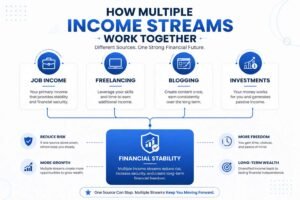
How Multiple Income Streams Actually Work Together
The mechanism isn’t complicated, but understanding it changes how you build toward it.
Each income stream has its own risk profile, things that could cause it to slow down or stop. A job depends on your employer’s stability and your role’s continued relevance. A freelance income depends on client relationships and market demand for your specific skill. A blog’s ad revenue depends on traffic and advertiser demand. Investment dividends depend on market performance.
When your income comes from sources with different risk profiles, a problem in one area doesn’t take down your entire financial picture. If your freelance clients go quiet during an economic slowdown, your blog’s ad revenue (driven by search traffic, not client relationships) continues to function independently. If your job hours get cut, your digital product sales continue regardless.
This is the same principle behind investment diversification, applied to income instead of assets. You’re not trying to maximise any single stream, you’re trying to build resilience across several.
Step-by-Step: How to Build Multiple Income Streams in 2026
Step 1 — Strengthen Your Primary Income First
This step gets skipped constantly, and it shouldn’t be. Before adding new streams, make sure your main income source, your job or primary business,s is as strong as it can reasonably be.
A side income built while neglecting your main income often results in both performing poorly. Get your primary income stable and reasonably optimised first. This gives you the financial runway and the time management discipline needed to build additional streams without panic-driven decisions.
Step 2 — Choose Your Second Stream Based on What You Already Have
The mistake most people make is picking a second income stream based on what looks exciting or what someone else succeeded with,th rather than what actually fits their current resources.
Ask yourself honestly: do I have more spare time, spare skill, spare money, or spare assets right now?
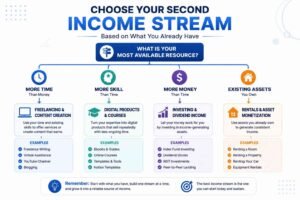
More time than money: Freelancing in a skill you already have, content creation (blog or YouTube), or a service-based side hustle.
More skill than time: Productising your expertise into a digital product, template, or mini-course that doesn’t require ongoing time once created.
More money than time: Index fund investing, dividend stocks, or peer-to-peer lending platforms where capital does more of the work than your hours.
An underused asset: Renting out a spare room, a vehicle, or equipment you own but don’t use constantly.
Building your second stream around your actual current resources, not someone else’s success story,y dramatically increases the odds it survives past the first difficult month.
Step 3 — Build One Stream at a Time, Not All at Once
This is the step that determines whether the whole project succeeds or collapses under its own weight.
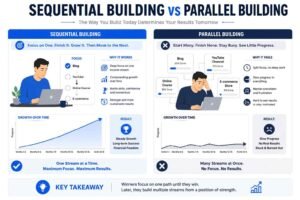
Trying to launch a freelance side hustle, a blog, a YouTube channel, and an investment portfolio simultaneously divides your already-limited spare time so thin that none of them gets the attention needed to actually take root.
Pick one. Give it focused effort for three to six months. Once it’s either generating consistent results or you’ve validated it’s not the right fit, move to the next one. Sequential building, not parallel building, is what actually works for people without abundant spare time,e which is most people trying to build this around a full-time commitment.
Step 4 — Separate Active Streams From Passive Streams
As you add income sources, deliberately track which ones require your continued active time (freelancing, a service business, content creation in its early stages) and which ones become more passive over time (investment income, an established digital product, a blog’s older articles still earning from search traffic).
A healthy multiple-income setup over several years usually shifts toward a higher proportion of passive or semi-passive streams, not because active income is bad, but because your time is finite and passive streams free up capacity to add even more sources without working more hours.
Step 5 — Reinvest Early Income From New Streams
When a second or third stream starts earning, the instinct is often to spend that money immediately,y understandable, especially if it’s the first real proof that the side effort is working.
A more strategic approach: reinvest a portion of early earnings from each new stream back into improving it or starting the next one. The first $200 from a digital product might fund better design tools or a small amount of promotion. The first commissions from affiliate marketing might fund a domain name and proper hosting, graduating a free blog into a more serious, scalable platform.
This compounding reinvestment is what turns a few small, fragile income trickles into a genuinely diversified financial picture over two to three years.
Real Examples of Multiple Income Streams Built Realistically
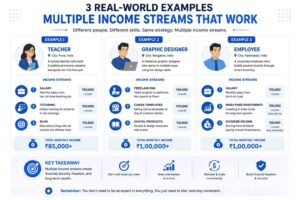
The teacher with three streams: A public school teacher earns her primary salary, tutors three students privately on weekends (Rs. 15,000/month), and runs a small blog reviewing educational apps and resources with Amazon and EdTech affiliate links (Rs. 8,000–12,000/month once established after a year). None of these streams alone would replace her job. Together, they add meaningful financial flexibility and a cushion if her teaching hours were ever reduced.
The freelancer who diversified into products: A freelance graphic designer earning client income recognised the risk of depending entirely on freelance work, as slow months happen unpredictably. She created a set of Canva templates for small business owners, sold through Etsy, generating a separate Rs. 20,000–35,000 monthly income that doesn’t depend on client availability. Her total income now comes from two genuinely independent sources.
The employee building toward investment income: A mid-level employee with a stable salary started investing a fixed Rs. 10,000 monthly into a diversified index fund three years ago. The dividend and growth income are still modest relative to his salary, but it’s compounding independently of his job performance or industry conditions, a third pillar building quietly in the background.
None of these examples describes anyone quitting their job to chase a dramatic alternative. They describe people methodically adding resilience to their financial picture over a sustained period.
Common Mistakes People Make Building Multiple Income Streams
Starting too many streams simultaneously. As covered above, this is the most common reason people abandon the whole effort within a few months, spreading limited time across five half-built projects instead of one or two properly developed ones.
Choosing streams with correlated risk. Two freelance clients in the same struggling industry isn’t real diversification. A blog and a YouTube channel both depending entirely on the same single traffic source (say, one social platform) isn’t either. Genuine diversification means different risk exposures, not just different-looking income sources.
Neglecting the primary income stream while chasing new ones. A side project that costs you performance or stability in your main job creates more risk than it solves, especially early on when the side income isn’t yet reliable.
Expecting every stream to grow equally. Some streams will outperform others. A digital product might take off while a freelance side hustle stays flat. This is norma,l the goal isn’t equal performance across streams, it’s overall resilience and optionality.
Quitting a stream during its slow-building phase. Almost every income stream, a blog, a YouTube channel, an investment portfolio, a freelance practice, has an unglamorous early period where it looks like it isn’t working. Many people quit exactly when persistence was about to pay off.
What Actually Works (and What Doesn’t)
What works: Building streams sequentially, giving each genuine focused time before adding the next. Choosing streams that match your actual current resources rather than chasing trends. Reinvesting early profits to strengthen what’s already working before starting something entirely new.
What doesn’t work: Buying into “5 income streams in 30 days” programmes that promise rapid parallel building. Real diversification takes years, not weeks, and rushing it produces five weak streams instead of two or three strong ones. Comparing your timeline to dramatic online success stories, most of which omit the years of groundwork that preceded the visible result.
What works: Tracking each stream’s performance separately so you understand which ones are genuinely working and which need to be rethought or abandoned.
What doesn’t work: Treating every income idea as permanent once started. Some streams genuinely don’t fit your skills, market, or interests. Recognising this and redirecting effort elsewhere is a sign of good judgment, not failure.
Helpful Tips for Building Income Streams Sustainably
Set a specific time budget for side income work and protect it. Five hours a week, consistently, for a year, builds more than fifteen sporadic hours crammed in occasionally. Treat your side-income time like an appointment with yourself.
Track your streams in a simple spreadsheet. Monthly income from each source, time invested, and notes on what’s working. This data becomes invaluable for deciding where to focus next.
Build streams that complement each other. A blog that promotes your freelance services, which funds your investment account, which eventually generates dividend income — streams that reinforce each other compound faster than entirely unrelated ones.
Give every new stream a minimum six-month trial before judging it. This protects you from the common mistake of abandoning something during its naturally slow early period.
Celebrate small milestones honestly. The first $20 commission, the first paying tutoring student, and the first dividend payment are real signals of progress, even when the amounts are modest. Recognising them keeps motivation alive through the slow-building phase.
FAQs
How many income streams should I aim for? There’s no magic number. Two to four genuinely independent streams are a realistic, sustainable target for most people over several years. More than that often becomes difficult to manage well alongside a primary job or business.
Should I quit my job to focus entirely on building multiple streams faster? Generally not advisable early on. Building income streams alongside a stable primary income reduces financial pressure and allows you to make patient, strategic decisions rather than desperate ones. Most successful multi-stream builders developed their additional sources gradually while maintaining their primary income.
How long does it take to build a meaningful second income stream? Realistically, six months to two years before a second stream becomes consistently meaningful, depending on the model chosen. Content-based streams (blogging, YouTube) and investment-based streams both typically take over a year to show substantial results. Service-based streams (freelancing, tutoring) can show results faster but require more ongoing active time.
What’s the safest income stream to start with? “Safest” depends on your existing skills. Generally, streams that monetise something you already know how to do (freelancing in your existing skill, tutoring in your area of expertise) have the lowest barrier to first income, even if their long-term ceiling is lower than content or investment-based streams.
Can I build multiple income streams with very little starting capital? Yes. Freelancing, content creation, and digital products require more time than money. Investment-based streams require capital. Choose your starting streams based on which resource, time or money you currently have more available.
The Honest Long View
Building multiple income streams isn’t a project with a finish line. It’s closer to an ongoing practice methodically adding resilience to your financial life over years, not weeks.
The version of this idea sold only, not five passive income streams running effortlessly within a month, doesn’t reflect how it actually happens for the vast majority of people who build it successfully. What actually happens is slower, less dramatic, and considerably more achievable than the hype suggests.
One stream, built properly over six months. Then a second, built over the next year. By year three, you have something genuinely diversified, not because you found a secret, but because you kept adding one solid piece at a time.
That slow, deliberate version is the one that actually works.
Disclaimer: This article is for educational and informational purposes only and does not constitute financial advice. Results from building additional income streams vary significantly based on effort, skills, market conditions, and individual circumstances. Always consult a qualified financial professional for advice specific to your situation.