
How to Make Money on Instagram in 2026

A cousin of mine spent two years posting consistently on Instagram. Good photos, genuine effort, a niche she cared about: home organisation and minimalist living. At the end of those two years, she had around 4,200 followers and had earned exactly nothing from the account.
Not because her content was bad. Not because the niche was wrong. But because she had no monetisation strategy. She was building an audience without a clear plan for how to use it. The account was a hobby dressed up as a business.
When she finally connected her content to actual income paths a small affiliate link in her bio, a digital product she’d been meaning to create, one brand collaboration she pitched herself things changed quickly. The audience she’d already built responded. Within four months, she had genuine, if modest, monthly income from an account she’d been running at a loss of time for two years.
That story is a useful starting point because it illustrates both sides of the Instagram money conversation honestly. The audience matters. The strategy matters more.
What “Making Money on Instagram” Actually Looks Like
Let me be upfront about something most articles in this space aren’t: Instagram itself does not pay you much directly, especially compared to YouTube or Facebook. Unless you’re producing qualifying Reels content and your country is eligible for their bonus programmes, Meta is not writing you cheques for having followers.
Most real Instagram income comes from using Instagram as a discovery and trust-building platform and then converting that trust into money through external channels. The platform is the bridge; the income comes from what’s on the other side of it.
In 2026, the practical income models for Instagram fall into these categories:
Affiliate marketing: Recommending products through links in your bio or link-in-bio tools. When followers buy through your link, you earn a commission.
Selling your own digital products or services: eBooks, templates, presets, online courses, coaching sessions, freelance services. Instagram drives people to your product; the sale happens externally.
Brand collaborations and sponsorships: A brand pays you to feature their product in your content. This path requires a real, engaged following, usually 3,000–5,000 minimum for micro-influencer deals, though engagement rate matters more than raw numbers.
Instagram Subscriptions: Meta’s native paid subscription feature lets creators charge followers a monthly fee for exclusive content. Available in eligible countries and requires a certain follower threshold.
Driving traffic to monetised content elsewhere: A blog with AdSense, a YouTube channel, a newsletter, and Instagram sends followers there, and those platforms generate the income.
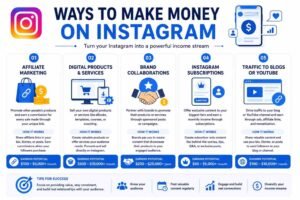
Each of these has different requirements in terms of follower count, niche, and effort level. The right choice depends entirely on what you already have to offer.
How Instagram Income Actually Works: The Trust Equation
Instagram monetisation is fundamentally a trust business. Followers who trust your taste, your knowledge, or your perspective will act on your recommendations. Followers who see you as just another posting account won’t.
This is why follower count is a misleading metric for potential income. An account with 2,000 highly engaged followers in a specific niche, say, budget meal prep for working mothers, will consistently outperform a 20,000-follower lifestyle account with scattered topics and surface-level engagement when it comes to affiliate conversions and product sales.
The reason is intent. Specific niches attract people with specific interests, problems, and buying patterns. When your content speaks directly to a specific person’s actual situation, your recommendations feel relevant rather than random, and relevant recommendations get clicked and purchased.
Build for depth of connection, not width of reach. That principle guides every decision that follows.

Step-by-Step: How to Make Money on Instagram in 2026
Step 1 — Define Your Niche With Genuine Specificity
“Lifestyle” is not a niche. “Fashion” is not a niche. They’re categories wide enough to drown in.
A niche that monetises well on Instagram has three qualities: a specific audience, a specific problem or interest that audience has, and a connection to products or services those people actually buy.
“Affordable modest fashion for university students in Pakistan” is a niche. “Home organisation for small apartments in South Asian homes” is a niche. “Freelancing and online earning tips for Pakistani beginners” is a niche.
When choosing, ask: do people in this niche spend money on products or services related to it? If yes, those are your eventual monetisation opportunities. If the niche is purely recreational with no commercial adjacent interest, income is harder to build.
Step 2 — Optimise Your Profile Before You Post Another Thing
Your profile is the first decision point every potential follower or potential brand makes about you. A profile that communicates clearly and professionally converts visitors into followers. A vague, inconsistent, or incomplete one doesn’t.
Profile photo: Clear, well-lit, recognisable. If you’re building a personal brand, use your face. If you’re building a niche brand, use a clean logo or relevant image.
Username: Simple, memorable, searchable. If your username is something random that doesn’t connect to your content, changing it costs nothing and can help discovery.
Bio: This is prime real estate. In 150 characters, tell visitors exactly who this account is for and what they’ll get from following. “Helping Pakistani students earn online through freelancing and digital skills. New tips every week” is specific, value-focused, and gives a reason to follow.
Link in bio: Use a tool like Linktree, Beacons, or Gumroad’s profile page to host multiple links: your blog, your product, your affiliate recommendations. This is where most Instagram income is actually initiated.
Step 3 — Choose Your Primary Monetisation Method First
Don’t try to do everything simultaneously. Pick one income path and build it before adding others.
For beginners with a skill or knowledge: Start with a digital product or a service offering. A template, a mini-guide, a coaching session. Instagram drives awareness; your external platform (Gumroad, Payhip, Calendly) handles the transaction.
For beginners with time but no product yet: Start with affiliate marketing. Join one or two relevant affiliate programmes (Amazon Associates, Canva, relevant apps in your niche), put your links in your Linktree, and reference them naturally in content. This earns while you build toward something larger.
For beginners already creating Reels consistently: Focus on Reels quality and posting frequency, build toward the follower and engagement thresholds required for Instagram Subscriptions or brand collaborations, and meanwhile use affiliate links as the near-term income method.
For those with an existing audience somewhere else: Use Instagram to drive traffic to your monetised blog, YouTube channel, or email list. Instagram as a traffic engine works particularly well when the destination is already generating income.
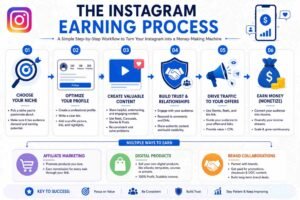
Step 4 — Create Content That Serves Your Monetisation Goal
Every piece of content should connect somehow to your income strategy, not in a salesy way, but in a logical way.
If your monetisation is affiliate marketing for budgeting tools, your content should be about budgeting, personal finance, and money management, not about travel, fashion, and food mixed in. The content creates context for the recommendation. Without that context, an affiliate link in your bio is invisible.
Content formats that work in 2026 for monetisation:
Reels with a clear, specific value: “3 things I stopped buying that saved me Rs. 8,000 a month” performs better than generic “money tips.” Specific, relatable, actionable.
Carousel posts that teach something: “How I set up my freelance profile (swipe to see the before/after)” carousels drive high save rates, which Instagram’s algorithm currently rewards significantly.
Stories for direct selling and relationship building: Product mentions, link sticker for affiliate links, polls and questions to understand your audience. Stories convert better for direct sales than feed posts because the link is clickable within the Story itself.
Reels showcasing your product or process: If you sell Canva templates, a Reel showing how the template works and looks is more persuasive than any static image.
Step 5 — Pitch for Brand Collaborations (Don’t Wait to Be Found)
Most beginners wait passively for brands to approach them. Experienced Instagram earners know that pitching brands proactively, especially at the micro-influencer level (3,000–15,000 followers), is far more effective than waiting.
A good pitch email:
- Identifies the specific product you genuinely use, or that genuinely suits your audience
- States your follower count, engagement rate, and niche clearly and briefly
- Proposes a specific deliverable (one Reel + two Stories, for example)
- Names a starting rate or offers to discuss compensation
Brands at the small-to-medium level receive very few proactive pitches from micro-influencers and often respond positively, especially if the pitch is specific and the follower-to-engagement ratio looks healthy.
Free tools like HypeAuditor’s free tier or Instagram’s own Insights can give you the engagement rate data you need for a credible pitch.
Step 6 — Build Toward Platform-Native Income as You Grow
Instagram Subscriptions, Reels bonuses, and the broader Meta Creator Programme become available as your account grows and your country qualifies. These aren’t where most people start, but they’re worth understanding as targets.
Instagram Subscriptions let followers pay a monthly fee (set by you) for exclusive Reel previews, exclusive Stories, or subscriber-only content. It’s Meta’s answer to Patreon. For a niche creator with an engaged, loyal audience, this can generate genuinely reliable recurring income, but it requires the trust that only consistent, specific content builds over time.
Check your Professional Dashboard regularly for what you currently qualify for and what thresholds you’re approaching.
Real Examples: What Different Instagram Earners Are Actually Doing
The micro-influencer in the budgeting niche: A 6,800-follower account posting personal finance tips for young Pakistani professionals. Income sources: one brand collaboration per month with a local fintech app (Rs. 12,000–18,000 per post), affiliate commissions from a budgeting tool recommended in Stories (approximately Rs. 5,000–8,000/month), and a Rs. 299 monthly budget planner template sold through Gumroad linked in bio. Total Instagram income: roughly Rs. 20,000–30,000 monthly. Not a full-time income yet, but real and growing from an account that took fourteen months to build.
The Canva template seller: A graphic designer with 3,200 followers posts Canva tutorials and behind-the-scenes of template creation. Every Reel naturally shows templates she sells on Etsy. Her Linktree bio link goes directly to her Etsy shop. Monthly Etsy sales driven by Instagram: $150–$250 consistently. She runs no ads. She spends four hours per week on content creation.
The freelance services promoter: A content writer with 2,400 Instagram followers posts writing tips, content strategy advice, and occasional case studies showing client results (with permission). Instagram drives direct client enquiries via DM, roughly one to two new client conversations per month from Instagram alone, with a conversion rate high enough to add meaningfully to her freelance income without needing a large following.
Common Mistakes That Keep People From Earning on Instagram
Posting inconsistently and expecting algorithmic momentum. Instagram’s algorithm actively deprioritises accounts that go dormant. Four posts per week consistently outperforms twelve posts in a week followed by two weeks of silence, even though the volume looks similar over a month.
Never putting a link anywhere accessible. Countless accounts with genuinely valuable content and engaged followers have no link in their bio, no link sticker in Stories, and no mention of any offer. The audience can’t buy what they can’t find.
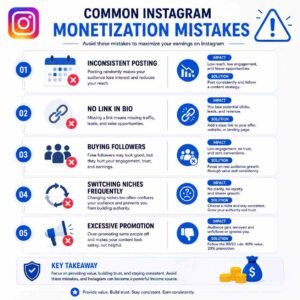
Buying followers. This damages Instagram income potential in a specific, measurable way. If you have 10,000 followers but only 100 of them engage with your content, your engagement rate is 1%, far below the industry average. Brands check this and decline to work with artificially inflated accounts. Instagram’s algorithm also reads low engagement as poor content quality and stops pushing your posts. Real followers, even fewer of them, are worth exponentially more.
Switching niches repeatedly. Every significant pivot resets the work of audience building and algorithm categorisation. If you’ve been posting about home organisation for six months and switch to travel, a significant portion of existing followers were there for the original topic; they’ll unfollow or stop engaging, reducing your reach exactly when you’re trying to grow.
Treating every post as an advertisement. If the majority of your posts are product mentions or affiliate pushes, followers start filtering you out mentally. A useful ratio: for every post that’s selling or recommending something, produce three or four genuinely useful, non-commercial posts first.
Tips That Give You a Genuine Edge
Use Instagram Stories daily, even when you’re not posting to the feed. Stories keep your account visible to existing followers between feed posts and build a more personal, direct relationship than feed content alone.
Save rates matter. Instagram currently weights saves as one of the highest-value engagement signals. Content that teaches something a how-to carousel, a useful list, a step-by-step tutorial gets saved far more than purely entertaining content. More saves means the algorithm pushes your content to more non-followers.
Reply to every comment in the first hour. Comment responses in the early window after posting boost your post’s engagement rate significantly, which feeds back into how many people the algorithm shows the post to. This is a small habit with a measurable impact on reach.
Your engagement rate matters more than your follower count to potential brand partners. 3,000 followers with 8% engagement is more valuable to a brand than 15,000 followers with 0.8% engagement. Calculate your engagement rate monthly (total engagements ÷ followers × 100) and track it as your real performance metric.
Add a call to action to almost every post. Not aggressive selling but a direction. “Save this if you found it useful.” “Check the link in bio for the full guide.” “DM me if you have questions about this.” Without direction, engaged followers often don’t know what step to take next.
FAQs
How many followers do I need to start earning on Instagram? For affiliate marketing, as few as 500 genuinely interested followers in a relevant niche. For brand collaborations, realistically 3,000–5,000 with good engagement. For Instagram Subscriptions and Meta’s native creator monetisation threshold requirements apply and vary by country. The consistent answer is: engaged followers in a specific niche matter far more than raw numbers.
Can I make money on Instagram in Pakistan? Yes. Affiliate marketing, digital product sales, freelance service promotion, and brand collaborations with both local and international brands all work for Pakistani creators. Meta’s native monetisation programmes (Subscriptions, Reels bonuses) are available in Pakistan; check your Professional Dashboard for current eligibility.
Do I need to show my face on Instagram to make money? No. Many successful monetised accounts use designed graphics, text-based Reels, tutorial-style screen recordings, or branded visuals without a personal presenter. Face-camera content typically builds a personal brand faster, but it’s not a requirement.
How long does it take to start earning from Instagram? For affiliate marketing with an existing niche account, weeks. For brand collaborations, typically six months to a year of consistent building. For platform-native income, longer still. Instagram income is a medium-term build, not an immediate return.
Is Instagram too saturated in 2026? For broad, generic content, yes. For specific, niche content with a clearly defined audience, no. Saturation at the general level doesn’t prevent a specific, well-positioned account from growing and earning. The saturated part is “generic lifestyle content for everyone.” Specific niches remain genuinely accessible.
The Sustainable Picture
My cousin’s account didn’t fail because she didn’t try. It was silent as a business for two years because she never connected her content to anything that could pay her. The audience was there. The path to income just hadn’t been built yet.
That gap between “account with followers” and “account that earns” is closed by strategy, not more content. Understanding what you’re selling, where the transaction happens, and how your content creates context for that transaction that’s what transforms a hobby account into something that actually pays you.
The platform works. Millions of people earn from it at every scale. The question is never whether it’s possible; it’s whether you’ve built the architecture around your content that gives it somewhere to go.
Disclaimer: This article is for educational and informational purposes only. Instagram monetisation results vary significantly based on niche, content quality, engagement, consistency, and individual effort. Platform policies, features, and eligibility thresholds mentioned are subject to change. Nothing in this article constitutes a guarantee of income.