
How to Get Your First Freelance Client in 2026

I remember opening a blank portfolio page and just sitting there.
Every “how to freelance” article I’d read said the same thing: “showcase your best work to attract clients.” Great advice, except I had no work to showcase. That’s the whole problem with being new. You need a portfolio to get a client, and you need a client to get a portfolio. It felt like a locked door with no handle.
What actually broke the cycle for me wasn’t a clever trick. It was realising that “portfolio” doesn’t have to mean “paid client work.” It can mean work you created specifically to show what you’re capable of before anyone has paid you a single rupee for it.
That single shift in thinking is what this article is about. Not the general “how to freelance” advice you’ve probably already read, but the specific, practical mechanics of getting your very first client when your portfolio folder is empty.
What “Zero Portfolio” Actually Means (And Why It’s Less Scary Than It Sounds)
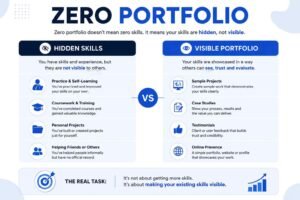
Zero portfolio doesn’t mean zero skill. It means you haven’t yet converted your skill into something visible that a stranger can look at and trust.
This is an important distinction, because most beginners conflate “I have no portfolio” with “I have nothing to offer,” and that’s simply not true. You might have built things for yourself, helped friends informally, completed coursework, or practised a skill privately for months. None of that counts as a traditional portfolio, but all of it is proof of capability that can be reshaped into something a client can evaluate.
The real task at this stage isn’t “get experience.” It’s “make your existing capability visible.” Those are very different problems, and the second one can be solved in days, not months.
How Beginners Actually Land Their First Client (The Real Mechanics)
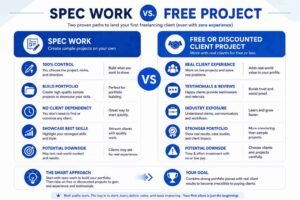
There are really only two paths that work consistently for someone with zero portfolio, and almost every successful freelancer’s first client falls into one of them.
Path 1 — Spec work. You create sample work specifically to demonstrate your skill, with no client attached. A logo designed for a fictional coffee shop. A blog article written on a topic in your niche. A redesigned Instagram grid for a real local business that never asked you to do it. This work exists purely to show capability.
Path 2 — A free or heavily discounted first project. You offer your service at no cost or a token price to a real person or business, in exchange for a genuine testimonial, real results you can document, and permission to show the finished work publicly.
Both paths solve the same underlying problem; they give a future paying client something concrete to evaluate, removing the uncertainty of hiring someone with no track record. Spec work proves you can do the work. A free first project proves you can do the work and deliver it professionally to a real client, which is a stronger signal but takes more coordination to arrange.
Most successful beginners use both spec work to build an initial portfolio quickly, then a free or discounted project to get the first genuine testimonial.
Step-by-Step: Getting Your First Client With Zero Portfolio
Step 1 — Create Two or Three Spec Pieces This Week
Don’t aim for ten. Three focused, well-made samples beat ten rushed ones.
Pick a specific, narrow service, e.g., not “I do graphic design,” but “I design Instagram post templates for small cafés and restaurants.” Then create three samples that demonstrate exactly that.
If you’re a writer: pick a real or fictional business in your target niche and write one genuinely good blog article or product description as if you were already their writer.
If you’re a designer: choose a real local business with weak visuals, a small shop, a clinic, a tutoring centre, and redesign three of their social media posts or one simple flyer.
If you’re a developer: build a small, complete project,t a simple landing page, a basic tool, a clone of a common website feature that’s functional and presentable, not just code on GitHub with no visual output.
The goal is not perfection. The goal is something specific enough that a potential client immediately understands what you can do for them.
Step 2 — Package Your Samples Properly
Raw files scattered across folders don’t function as a portfolio. Package your two or three samples into something a stranger can view in under sixty seconds.
A simple Canva-designed PDF works perfectly for design and writing samples. A live link works best for development work. Host it for free on GitHub Pages, Netlify, or Vercel. For social media work, a simple Instagram-style mockup grid in Canva, exported as one image, communicates the work instantly.
Label each sample clearly: what it is, who it was made for (real or “concept project for [business type]”), and what skill it demonstrates. A client should never have to guess what they’re looking at.
Step 3 — Identify Five to Ten Realistic First-Client Targets
Forget big, established companies for your very first client. They have too many options and too little patience for unproven freelancers. Realistic first targets are:
Small, local businesses with a visible but weak online presence, such as a shop, café, clinic, or tutoring service, with an outdated or inactive social media account.
People in your existing network, family friends, former classmates, people from community groups who run any kind of small business or side project, even informally.
Early-stage solo entrepreneurs and small online sellers, people selling handmade products, running small Instagram shops, or just starting a side business,s who genuinely cannot afford established freelancers yet but need help.
These targets share one trait: lower expectations of polish and prior experience, combined with a genuine, visible need for your service. That combination is exactly where zero-portfolio beginners can realistically compete.
Step 4 — Make the Free or Discounted Offer Strategically
Once you’ve identified your targets, choose one or two to approach with a free or heavily discounted first project,ct not all ten. Spreading a free offer too widely reduces how seriously each recipient takes it, and you can’t deliver quality work to many people simultaneously anyway.
A message that works:
“Hi [Name], I noticed your [Instagram page/website/shop] and had an idea for [specific observation e.g., ‘a cleaner post layout that could help you stand out more’]. I’m building my portfolio in [your service]. I would like to offer you [specific deliverable] completely free / at a reduced rate of [small amount], in exchange for honest feedback and permission to share the result. No pressure at all, just thought it could be useful for both of us.”
Notice what this message does: it’s specific (not a generic pitch), it states the exchange clearly (free work for feedback and permission to showcase), and it removes pressure (genuinely low-risk for the recipient to say yes).
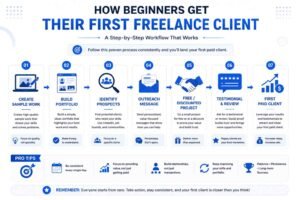
Step 5 — Deliver Like You’re Already Being Paid Premium Rates
This is the step that determines whether your free project actually produces a usable testimonial. Treat it with full professionalism, clear communication, on-time delivery, asking clarifying questions before starting, and a clean final handover.
A free project delivered casually produces a lukewarm, forgettable testimonial, if any. A free project delivered with complete professionalism produces genuine enthusiasm and a testimonial that sounds like it came from a paying client, because the experience felt like one.
Step 6 — Convert the Result Into Your First Real Portfolio Piece and Testimonial
Once the project is delivered and the client is happy, ask directly: “Would you be willing to share a short sentence about your experience working with me? And would you be okay with me showing this work in my portfolio?”
Most satisfied clients say yes immediately, yet they often don’t think to offer this unprompted, but rarely hesitate when asked directly. Use their actual words, not a paraphrase. A genuine, specific testimonial (“She redesigned our Instagram grid and our engagement noticeably improved within two weeks”) is far more credible than a generic one.
You now have a real client result. This becomes the anchor of your portfolio and the proof you reference in every proposal or pitch that follows.
Step 7 — Use This Result Immediately for Your Next Paid Client
Don’t wait. The momentum from a successful free project fades if you don’t act on it quickly. With your new testimonial and real result in hand, approach your next prospect this time at a real, even if modest, price.
Reference the result specifically: “I recently helped [type of business] redesign their social content, and they saw [specific result]. I’d love to do something similar for you.” This is dramatically more persuasive than “I’m new, but I’d love to help” because now you have evidence, not just willingness.
Real-World Example: A Realistic First-Client Timeline
Someone wants to freelance as a content writer with zero clients and zero published work. Week one: they write two sample articles, one about budgeting tips for students, one a product description for a fictional skincare brand, and package them into a simple Canva PDF. Week two: they identify six small businesses with weak blog content and message two of them with a free article offer. One responds positively.
Week three: they write the free article, communicate proactively throughout, and deliver early. The business owner is pleased and agrees to a testimonial: “Clear, well-researched writing that fits our brand voice perfectly. Delivered ahead of schedule.” Week four: armed with this testimonial and now three total samples, they apply to five Upwork jobs in their niche, referencing the real result in each proposal. They land their first paid contract, a modest $25 article by week five.
This is not a dramatic, lucky story. It’s the realistic mechanical sequence that gets most successful beginners from zero to their first paid client within a month of focused effort.
Common Mistakes Beginners Make at This Stage
Waiting until the spec work feels “perfect” before sharing it. Spec samples don’t need to be flawless. They need to be specific and competent. Endless refinement before showing anyone delays the entire process for no real benefit.
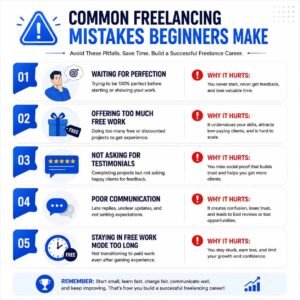
Offering free work to too many people at once. This dilutes your attention and often results in mediocre delivery across several projects instead of excellent delivery on one or two, which defeats the purpose entirely.
Not asking directly for a testimonial. Many beginners complete a great free project and never ask for feedback or permission to showcase it, leaving real proof of their work unused and invisible to future clients.
Treating the free project casually because “it’s not real money.” The entire value of this approach depends on the experience of feeling fully professional to the client. A rushed or careless free project produces a weak or absent testimonial, wasting the opportunity completely.
Staying in “free work mode” too long. One or maybe two free or heavily discounted projects are enough to generate your first proof points. Beyond that, you’re giving away value you’ve already demonstrated you can charge for. Transition to paid work as soon as you have genuine evidence to show.
Choosing spec work or free clients outside your intended niche. If you want to freelance in finance content writing, a free project for a pet grooming business doesn’t build the specific credibility you need. Stay within or close to your target niche, even for unpaid practice work.
Helpful Tips
Pick free-project recipients who are likely to actually respond and follow through. A small business that’s clearly active and engaged (recent posts, responsive to comments) is a better candidate than one that looks abandoned; they’re more likely to actually collaborate with you and provide a testimonial afterwards.
Document the process, not just the result. A short note about your process, “I started by reviewing their last 20 posts to understand their tone before writing”, adds credibility to your portfolio piece beyond just the final output.
Set a clear, small scope for free or discounted work. “One Instagram post redesign” is a contained, deliverable scope. “Help with your social media” is vague and risks scope creep, where the free project quietly expands into far more work than intended.
Use screenshots and before/after comparisons wherever possible. A before-and-after view of a redesigned post, an improved product description, or a cleaner spreadsheet is more persuasive than the finished work shown in isolation.
Keep a swipe file of every piece of feedback you receive. Even casual compliments in a message (“this looks amazing, thank you”) can sometimes be requested as a more formal testimonial later, if the relationship continues.
FAQs
Is spec work the same as working for free? No. Spec work is created without a specific client request, an entirely self-directed practice and portfolio building. Free or discounted work involves an actual client relationship, real communication, and real delivery, just without (or with reduced) payment. Both are useful; they serve slightly different purposes.
How many free projects should I do before charging? One or two is typically enough to generate a real testimonial and portfolio piece. Beyond that, continuing to work for free delays your transition to paid work without adding proportional benefit.
What if nobody responds to my free project offers? Expand your outreach list and refine your message. A 20–30% response rate to well-targeted, specific outreach messages is realistic. If you’re getting far less, the issue is often a too-generic message or targeting businesses with no visible need for your service.
Should I ever pay for an existing portfolio template or pre-made samples? This isn’t recommended. Portfolio pieces should reflect your actual skill and decision-making, not someone else’s pre-made work. Clients evaluating your portfolio are evaluating your judgment, not just visual polish.
How do I avoid being taken advantage of by people who just want free work? Set a clear, contained scope before starting, agree on the exchange (free work for testimonial and portfolio permission) explicitly in writing, and limit yourself to one or two free projects total. If someone tries to expand the scope significantly beyond what was agreed, it’s reasonable to either decline the addition or discuss a paid arrangement for the extra work.
Getting Started Today
The locked-door feeling- needing a portfolio to get a client, needing a client to get a portfolio- isn’t actually a closed loop. It only feels that way until you realise the portfolio doesn’t have to come from a client at all.
Spend this week creating two honest, specific samples of your work. Spend next week reaching out to two or three realistic, well-chosen first targets with a clear, professional offer. Deliver the resulting project as if it’s the most important work you’ve ever done because,e in a real sense, for your freelance career, it is.
The empty portfolio folder doesn’t stay empty because of a lack of opportunity. It stays empty because the first step of creating something to put in it keeps getting postponed. That’s the only real barrier left to remove.
Disclaimer: This article is for educational purposes only. Freelancing outcomes vary based on skill, effort, niche, and market conditions. Nothing in this article constitutes a guarantee of income or client acquisition.