

How to Find Freelance Clients Without Upwork or Fiverr

There’s a specific kind of exhaustion that comes from refreshing your Upwork proposals page for the fourteenth time in a week and seeing nothing.
You’ve written the proposals. You’ve adjusted the rates. You’ve rewritten your profile twice. And still either silence, or a client who wants a full project for $5 because “it’s for exposure.” After a while, it starts to feel like the platform itself is the problem.
Sometimes it is. Not because Upwork or Fiverr are bad platforms, they work genuinely well for many freelancers. But they’re not the only way to find clients, and for some freelancers, particularly those in professional service areas, those with niche expertise, or those targeting higher-budget clients, off-platform approaches consistently outperform the marketplaces.
This guide is for the freelancer who’s either burned out on the marketplaces or simply wants to build a client pipeline that doesn’t depend on a platform’s algorithm, its fee structure, or increasingly competitive proposal system.
Why Off-Platform Client Acquisition Works Differently
Upwork and Fiverr work on a pull model, where you create a profile or submit proposals, and clients who are already searching the platform find you. The marketplace does the discovery work, but you compete against everyone else who’s showing.
Off-platform client acquisition works on a push model; you go where your ideal clients already are, establish presence and credibility there, and move conversations toward a working relationship. There’s no algorithm deciding which freelancers get shown to which clients. There’s just a direct human connection.
The trade-off is that off-platform approaches require more patience and upfront relationship-building before they generate income. But the clients they generate tend to be better, longer engagements, higher rates, and more respectful working relationships because trust was established before any money changed hands.
The Main Off-Platform Channels That Actually Work
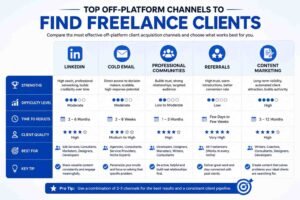
LinkedIn: The Most Underused Professional Platform in Freelancing
LinkedIn is the single most effective off-platform client acquisition channel for freelancers in professional service areas, writing, design, marketing, development, consulting, virtual assistance, and similar fields.
The reason is straightforward. LinkedIn is where decision-makers, small business owners, marketing managers, startup founders, and operations directors spend professional time. These are exactly the people who need freelancers, and they’re reachable without paying for access.
The approach that works is not “connect with everyone and send a pitch immediately.” That’s spam, and it damages your reputation. What works is a three-part presence:
An optimized profile that communicates your specific value. Your headline should describe who you help and how, not just your job title. “Content writer” tells nobody anything. “I write SEO blog content for SaaS companies that want to rank on Google,” tells your ideal client exactly whether you’re relevant to them.
Regular content that demonstrates your expertise. Short posts about a lesson from a recent project, an observation about your industry, a before/after comparison of something you improved for a client, or an honest thought about your work. This content is not for entertainment; it’s for discoverability. When you post regularly, LinkedIn shows your content to people in your professional network and their extended connections. Over time, the right people see that you know what you’re doing.
Thoughtful, personalized connection requests and direct messages. When you identify someone who might need your service, a small business owner whose LinkedIn posts reveal they’re struggling with something you solve, a short, specific, non-salesy message opens a door. Not “Hi, I’m a writer, do you need content?” but “I noticed you posted about struggling to keep your blog consistent, that’s exactly the problem I help with. Happy to chat if it’s useful, no pressure.”
The timeline for LinkedIn is longer than Fiver, three to six months of consistent activity before it generates regular inbound interest. But the clients it generates are typically higher-budget, more serious, and more likely to become long-term.
Direct Outreach via Email is More Effective Than Most Freelancers Think
Cold email has a bad reputation because most cold emails are terrible. Generic, clearly templated, obviously mass-sent. Hitting delete takes less than a second.
But genuinely personalized, research-backed cold email to carefully selected targets converts surprisingly well, especially for freelancers targeting small and medium businesses that aren’t actively searching the marketplaces.
The key distinction is the level of personalization. Before writing to anyone, spend five minutes on their website, their recent social media posts, and any public information about their business. Reference something specific in your email, a recent blog post they wrote, a product launch they announced, or something in their content that reveals a relevant problem you solve.
A cold email that converts:
“Hi [Name], I found your [specific thing] last week and thought it was genuinely useful. I’m a [your specific service] who specializes in [their niche or problem area]. I noticed [specific, observation-based gap or opportunity in their current approach] and had an idea that might help. Would you be open to a quick five-minute conversation? No pitch, just a specific idea.”
This works because it proves you did real research (not a template), offers a specific idea rather than a generic service, and asks for almost nothing (five minutes, not a contract).
Target small and medium businesses in your service niche, agencies that sometimes outsource work to freelancers, and startups in growth phases. A genuine hit rate of 10–20% on carefully targeted, properly personalized cold email is realistic and meaningful.
Facebook and LinkedIn Groups: The Community Approach
Relevant professional communities, such as Facebook groups for entrepreneurs, LinkedIn groups for specific industries, and online forums for people in your niche’s target audience, regularly contain people actively asking for help with things freelancers can provide.
The approach here is contribution before promotion. Spend two to four weeks genuinely participating in a group answering questions, sharing useful observations, and being helpful without any transactional agenda. Once your name is recognizable as someone who provides value, mentioning your services when relevant lands entirely differently than cold promotional posts from a stranger.
Many freelancers land their first or best clients from a single, genuinely helpful comment thread in the right Facebook group. The conversion doesn’t happen because you pitched it happens because someone saw you demonstrating competence in a context they trusted.
Referrals From Existing Clients and Network Contacts
This is the highest-conversion client acquisition channel available to any freelancer, and it costs nothing except the willingness to ask.
A satisfied client who refers you to someone in their network is providing that person with a pre-built trust transfer. The referred prospect already knows something about you before the first conversation; they know you delivered well for someone they respect. The conversion rate from a warm referral is dramatically higher than any cold outreach approach.
The mistake most freelancers make is assuming referrals happen automatically. They occasionally do. More often, they require a simple, direct ask: “If you know anyone who might need [what you do], I’d really appreciate an introduction.”
A client who liked your work but would never have thought to refer you unprompted will often refer you enthusiastically when asked directly. This is one of those small, slightly uncomfortable actions that produces disproportionate results.
Your Own Content Building Inbound Leads
A blog, a newsletter, a consistent Instagram or LinkedIn content presence, or any platform where you regularly demonstrate expertise in your niche eventually produces inbound enquiries from people who’ve been following your content and decided to reach out.
This is the slowest approach but the highest-leverage one long-term. An article you wrote about a specific problem in your client’s industry, appearing in Google search results when they look for solutions, produces a client enquiry where the prospect already trusts you before the first word is exchanged.
For a freelance content writer, posting case studies of before/after content improvements. For a freelance designer, posting an analysis of why certain visual choices work, and others don’t. For a freelance marketer, posting honest assessments of campaigns and what they could have done better.
This is your expertise, made visible. And visible expertise is the most durable form of client acquisition.
Step-by-Step: Building an Off-Platform Client Pipeline
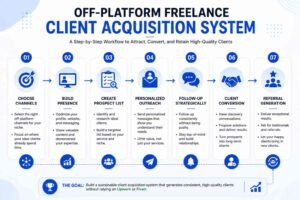
Step 1 — Choose Two Channels, Not Five
Trying all of these simultaneously produces the same result as any other scattered approach, thin presence everywhere, meaningful presence nowhere. Pick two channels that match your style and existing presence:
If you’re comfortable writing and have professional network contacts: LinkedIn + cold email. If you’re active in online communities: Facebook/LinkedIn groups + referral cultivation. If you’re building content: blog/newsletter + LinkedIn.
Step 2 — Spend Two Weeks Building Before Pitching
Before approaching anyone commercially, establish a visible presence in your chosen channels. Update your LinkedIn profile completely. Publish two or three genuine posts. Join the groups and contribute to ten conversations before mentioning your services.
This two-week foundation makes every subsequent approach land differently. You’re not a stranger asking for work; you’re someone with a visible track record, even if that track record is only two weeks old.
Step 3 — Build a Simple Prospect List
A spreadsheet with twenty to thirty names of businesses or individuals who might benefit from your service gives you something concrete to work from. Include their name, company, what you know about their current situation or problem, and the channel through which you’ll approach them.
Don’t try to contact all twenty in the same week. Five to eight thoughtful, personalized approaches per week done properly consistently outperform twenty rushed, generic ones.
Step 4 — Follow Up Once, Specifically
The first message often gets missed, not ignored. A single follow-up one week after the original message, referring briefly to your first message and asking whether it reached them, is appropriate and professional.
More than one follow-up to someone who hasn’t responded starts to feel like pressure. One follow-up is diligence. Two follow-ups are persistence. Three follow-ups are something a potential client is unlikely to forget positively.
Step 5 — Convert Clients Into a Referral System
After every successful project, close with a version of: “I really enjoyed working with you. If you know anyone facing similar challenges, I’d be grateful for an introduction.” Add a note in your prospect spreadsheet to follow up with each past client every three months, a brief, genuine check-in that keeps the relationship warm without being transactional.
Real Examples: Off-Platform Clients in Practice
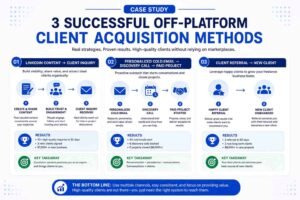
The LinkedIn content approach: A freelance copywriter starts posting three times a week on LinkedIn about common mistakes in email marketing campaigns. After two months of consistent posting, a marketing manager at a mid-sized e-commerce company comments on one of her posts, then DMs her asking about her availability. First project: Rs. 45,000 for a welcome email sequence. No proposal competition. No platform fee. Direct conversion from a post she wrote once.
The cold email approach: A freelance developer identifies fifteen small SaaS companies whose websites have obvious UX problems he can diagnose quickly. He sends fifteen personalized emails, each referencing one specific issue on their site and suggesting one specific improvement. Four respond. Two scheduled calls. One becomes a paying client at $800 for an initial project, leading to a recurring retainer.
The referral approach: A virtual assistant finishes a project for a small business owner, asks directly for referrals, and receives an introduction to two colleagues within a week. Both are working, paying clients within a month. Zero platform involvement. Zero proposal competition.
Common Mistakes in Off-Platform Client Acquisition
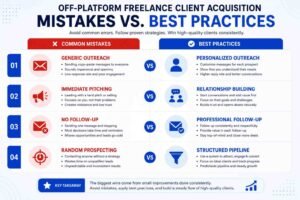
Pitching immediately after connecting. A LinkedIn connection request followed immediately by a pitch reads as exactly what it is: someone who connected only to sell something. Build presence first. Even one week of visible activity before reaching out changes the dynamic entirely.
Using the same message for everyone. Generic outreach is the most common reason cold emails and cold DMs fail. Personalization isn’t optional; it’s the mechanism by which these approaches actually work.
Giving up after five non-responses. Cold outreach at a 10–15% response rate is performing well. Five non-responses mean you need to send thirty more messages, not that the approach doesn’t work.
Not tracking the pipeline. A spreadsheet with names, approach dates, follow-up status, and outcomes transforms a scattered series of messages into a managed system. The freelancers who build consistent off-platform income treat it like a sales pipeline, because it is one.
Only reaching out when you need work. The most effective off-platform client relationships are built continuously, not in desperate bursts when the pipeline runs dry. Steady, ongoing presence and outreach, even when you’re busy, keeps the pipeline healthier than reactive scrambles.
Helpful Tips
Keep your LinkedIn profile URL clean and memorable. Change your default URL (linkedin.com/in/name-numbers-letters) to just your name (linkedin.com/in/your name) in settings. It looks more professional in email signatures and proposals.
Create a simple one-page PDF of your services. Not a formal proposal, just a clear, one-page document listing what you do, who it’s for, what clients typically get, and how to reach you. Something you can attach to a cold email or share when someone asks, ” What exactly do you do?” It removes friction from the conversion step.
Follow up with past clients quarterly. A brief, genuine message, “I was thinking about [project we worked on], hope things are going well, let me know if there’s anything I can help with,” costs three minutes and occasionally produces new projects from clients who’ve been meaning to reach out but haven’t. The freelancers who stay top-of-mind with past clients fill their calendars far more efficiently than those who only chase new leads.
FAQs
Is it possible to build a full-time freelance income without Upwork or Fiverr? Yes. Many established freelancers operate entirely through referrals, direct outreach, and content-driven inbound leads without using marketplaces at all. The path is slower to start than a marketplace, but it produces better clients and higher rates once established.
Which off-platform approach works fastest for beginners? Direct outreach, cold email, IL, or direct LinkedIn messages produce the fastest results because it generates conversations immediately rather than waiting for content or SEO to build momentum. Referral cultivation is faster still, but requires existing client relationships to start from.
Do I still need a portfolio for off-platform outreach? Having something to show is always better than not, but the bar is lower in direct outreach than on marketplaces because you can lead with a specific, relevant observation that demonstrates your expertise before anyone asks to see your portfolio. A one or two-item portfolio combined with a well-crafted, personalized message often beats a ten-item portfolio with a generic pitch.
How long before off-platform approaches generate consistent income? For direct outreach: one to three months of consistent effort. For LinkedIn content: three to six months. For referrals: depends on existing relationships, but it can happen within weeks of starting to ask. Combining two of these approaches simultaneously produces results faster than either alone.
The Bigger Point
Upwork and Fiverr are tools. Good tools, but tools with specific limitations. High competition, platform fees, algorithm dependency, and a client pool that often skews toward the lowest price point.
Off-platform client acquisition removes most of those constraints. The clients are better. The relationships are more direct. The rates reflect your expertise rather than marketplace pricing pressure. And once built, the pipeline belongs entirely to you; no platform can deprioritize your profile or change its algorithm in a way that affects what you’ve built.
The work of building it is real and front-loaded. But so is most worthwhile professional infrastructure. The freelancers who eventually look back and wonder why they spent so long fighting for $15 proposals are almost always the ones who discovered off-platform approaches eventually and wished they’d started building them sooner.
Disclaimer: This article is for educational and informational purposes only. Freelancing results vary based on skill, effort, niche, and market conditions. Nothing in this article constitutes a guarantee of income or client acquisition.