

How to Pick Profitable Affiliate Products


My first year of affiliate marketing was an education in how not to pick products.
I chose one product because it had a 70% commission rate. Another reason was that the sales page looked impressive. A third reason was that someone in a Facebook group said it was “converting like crazy.” I spent four months promoting these three things and earned a combined total of around $18, all of it from one of them, despite it having the lowest commission rate of the three.
When I went back and actually analysed what happened, the answer was embarrassingly simple. The two products that earned nothing had commissions nobody wanted to pay for things nobody particularly needed. The one that earned was something I’d personally used, found genuinely useful, and recommended in content that actually matched what people were searching for.
I was picking products based on what looked profitable on paper. I should have been picking them based on what was actually useful to my specific audience. Those are completely different criteria, and most beginners confuse them until they’ve wasted enough time to notice the difference.
What Makes an Affiliate Product “Profitable?” The Right Definition
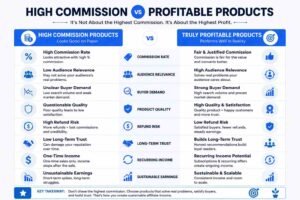
Profitable doesn’t mean “high commission rate.” That’s the definition beginners use, and it’s why beginners consistently pick products that earn less than they expect.
A truly profitable affiliate product converts at a meaningful rate from your specific audience, generates low refund requests, pays a commission that justifies your promotion effort, and can be recommended honestly without damaging your credibility.
Notice that the commission rate is one element in a four-part assessment, not the whole picture. A product with a 60% commission that nobody buys earns nothing. A product with a 5% commission that your audience buys consistently earns significantly more and builds the trust that produces compounding income across future recommendations.
The shift from “what pays most?” to “what will my audience actually buy and be satisfied with?” is the fundamental mindset adjustment that separates affiliate marketers who build durable income from those who chase commissions in circles.
The Six Factors That Actually Predict Affiliate Product Profitability
Before getting into the selection process, it helps to understand the specific factors that determine whether a product will actually earn for you, not in the abstract, but for your specific audience and niche.
Relevance to your audience. This is the most important factor, and the one that most beginners underweight. A product that directly solves a problem your audience currently has converts at a completely different rate than a product that’s tangentially related or requires your audience to develop an interest they don’t currently have.
Evidence of buyer demand. You need to know that people are actively searching for or buying products in this category, not just that the product exists. Demand that already exists is far easier to tap than demand you’d need to create.
Product quality and satisfaction rate. High refund rates erode your earned commissions and, more importantly, damage your readers’ trust in your future recommendations. Product quality isn’t just an ethical consideration; it’s a financial one.
Commission structure sustainability. A one-time commission and a recurring commission that continues as long as the customer maintains their subscription look similar on paper and perform very differently over time. Understanding which structure you’re working with changes how you evaluate the product’s long-term earning potential.
Merchant reputation and programme reliability. Affiliate programmes sometimes reduce commission rates, change terms, or shut down without warning. An established merchant with a well-run affiliate programme is significantly more reliable as an income source than a newer or less established one.
Your ability to promote it authentically. This is the factor most evaluation frameworks omit. If you can’t write or speak about this product with specific, genuine conviction because you’ve used it, researched it deeply, or understand exactly who it’s for, your content about it will lack the detail and credibility that drive actual conversions.
Step-by-Step: How to Pick Profitable Affiliate Products
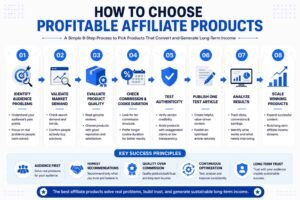
Step 1 — Start With Your Audience’s Actual Problems, Not the Marketplace
The mistake beginners make is opening Amazon Associates, ClickBank, or ShareASale and browsing for products that look good. This is working backwards.
Start instead by writing down the five to ten most common problems, frustrations, or questions your audience has based on your content, the comments and messages you receive, or the questions you see repeatedly in relevant online communities.
Each of these problems is a potential product category. “My readers struggle to track their freelance income and expenses” is a problem that leads to the use of accounting software, spreadsheet templates, or budgeting tools, all of which have affiliate programmes. “My audience wants to create professional social media content without design skills” leads to Canva, design template packs, or social media scheduling tools.
Reversing the sequence problems first, products second- means every product you consider is already relevant to a real, identified need before you’ve spent any time evaluating it.
Step 2 — Validate That Demand Actually Exists
Identifying a problem is the first step. Confirming that people are actively searching for solutions is the second.
Use Google’s autocomplete and related searches to check whether people are searching for terms related to your identified problem and the product category it suggests. If you type “budgeting tools for freelancers” into Google and find it autocompletes with multiple specific variations, that’s a signal of active demand.
Google Keyword Planner (free with a Google Ads account; you don’t need to run ads) shows approximate monthly search volumes for specific phrases. A topic with consistently high monthly searches indicates existing demand. A topic with near-zero search volume requires you to create demand before your content earns a significantly harder position.
Amazon’s own search autocomplete and the “Customers also bought” section are useful for understanding what products people are actively finding and purchasing in a category. If a product type appears in multiple search contexts with good review volumes, buyer demand is confirmed.
Step 3 — Evaluate Specific Products Against the Six Factors
Once you’ve identified a product category with confirmed demand, evaluate specific products within it against the six factors above.
For quality and refund risk: Look for products with independently verifiable reviews on platforms other than the product’s own site, Reddit discussions, YouTube reviews from non-affiliates, and app store ratings. Products that have only glowing reviews from obvious affiliates and nothing else are a warning sign. Products with a mix of genuine praise and honest criticism from real users are more trustworthy.
For commission structure: Check whether the product offers a one-time commission, a recurring commission on subscription renewals, or a tiered structure. SaaS tools (software as a service) with monthly subscription fees and affiliate commissions on each renewal are particularly valuable, as a single referral keeps earning as long as the customer maintains their subscription.
For refund rate data: ClickBank displays refund rate information in its marketplace metrics. For programmes on other networks, you can sometimes find this information in affiliate forums or by directly asking the merchant’s affiliate manager. A refund rate above 10–15% is a warning sign for most product categories.
For programme reliability: Check how long the merchant has operated the affiliate programme, whether their commission terms have changed recently (affiliate forums and communities often discuss this), and whether they have an active, responsive affiliate support team. Established programmes from recognisable brands are significantly more reliable than newer ones offering unusually high commissions.
Step 4 — Test Authenticity Against Your Own Standard
Before promoting anything, run it through what I think of as the family test: would you recommend this product if a trusted family member asked for your honest advice and you knew they were going to spend their own money on it?
If the answer is yes, you’d recommend it without hesitation to someone you care about, you have a product you can promote authentically. If the answer is “probably” or “it depends” or “it’s okay for some people,” those qualifications need to be reflected honestly in your content. And if the answer is no, you wouldn’t actually recommend it to someone you care about, don’t promote it, regardless of the commission.
This standard protects both your audience and your credibility. And credibility, compounded over time, is worth more than any single commission.
Step 5 — Test With One Piece of Content Before Major Investment
Before writing five articles about a product or building a significant promotional campaign, create one high-quality piece of content featuring the product and measure the results.
Publish it. Check affiliate dashboard data after 30 days. How many clicks did your affiliate link receive? What was the conversion rate? Were there any refund requests?
This initial test, done before significant promotional investment, tells you more about the product’s real earning potential for your specific audience than any amount of theoretical evaluation. Some products that look excellent on paper convert poorly for your specific readership. Others that look modest on paper convert surprisingly well because they happen to match a very specific need your audience has.
Data from a real test beats prediction every time.
Real Examples: Good and Poor Product Choices
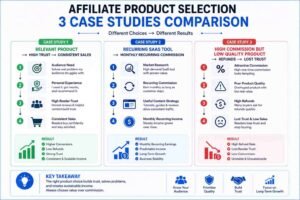
Good choice — the right relevance fit: A blogger covering online earning for beginners in Pakistan recommends Canva Pro to readers who’ve been using Canva’s free tier based on tutorials in the blog’s content. The audience already uses the product. The upgrade is a natural next step they’ve already been considering. The conversion rate is significantly higher than average because the recommendation meets a pre-existing intention, not a new one.
Poor choice — relevance mismatch: The same blogger promotes a premium stock photography subscription because the affiliate commission is attractive. The audience, freelancers and online earners who create digital products and social media content,t doesn’t particularly need premium stock photography; they use Canva’s built-in image library. Click-through is low, and conversion is near zero, despite a substantial commission rate.
Good choice — recurring commission value: A productivity blogger promotes a project management SaaS tool that pays a 20% recurring commission on monthly subscriptions. Over 12 months, a single referred customer who pays $29/month generates $5.80/month in recurring commissions, $69.60 over the year from one referral. The initial commission appears modest; the annual value is meaningful and continues as long as the customer stays subscribed.
Poor choice — high refund risk: A blogger promotes a digital course with a 60% commission and an impressive sales page. Two months later, affiliate reports show a 22% refund rate. Actual earned and kept commissions are significantly lower than expected, and readers who purchased based on the recommendation and then refunded have become less likely to act on future recommendations.
Common Mistakes When Picking Affiliate Products
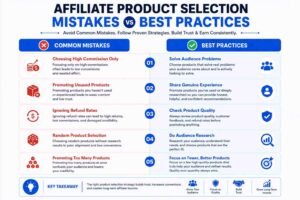
Choosing based on commission rate alone. Already covered in detail, this is the foundational error. Commission rate is the last thing to evaluate, not the first.
Promoting products in unrelated categories because the commission is attractive. An online earning blog that suddenly promotes kitchen appliances because Amazon’s cookware commission rates happen to be decent loses niche coherence that Google and readers both rely on. Stay in your lane;e niche-relevant products from a clearly defined expert beat high-commission tangents every time.
Not accounting for cookie window length. A 24-hour cookie (Amazon) means you only earn if the buyer purchases within one day of clicking your link. A 30-day or 60-day cookie (many SaaS tools) means you earn on purchases that happen weeks later. Products with longer cookie windows are more valuable for educational content where the buyer’s decision cycle is longer than a day.
Ignoring the merchant’s payment reliability. Affiliate programmes sometimes delay payments, change minimum payout thresholds, or, in rare cases, fail to pay entirely. Research the programme’s payment reputation in affiliate forums before investing significant promotion effort.
Promoting too many products simultaneously. A site that promotes fifty different affiliate products in scattered, thin content earns less than a site that thoroughly covers ten products in deep, genuinely useful content. Breadth reduces per-product authority; depth builds it.
Helpful Tips
Read negative reviews as carefully as positive ones. The consistent criticisms in negative reviews of a product tell you more about its real limitations than any number of positive testimonials. These limitations are exactly what your content should address honestly, which both protects your readers and makes your review more credible than generic praise.
Build a simple affiliate product spreadsheet. For each product you’re considering or currently promoting: the programme name, commission rate and structure, cookie window, payout threshold, your personal assessment of quality, and the article or content piece you’ve associated it with. This overview prevents the common problem of losing track of what you’re promoting and how each element is performing.
Check affiliate forums for programme reputation. Affilitrama, AffiliateFix, and relevant subreddits (like r/juststart or r/affiliatemarketing) discuss specific programme experiences,s payment delays, commission changes, and conversion data across niches. These community observations add real-world context that official programme descriptions don’t provide.
Prioritise programmes with strong affiliate manager support. A responsive affiliate manager who answers questions, provides updated promotional materials, and gives honest conversion data is a sign of a well-run programme worth investing in. Programmes where contact with an affiliate manager is impossible or slow suggest the programme is under-resourced.
FAQs
How many affiliate products should I promote on one blog? Focus and depth beat breadth consistently. For a new blog, two to four well-chosen, thoroughly promoted products in your core niche will outperform ten lightly mentioned products. Expand as your content library and traffic grow, adding only products that genuinely fit new content topics rather than adding products for their own sake.
Should I only promote products I’ve personally used? Ideally, yes, personal use produces the specific, credible detail that converts. When promoting a product you haven’t used directly, be transparent about it and invest significantly more research time into understanding the product from external sources. “I researched this extensively through user reviews and documentation, though I haven’t personally used it” is more honest and more credible than implied personal experience that doesn’t exist.
What’s a reasonable conversion rate to expect from affiliate links? This varies enormously by niche, product type, and traffic quality. For digital products and SaaS tools promoted in educational content, conversion rates of 1–5% are common. For physical products on Amazon in product-review content, 3–8% is achievable. Your own baseline will emerge after your first 90 days of data; focus on improving your rate from your own starting point rather than benchmarking against industry averages from different contexts.
How do I know if a product’s sales page is misleading? Warning signs: specific income or results claims without evidence or disclaimers, countdown timers that reset when you refresh the page, no clear description of what’s actually in the product, testimonials without verifiable details, and no visible refund policy or terms. Legitimate products have clear value propositions, honest limitations, and transparent policies.
The Selection Decision in Miniature
Every good affiliate product selection comes down to one compound question: is this something my specific audience genuinely needs, is it actually good enough that they’ll be satisfied with it, and can I promote it with the kind of specific, honest conviction that makes recommendations convert?
If all three are yes, you have a product worth promoting regardless of its commission rate. If any one of them is no, the commission rate doesn’t matter; the product will either not convert, produce refunds that erode your earnings, or damage the reader’s trust that makes every future recommendation you make worth something.
Commission rate is the easy part of the evaluation. The three questions above are the hard part. And the hard part is what actually determines whether your affiliate income grows or stays stuck at the level of effort you’re putting in without the return you’re expecting.
Disclaimer: This article is for educational and informational purposes only. Affiliate marketing results vary based on niche, audience, content quality, and individual effort. Nothing here constitutes a guarantee of income.