

How to Build Long-Term Client Relationships as a Freelancer


My most valuable client came from a Rs. 3,500 project I almost didn’t take.
It seemed too small. The brief was vague. The client was a one-person operation running a tiny online store, and I wasn’t sure there’d be much work beyond a single article. But something made me take it seriously. I asked good questions before starting, delivered earlier than expected, and sent a brief follow-up note after delivery to ask whether the piece had landed the way they hoped.
That client has been working with me for two years. The relationship has generated more consistent income than any other client I’ve had, including ones who started with much larger initial projects.
What I learned from that experience is the thing most freelancers understand intellectually but rarely practice consistently: the way you treat a small first project determines whether there’s ever a second. And the way you treat the relationship between projects determines whether there’s ever a third, fourth, or fiftieth.
Building long-term client relationships is not complicated. But it requires a deliberate approach that most freelancers, especially beginners, focused on landing the next new client, don’t give enough attention to.
What Long-Term Client Relationships Actually Look Like

A long-term client relationship isn’t just a client who comes back occasionally. It’s a working relationship where both parties trust each other enough to operate efficiently, with fewer briefing calls, faster approvals, more candid feedback, and a level of context about each other’s work that genuinely improves the quality of what gets delivered.
From the freelancer’s side, long-term clients are the most efficient source of income. You spend no time on proposals. You spend less time on briefings because the client’s voice, preferences, and standards are already known to you. Payments are predictable. Communication is comfortable. The cognitive overhead of managing an established client is dramatically lower than that of starting from scratch with someone new each time.
From the client’s side, a reliable freelancer they trust represents a solved problem. Finding and vetting freelancers takes time. Training them in brand voice and working style takes time. When a client finds someone who delivers quality work, communicates well, and behaves professionally, replacing that person is a cost they actively want to avoid.
This mutual value is the foundation of every long-term freelance relationship. Your job is to make the client’s cost of leaving higher than the cost of staying, not through lock-in or dependency, but through genuine reliability and quality they’d struggle to replace.
How Long-Term Relationships Get Built
Long-term client relationships are not built in a single impressive delivery. They’re built across a series of interactions, each one either adding to or subtracting from the client’s sense that you are someone worth keeping.
The interactions that add most to this sense:
Delivering consistently, not just occasionally. One exceptional delivery followed by a mediocre one creates uncertainty. Consistent, reliable quality, even if it’s not the most dazzling work the client has ever seen, creates confidence. Clients don’t need their freelancer to be brilliant every time. They need them to be dependable every time.
Communicating proactively, not reactively. A freelancer who surfaces a potential problem before it becomes one “I noticed the brief mentions X, which might conflict with Y; should we clarify before I start?” is far more valuable than one who delivers work with obvious issues and waits to be told. Proactive communication signals that you’re thinking about the client’s outcome, not just completing a task.
Remembering and applying what you’ve learned about the client. Every client interaction teaches you something: a preference, a constraint, a working style. Applying that learning in subsequent work (“I remembered you mentioned you prefer shorter paragraphs, so I’ve kept this more concise”) signals that the relationship is a two-way investment.
Treating the client’s business outcomes as the actual measure of success. A freelancer who asks “Did this article bring in traffic?” or “Did the design get the response you hoped for?” is thinking about the client’s success, not just the deliverable. This is rare enough that clients notice and remember it.
Step-by-Step: How to Build Long-Term Client Relationships Deliberately
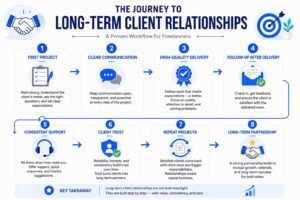
Step 1 — Set the Right Tone in the First Project
Long-term relationships are either started or killed in the first project. A client who had a confusing, frustrating, or disappointing experience in the first engagement rarely gives a second chance.
What sets the right tone: asking specific clarifying questions before starting rather than making assumptions, communicating when you’ll deliver before the client asks, and then delivering on time or early. These three habits, applied consistently to every first project, establish an immediate impression that distinguishes you from most freelancers the client has worked with.
Step 2 — Make the First Delivery Exceed the Stated Brief
The stated brief is the minimum. What converts a one-time client into a repeat client is receiving something that delivers on the brief and offers something additional they didn’t ask for but immediately recognize as valuable.
This doesn’t mean scope creep, adding work you’ll later resent doing for free. It means small, relevant additions that demonstrate genuine investment. An extra subheading that improves the article’s structure. A note explaining a design choice that wasn’t in the brief but addresses a potential user experience issue. A brief observation about how the delivered work could be extended or improved in future projects.
These additions take minutes. Their impact on client perception is disproportionate.
Step 3 — Send a Follow-Up After Delivery
Most freelancers deliver their work and wait for payment. That’s the end of the interaction.
A brief, genuine follow-up sent one or two days after delivery changes the dynamic entirely. Something like: “Hope the article has been landing well. Let me know if any tweaks would be useful after you’ve had a chance to review it properly. Happy to make adjustments.”
This does several things. It signals that the relationship matters to you beyond the invoice. It gives the client a natural opening to share feedback they might not have shared unprompted. And it keeps the conversation alive past the delivery moment, which is exactly when the seed of a repeat project is most likely to be planted.
Step 4 — Check In Between Projects Genuinely
The clients who stay longest are the ones you stay present with between projects, not just during them.
A brief, genuine message every few months, not a pitch, just a human check-in, keeps your name present when the client eventually has a new need. “I saw you launched a new product, hope it’s going well” or “just wanted to check in and see how the website redesign project has been performing” costs nothing and keeps a warm relationship warm.
This is distinct from cold outreach. These are people you’ve already worked with and built some rapport with. The follow-up is natural, not promotional.
Step 5 — Handle Problems Professionally When They Arise
Every long-term relationship eventually encounters a problem: a delivery that misses the mark, a misunderstood brief, a delayed timeline. How you handle these moments determines more about the long-term relationship than any smooth delivery.
The instinct under criticism is to defend or deflect. The professional response is to acknowledge specifically, understand fully, and fix quickly.
“You’re right, I missed the tone you were going for. Let me revise this today with the style guide you mentioned. Can you point me to the specific examples?” is a better response than any amount of explanation about why the first version was reasonable. The client doesn’t want your reasoning. They want the problem solved and evidence that you understood it.
Clients who see you handle a problem well often become more loyal after the difficulty than they were before, because they’ve now seen what happens when things go wrong, and the result has given them more confidence, not less.
Step 6 — Position Yourself as a Long-Term Partner, Not a Task Executor
The transition from “freelancer I hire occasionally” to “person I think of first when I have a relevant need” happens when a client starts to see you as invested in their goals rather than just completing their tasks.
This is demonstrated through actions over time, follow-up questions, between-project check-ins, and genuine interest in whether your work is producing results. But it can also be explicitly offered: “If it would ever be useful, I’m happy to look at your content calendar and suggest angles I haven’t covered yet, no charge, just something I can do to stay useful.”
Most clients never take you up on this. Some do. The offer itself signals a posture that distinguishes you from a transactional service provider and accumulates over time.
Real Examples: Long-Term Relationships in Practice

The writer has worked with one client for three years: A freelance content writer who landed a small project for a Pakistani tech startup, a single blog article. She delivered on time, followed up to check if it had been published, and included a brief note about two follow-up articles that could extend the topic. The client came back the following week with a request for those two articles, then a monthly retainer arrangement three months later. Three years on, the client represents roughly 40% of her monthly income. Nothing about the first project was exceptional except her follow-through.
The designer who over-delivered once: A freelance graphic designer delivered a social media template pack for a clothing boutique. He included two bonus templates not in the brief, and sizes optimised for Stories, which the client hadn’t requested but immediately appreciated. The client commented on the bonus delivery in the invoice reply. Six months later, when the boutique was planning a full rebrand, the designer was the first person they called. The two bonus templates had cost him forty-five minutes.
The virtual assistant who handled a mistake well: A VA missed a scheduling error that resulted in a client double-booking an important meeting. Rather than minimising the issue, she acknowledged it directly in a short message, explained what she’d do differently to prevent recurrence, and offered to handle the rescheduling personally. The client, who had been frustrated, replied later that week with an extended contract offer. The response to the mistake had impressed them more than the months of problem-free work before it.
Common Mistakes Freelancers Make With Client Relationships
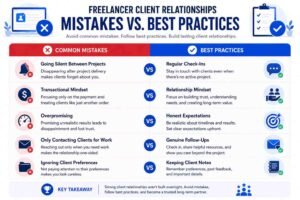
Going quiet between projects. A client who doesn’t hear from you for four months after a project ends will often assume you’re busy, not interested, or have moved on. Absence from their awareness means absence from their mind when a new project arises.
Treating every project as a transaction. Freelancers who deliver, invoice, and disappear signal that the relationship ends at the bank transfer. Those who follow up, check in, and show genuine interest in outcomes signal something different, and clients respond to that difference by coming back.
Over-promising to win work and under-delivering in execution. The freelancer who inflates their capabilities to secure a project, then delivers something that doesn’t match what was promised, loses not just that client but every potential referral from them. Realistic promises, consistently fulfilled, build more durable relationships than impressive promises occasionally kept.
Only reach out when you need work. If the only time a client hears from you is when your pipeline is empty, and you’re looking for projects, that pattern becomes obvious over time. Clients who recognise this dynamic feel like a backup option rather than a valued relationship.
Not documenting client preferences. Every client teaches you things: their preferred communication style, their brand voice, their working hours, and their pet peeves. Freelancers who keep no notes on this forget details between projects, requiring clients to re-explain preferences they’ve already stated. Clients who notice this wonder whether they’re actually remembered or just invoiced.
Helpful Tips
Keep a simple client file for each long-term relationship. A one-page document noting their brand voice preferences, working style, feedback patterns, personal details they’ve mentioned (a project launch they were excited about, their team’s names), and any standing instructions. Reviewing this before every project or call shows up as attentiveness that clients notice without knowing why.
Remember things they mention in passing. If a client mentions during a call that they’re launching a new product in March, a brief message in February, “hope the launch preparations are going well,” costs thirty seconds and signals that you listen and remember. This is rare enough that it makes a genuine impression.
Invoice consistently and professionally. Erratic invoicing, unclear payment terms, or awkward money conversations are one of the most avoidable sources of friction in client relationships. A clean, consistent invoicing process- same format, same timing, clear payment terms stated up front- removes a layer of administrative discomfort that quietly damages otherwise good working relationships.
Express genuine appreciation selectively. A blanket “thanks so much for working with me!” on every invoice is noise. A specific expression of appreciation, when it’s actually warranted, “I genuinely enjoyed this project, the topic aligned well with what I’ve been interested in,n” is something a client receives as real.
FAQs
How do I transition a one-time client into a long-term relationship? The follow-up after delivery is the most direct mechanism; it keeps the conversation open past the moment when most freelancers go silent. Beyond that, expressing genuine interest in the outcome of the work and demonstrating that you’ve remembered something specific about their business or preferences in subsequent interactions plants the seeds of continuity.
What if a long-term client starts reducing project volume or going quiet? A genuine, non-pressuring check-in “just wanted to see how things are going, no rush if it’s a busy period” is appropriate and sometimes surfaces the real issue (budget constraints, internal changes, a problem with previous work they didn’t mention). It also prevents the slow drift where a relationship dies not from dissatisfaction but from simple inattention on both sides.
Should I offer discounts to retain long-term clients? Pricing should be based on the value you provide, not primarily on relationship length. A modest rate review for a genuinely loyal, high-volume client can make sense in specific situations, but discounting as a retention tool signals that your rates are negotiable under pressure, which affects how all future pricing discussions go. Better retention tools are quality, reliability, and communication.
How many long-term clients should a freelancer aim to maintain? Enough to create income stability without creating overcommitment. For most freelancers, three to five solid long-term relationships covering roughly 60–70% of monthly income provide a stable base that allows room for new projects without the constant pressure of starting from zero each month.
The Bigger Picture
The math of long-term client relationships is straightforward when you lay it out. Finding a new client typically takes more time, energy, and cost than retaining an existing one. A client you have worked with for two years generates far more income with far less overhead than two years of finding and onboarding new clients continuously.
But the reason to invest in these relationships isn’t just the math. The best freelance work tends to happen within established relationships where the context is shared, the communication is efficient, and both parties are genuinely invested in a good outcome. That quality of work is harder to achieve with someone new.
Building long-term client relationships is, in the end, just the professional version of what makes any relationship worth having: showing up consistently, paying genuine attention, and caring about what happens to the other person beyond the moment of transaction.
Disclaimer: This article is for educational and informational purposes only. Freelancing results and client relationship outcomes vary based on individual circumstances, skill, niche, and effort. Nothing here constitutes a guarantee of income or specific business results.