

Best Freelancing Websites for Beginners in 2026

When I decided to start freelancing, I spent more time picking a platform than I did actually working on my profile. I read article after article, each one listing eight or ten platforms with almost identical descriptions: “great for beginners,” “huge marketplace,” “millions of clients.” None of it told me what I actually needed to know: which platform would realistically give someone with zero reviews and zero history their first job.
I eventually picked one almost at random, spent two weeks getting nowhere, switched to a different one, and within three weeks had my first paying client. The platform mattered more than I expected, not because one is universally “better” but because different platforms suit different beginners in different ways.
This article is the comparison I wish someone had given me based on what each platform actually feels like to use as a complete beginner, not just a marketing description of how big they are.
What “Freelancing Website” Actually Means
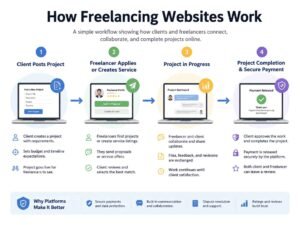
A freelancing website (also called a freelance marketplace) is a platform that connects people who need work done with people willing to do that work for a project fee or hourly rate, without a traditional employment relationship.
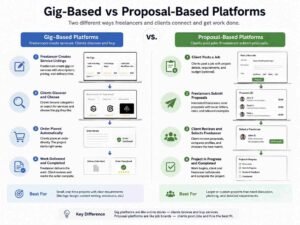
Some platforms work on a “gig” model: you create a service listing, a “gig” with a fixed price, and clients browse and buy directly. Other platforms work on a “proposal” model: clients post jobs, and freelancers submit proposals competing for the work. A few platforms use a hybrid of both.
The platform you choose affects almost everything about your early experience: how you get discovered, how much competition you face, what kind of clients you’ll meet, and how quickly you can realistically expect your first job.
How These Platforms Actually Work (The Part Nobody Explains Clearly)
Every freelancing platform makes money by taking a percentage of what you earn, usually called a “service fee” or “platform fee.” This ranges from 5% to 20% depending on the platform and sometimes depends on how much you’ve earned from a specific client over time.
Beyond the fee structure, platforms differ in how visibility works. On gig-based platforms, your listing needs to rank in search results and category browsing, similar to how products rank on Amazon. On proposal-based platforms, you’re competing directly against other freelancers who applied to the same job, often within minutes of it being posted.
Understanding this distinction early saves you a lot of frustration. If you’re on a gig-based platform and nobody is finding your gig, the problem is that your gig isn’t appearing in relevant searches. If you’re on a proposal-based platform and you’re not getting replies, the problem is usually your proposal itself, or you’re applying too late after a job is posted.
The Best Freelancing Websites for Beginners in 2026
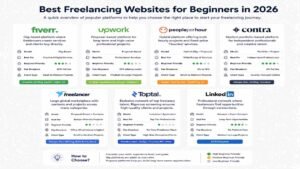
1. Fiverr — Best for Getting Discovered Without Applying to Jobs
Fiverr works on the gig model. You create service listings: “I will design a logo,” “I will write a blog post,” “I will edit your video,” and clients search for and buy these services directly.
For beginners, Fiverr’s biggest advantage is that you don’t need to compete in real-time against other applicants the moment a job posts. Your gig sits there, and clients find it through search whenever they’re looking for that service.
The downside is that Fiverr has an enormous number of sellers, especially in popular categories like logo design, content writing, and voiceover work. A brand-new gig with zero reviews can sit unseen for weeks unless you optimise it well.
What actually helped me on Fiverr: creating multiple gig variations for slightly different services (rather than one generic gig), using all the tags Fiverr allows, and pricing my first gig competitively not the cheapest in the category, but in the lower-middle range, which signals “affordable but not desperate.”
Best for: Creative and digital services writing, design, voiceover, video editing, translation, virtual assistance. Beginner friendliness: High to get started, moderate to get noticed. Fee structure: 20% flat fee on all earnings.
2. Upwork — Best for Higher-Budget Clients (Once You Have Something to Show)
Upwork works on the proposal model. Clients post jobs, you submit a proposal with a price and a message explaining why you’re right for the project, and the client reviews proposals and picks someone.
Upwork tends to attract clients with bigger budgets and longer-term projects compared to Fiverr; think ongoing content writing contracts, multi-month design projects, or development work, rather than one-off small tasks.
The challenge for absolute beginners is that Upwork’s “Job Success Score” and review system mean new freelancers with zero history are competing against established freelancers with dozens of five-star reviews. Your first few proposals need to work much harder to stand out.
What actually helped me on Upwork: applying to smaller, lower-budget jobs first the ones experienced freelancers often skip because the pay doesn’t justify their time. These smaller jobs are where beginners can realistically win their first contract and start building the review history that opens up bigger jobs later.
Best for: Writing, development, design, marketing, virtual assistance, consulting, broader range of professional services. Beginner friendliness: Moderate; requires well-written proposals and patience. Fee structure: Sliding scale, generally 10% for most freelancers (varies by total billing with a client).
3. PeoplePerHour — Best for Less Competition Than Fiverr or Upwork
PeoplePerHour is a UK-based platform that operates similarly to Fiverr (you can create “Hourlies” fixed-price service offers) but also has a proposal-based job board similar to Upwork.
What I noticed when I tried PeoplePerHour after Fiverr was simply less competition. Fewer sellers means your listings and proposals get seen by a higher percentage of the people browsing, even with zero reviews.
The trade-off is a smaller overall pool of clients compared to Fiverr or Upwork, fewer total opportunities, but a better ratio of opportunities to competing freelancers.
Best for: Writing, design, digital marketing, admin support, particularly for freelancers comfortable working with UK and European clients. Beginner friendliness: High; a smaller platform means new profiles aren’t buried as quickly. Fee structure: 20% on first £175 with a client, decreasing to 7.5% after that threshold.
4. Contra — Best for a Modern, Portfolio-First Approach
Contra is a newer platform (relative to the others) that positions itself as “commission-free,” meaning Contra doesn’t take a cut of your earnings on direct client payments through the platform.
The platform is built around a strong portfolio-first profile, more like a personal website than a traditional gig listing. This makes it particularly good for creative fields like design, video, photography, and writing where visual presentation of past work matters.
Because it’s newer and smaller, the client pool is also smaller than the established platforms. But for beginners building a portfolio-focused profile, Contra is worth setting up alongside a more established platform; it costs nothing and gives you another discoverable presence online.
Best for: Designers, writers, video editors, photographers, visually-driven portfolios. Beginner friendliness: High to set up, client volume still growing. Fee structure: No platform commission on direct payments (payment processing fees may still apply).
5. Toptal — Not for Day-One Beginners, But Worth Knowing About
Toptal positions itself as an exclusive network for “top 3%” freelance talent primarily in development, design, finance, and project management. They have a rigorous screening and testing process before you’re accepted.
I’m including Toptal not because beginners should apply on day one, but because it’s a useful long-term goal. Once you have a solid portfolio and some client history from other platforms, Toptal becomes a realistic target, and the rates on Toptal are significantly higher than entry-level platforms.
Best for: Experienced developers, designers, and finance professionals; a goal for later, not a starting point. Beginner friendliness: Low for absolute beginners; best approached after 6–12 months of experience elsewhere. Fee structure: Built into client billing rates; freelancers set their own rates within Toptal’s structure.
6. Freelancer.com — Best for High Volume of Job Postings
Freelancer.com has one of the largest volumes of job postings across a huge range of categories from simple data entry to complex software development.
The sheer volume means more opportunities to apply to, but also means each job posting often receives a very high number of bids, sometimes 50 or more within hours. Standing out requires either a very competitive bid or a genuinely well-targeted proposal.
Freelancer.com also runs contests; clients post a project (often design-related), and multiple freelancers submit work speculatively, with the client choosing a winner to pay. This can be a way to showcase work without needing existing reviews, though it means working without guaranteed payment.
Best for: Data entry, virtual assistance, simple design tasks, high-volume categories. Beginner friendliness: Moderate high competition but high volume balances it out. Fee structure: Varies by project type, generally 10% or a minimum fee, whichever is higher.
7. LinkedIn — Often Overlooked, Genuinely Effective
LinkedIn isn’t a traditional “freelancing website” in the marketplace sense, but for service-based freelancing consulting, writing, marketing, design, and virtual assistance, it’s one of the most underused tools by beginners.
The advantage of LinkedIn is that you’re not competing in a marketplace at all. You’re building a professional presence that potential clients, small business owners, marketing managers, and startup founders can find directly. There’s no platform fee because payments happen outside LinkedIn entirely, through whatever method you and the client agree on.
What worked for me on LinkedIn: optimising my profile headline around the specific service I offer (not a generic job title), connecting with people in industries I wanted to work with, and occasionally posting content that demonstrated my expertise. Within a couple of months, I had inbound messages from people who found my profile without applying to a single job posting.
Best for: Consulting, writing, marketing, business services, anything where direct professional relationships matter. Beginner friendliness: High, but slower to show results; this is a medium-term play, not an instant one. Fee structure: None; LinkedIn doesn’t process payments or take commissions on freelance work found this way.
Real Example: Choosing Between Two Platforms as a Beginner
Imagine two people both starting freelance content writing with zero experience.
Person A joins Upwork first. They write three proposals on day one for jobs that already have 20+ applicants. No replies. They feel discouraged and consider quitting after a week.
Person B joins Fiverr first. They create one gig, “I will write SEO blog articles for small businesses,” with three pricing tiers. They spend a few days optimising the gig description and tags. In week two, they get their first order of a basic 500-word article for $15. They deliver it well, get a five-star review, and use that review as social proof when they later create an Upwork profile.
By week six, Person B has three Fiverr reviews and uses them to strengthen their Upwork proposals, referencing real client feedback even though the platforms are different. Person A, still on Upwork alone, has sent 30 proposals with no contracts and is genuinely considering giving up.
This isn’t to say Upwork doesn’t work for beginners; it does, eventually. But starting with a platform where visibility doesn’t depend on winning a real-time competition against established freelancers can build the early momentum that makes everything afterward easier.
Common Mistakes Beginners Make When Choosing a Platform
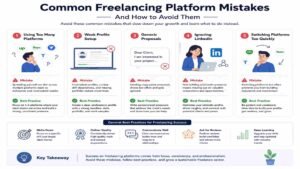
Trying to be active on five platforms at once from day one. Managing five profiles, five sets of messages, and five different proposal styles spreads your effort too thin. Start with one or two, get your first reviews, then expand.
Picking a platform based on its size alone. A bigger platform means more clients, but also more competing freelancers. Sometimes a smaller platform with less competition gets you results faster, even with fewer total opportunities.
Copying the same profile description across every platform. Each platform has a different audience and a different “voice.” A profile that works well on LinkedIn (professional, consultative) often feels out of place on Fiverr (more direct, service-focused).
Underestimating LinkedIn because it doesn’t feel like a “freelancing site.” Some of the best long-term freelance relationships come from LinkedIn precisely because there’s no platform taking a cut and no marketplace competition, but it requires patience and consistent presence, which beginners often skip in favour of marketplaces that feel more “active.”
Switching platforms too quickly. Two weeks without results doesn’t mean a platform doesn’t work; it might mean your profile, gig, or proposals need adjustment. Give a platform at least a month of consistent effort with adjustments before deciding it’s not working.
Helpful Tips for Choosing and Using These Platforms
Start with one gig-based and one proposal-based platform. This gives you exposure to both discovery models: Fiverr (or PeoplePerHour) for passive discovery, and Upwork (or Freelancer.com) for active proposal-based work.
Use your first reviews as cross-platform proof. A genuine five-star review from Fiverr can be referenced (not copy-pasted, but mentioned) in your Upwork proposals and LinkedIn profile. “I’ve completed X projects with consistently positive feedback” is honest and credible even across platforms.
Set up your LinkedIn profile even if you don’t plan to focus on it immediately. It costs nothing, takes an hour to set up properly, and continues working in the background while you focus on marketplace platforms.
Read the platform’s beginner resources. Fiverr, Upwork, and PeoplePerHour all have guides for new sellers/freelancers. These aren’t just marketing; they often contain genuinely useful, platform-specific advice about what their algorithms favour.
Don’t ignore platform fees when pricing your services. If Fiverr takes 20%, your $25 gig actually nets you $20. Price with the fee in mind so your effective earnings match your expectations.
FAQs
Which platform is best for someone with absolutely zero experience? Fiverr is generally the easiest entry point because clients come to you rather than requiring you to compete for jobs in real time. It won’t necessarily be your best long-term platform, but it’s often the fastest place to get a first review.
Can I use multiple freelancing websites at the same time? Yes, and many successful freelancers do. The key is not spreading yourself so thin that none of your profiles get proper attention. Start with one or two.
Do I need a portfolio before joining these platforms? For gig-based platforms, having sample work in your gig images significantly improves performance, but isn’t strictly required to create a gig. For proposal-based platforms like Upwork, a portfolio section with even a few samples makes a real difference in how clients perceive your proposals.
Are these platforms safe for payments? The established platforms (Fiverr, Upwork, PeoplePerHour, Freelancer.com) use escrow or hold-and-release payment systems, meaning the client’s payment is secured before you start work and released to you upon completion or milestone approval. This protects freelancers from non-payment in most cases.
How do I get paid in Pakistan from these platforms? Most platforms support Payoneer, which provides a virtual US bank account and a debit card, making it straightforward to receive international freelance payments and convert them to local currency.
Where to Start
If you’re genuinely starting from zero, here’s the simplest path: set up a Fiverr gig this week, focused on one specific service. Spend a few days getting it right: a good description, clear pricing, relevant tags. While that’s live and potentially getting discovered, set up your LinkedIn profile properly; it costs nothing and works in the background.
Once you have your first review on Fiverr, even if it’s a small job, use it as the foundation for an Upwork profile, applying to smaller jobs where your lack of platform-specific history matters less.
The platform isn’t the hard part. Getting your first piece of social proof is. Everything gets easier after that on every platform, not just the one where you got it.
Disclaimer: This article is for educational purposes only. Platform fees, policies, and features mentioned are accurate as of the time of writing but may change, and always check each platform’s current terms before relying on specific figures. Freelancing results vary based on skill, effort, and market conditions.