
Passive Income Ideas for Beginners in 2026

A few years back, I was doing the math on my monthly expenses at 1 AM, not because I enjoy spreadsheets at that hour, but because I was genuinely stressed. My job covered the basics. But there was nothing left over. No safety net. No breathing room.
I’d heard about passive income before. Who hasn’t? But every article I found was either vague “invest in stocks” or felt like it was written by someone who had never actually tried any of it. Lists of 47 ideas with zero practical guidance on where to actually begin.
So I started testing things myself. Some worked slowly. Some worked surprisingly well. Some were a complete waste of three months of evenings.
This is what I actually learned.
First, Let’s Be Honest About What “Passive” Really Means
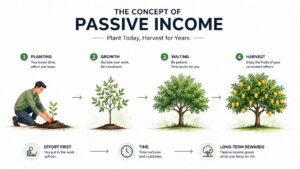
Here’s the thing nobody tells you upfront: passive income is not effortless income. Almost every passive income stream requires real work at the beginning, sometimes a lot of it, before it starts paying you while you sleep.
Think of it like planting a mango tree. You have to dig, plant, water, and wait. For months, sometimes longer, nothing happens. Then one day you have mangoes. And the next year, more mangoes. You still have to maintain the tree, but the heavy lifting is behind you.
That mental shift matters. If you go in expecting to do nothing and earn something immediately, you’ll quit before anything has a chance to grow.
With that said, here are the passive income ideas that actually make sense for beginners in 2026, in order of how realistic they are to start with no prior experience.
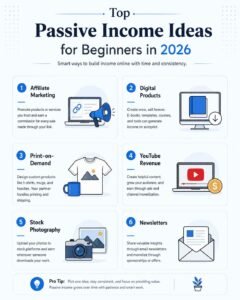
1. Affiliate Marketing Through a Blog or YouTube Channel
This one sits at the top of the list for a reason: low start-up cost, no product to create, and once content ranks or accumulates views, it genuinely earns on its own.
The model is simple. You create content that recommends products or services. When someone clicks your link and buys, you earn a commission. Amazon Associates, Impact, ShareASale, and PartnerStack are all programmes beginners can join for free.
The catch? You need an audience. And building one takes time.
I started a small niche blog in the personal finance space. For the first four months, I earned exactly Rs. 0. In month five, I made about $11. In month eight, I crossed $80. By month twelve, a single article I’d written about budgeting tools was generating consistent monthly income without me touching it.
That article took me four hours to write. It has since paid me back dozens of times over.
Where to start: Pick one topic you genuinely know or care about. Start a WordPress blog on affordable hosting (Hostinger works well and costs very little). Write detailed, honest articles. Sign up for Amazon Associates or any affiliate programme relevant to your niche. Be patient. The first six months are an investment, not a return.
2. Selling a Digital Product
This one surprised me the most.
Digital products eBooks, templates, Notion dashboards, Canva social media kits, Excel budget trackers, mini-courses cost nothing to reproduce. You make them once, and someone can buy them a thousand times without you having to do any additional work.
I know someone who built a simple CV template in Canva, uploaded it to Gumroad, shared it in three Facebook groups for job seekers, and made $200 in the first month. She spent one Sunday afternoon creating it.
The key is solving a specific, real problem. Not “a pretty template” but “a CV template designed specifically for fresh graduates with no work experience.” The more specific the problem, the easier it is to find the people who desperately need the solution.
Where to start: Think about something you’ve figured out that others struggle with. Package that knowledge into a PDF, template, or short guide. Sell it on Gumroad (free to start), Payhip, or your own website. Price it between $5 and $29 for beginners, affordable enough to buy without much hesitation.
3. Print-on-Demand (Without Holding Any Stock)
Print-on-demand is one of the cleanest beginner models I’ve seen. You design something, upload it to a platform, and when someone orders it, the platform prints and ships it directly to them. You earn a margin. You never touch a product.
Platforms like Redbubble, Merch by Amazon, and Printful (connected to Etsy or your own store) handle everything after the sale.
The honest reality: the income is small per item, sometimes $2 to $5 per sale. But a good design on a popular theme (motivational quotes, niche humour, regional pride, professions) can sell consistently for years.
One thing I noticed: seasonal designs sell explosively and then die down. Evergreen designs that people want year-round are the better long-term play. “Funny engineer mug” will be sold in January. “Valentine’s Day” mug will not.
Where to start: Create simple, clean designs using Canva or Adobe Express (free tier is enough to start). Upload to Redbubble first; the marketplace already has buyers browsing. Focus on a specific audience or theme rather than random designs.
4. YouTube Ad Revenue
This one takes the longest to build, but once a channel qualifies for YouTube’s Partner Programme, the ad revenue genuinely runs in the background.
To qualify, you need 1,000 subscribers and 4,000 watch hours (or 10 million Shorts views) in the past 12 months. For most beginners, that’s a 6–18 month journey depending on the niche and consistency.
The channels that grow fastest are not the most polished; they’re the most useful or the most relatable. A Pakistani student showing exactly how they studied for exams, or someone demonstrating a skill they use daily, will outperform a beautifully produced but generic video every time.
What I’ve learned watching creators in this space: the niche matters enormously for ad revenue. Finance, tech, education, and health channels earn significantly more per 1,000 views than entertainment or lifestyle channels. A small finance channel with 20,000 subscribers can earn more than a lifestyle channel with 200,000.
Where to start: Pick one topic. Record your first five videos on your phone; lighting and sound matter more than the camera itself. Post consistently. Focus on searchable topics (use YouTube’s autocomplete to find what people are actually looking for). Monetisation comes later; consistency comes first.
5. Licensing Your Photography or Music
If you already take photos or make music as a hobby, this one costs you almost nothing extra.
Stock photography platforms like Shutterstock, Adobe Stock, and iStock pay you every time someone licenses your photo for commercial use. The payments per download are small, sometimes $0.25 to $3, but a catalogue of 300–400 good photos can generate a predictable monthly income quietly in the background.
The same applies to music on platforms like Pond5 or AudioJungle, where YouTubers and video creators regularly buy background tracks and sound effects.
This is genuinely passive once uploaded. You do the work once; the platform handles discovery, licensing, and payment.
Where to start: If you already have a collection of good photos of travel shots, food, nature, and urban scenes, upload a batch to Shutterstock and Adobe Stock today. Read their contributor guidelines first. Metadata (titles, descriptions, keywords) on your uploads matters a lot for how often they get found.
6. A Niche Newsletter With Sponsorships
This one feels old-fashioned until you see the numbers.
Email newsletters have made a quiet comeback. Unlike social media followers who may or may not see your content depending on an algorithm’s mood that day, email subscribers receive your content directly. That relationship is valuable to advertisers.
Small, highly focused newsletters (500–2,000 subscribers in a specific niche) can charge $50–$200 per sponsored issue to companies wanting to reach that audience. Once the newsletter is running and growing, it requires only a few hours per week to maintain.
The key is focusing on a niche tight enough that sponsors see real value. “A newsletter about general life tips” is hard to monetise. “A weekly newsletter for freelance graphic designers in Pakistan” is specific enough that design software companies, job platforms, and online course providers would pay to reach those readers.
Where to start: Use Beehiiv or Substack; both are free to start and have built-in discovery features. Write about something you follow closely anyway. Grow slowly through genuine content. Sponsorship conversations usually begin naturally once you reach 500+ engaged subscribers.
The Mistakes I Made (So You Don’t Have To)
Trying too many things at once. I spent one year dabbling a little blogging here, a little print-on-demand there, a YouTube video every few months. I had mediocre results across everything. The moment I picked one thing and stayed with it for six months straight, results improved significantly. Focus is the most underrated strategy in passive income.
Expecting results in 30 days. Every passive income stream I’ve described has a 3–12 month ramp-up period. This is not a flaw; it’s the reason most people quit before it works, which means less competition for those who stay.
Ignoring the quality of the audience. 10,000 random visitors to a blog is worth less than 1,000 highly targeted visitors actively looking for what you’re recommending. Early on, I chased the traffic volume. Later, I learned to chase the right traffic.
Not disclosing affiliate links. This is both an ethical and legal issue. The FTC requires disclosure, and so do most affiliate programmes. Always mention clearly when you earn a commission from a recommendation. Readers respect honesty, and it keeps you out of trouble.
Spending money on courses before testing the idea. I bought a $197 course on print-on-demand before I’d uploaded a single design. The free YouTube tutorials covered everything I needed for the first year. Invest money in a strategy after you’ve validated it works for you, not before.
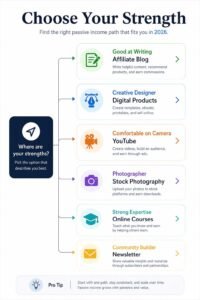
What I’d Tell Someone Starting From Zero in 2026
Pick the idea that matches what you already have skills, time, or audience.
If you write well and have patience: start a niche blog with affiliate marketing. If you create things: digital products or print-on-demand. If you’re comfortable on camera: YouTube. If you have a skill others need: package it into a digital product or course.
You don’t need to start with money. You need to start with honesty about which of these you’ll actually stick with for six months when it feels like nothing is working.
Because something will work. It just needs enough time to grow.
Real Questions People Ask
How much money can I realistically make in the first year? Honestly, between $0 and $500 a month, depending on how focused and consistent you are. A few people exceed that. Most fall somewhere in between. Anyone promising you $5,000 a month in 60 days is selling you a fantasy, not a strategy.
Do I need to invest money to start? Most of these ideas require very little; $3–$10 a month for blog hosting is the highest cost. Gumroad, Redbubble, Substack, and YouTube are all free to start. Start lean, reinvest what you earn.
Which one is fastest to earn from? Digital products, if you already have knowledge others want. You can have something to live and earn within a week. The audience-building part is slower, but the product itself can be ready quickly.
Can I do this while working a full-time job? Yes, and this is actually the ideal way to start. Don’t quit your job to chase passive income. Build it on the side, during evenings and weekends, until it’s generating something consistent. Then make bigger decisions from a position of financial stability.
The best time to start one of these was probably two years ago. The second best time is this weekend.
Disclaimer: This article is for educational and informational purposes only. Income results from passive income strategies vary significantly based on effort, consistency, niche, and individual circumstances. Nothing in this article constitutes financial advice or a guarantee of earnings.